Deep Dive into ByteDance's Hermes Agent Orange Book: A 198-Page Complete Guide to AI Agent Development

ByteDance releases 198-page Hermes Agent Orange Book detailing its self-evolution loop and three-layer memory architecture.
ByteDance has released a 198-page Hermes Agent Orange Book comprehensively introducing its AI agent framework. Core innovations include a self-evolution loop (task execution → result evaluation → experience extraction → capability update) and a three-layer memory system (short-term, long-term, and working memory), enabling continuous learning and complex reasoning. The document also covers Skill ecosystem building, multi-Agent collaboration, framework comparisons, and production pitfall guides, providing a systematic learning resource from beginner to advanced levels.
Introduction: Why Hermes Agent Deserves Your Attention
As competition in the AI Agent space intensifies, ByteDance has quietly released a heavyweight document — the Hermes Agent Orange Book. This 198-page technical document systematically covers the complete knowledge system of Hermes Agent, from underlying architecture to practical deployment. For developers struggling to find comprehensive tutorials, this is an invaluable learning resource.
AI Agents are one of the hottest technical directions in artificial intelligence for 2024-2025. Unlike traditional large language model (LLM) single-turn Q&A, AI Agents emphasize autonomy — they can perceive environments, formulate plans, invoke tools, and iterate on execution until complex goals are achieved. Major players in this space include OpenAI's Assistants API, LangChain, AutoGPT, Microsoft AutoGen, and CrewAI. ByteDance's entry with Hermes Agent marks a formal commitment from a major Chinese tech company to Agent infrastructure.
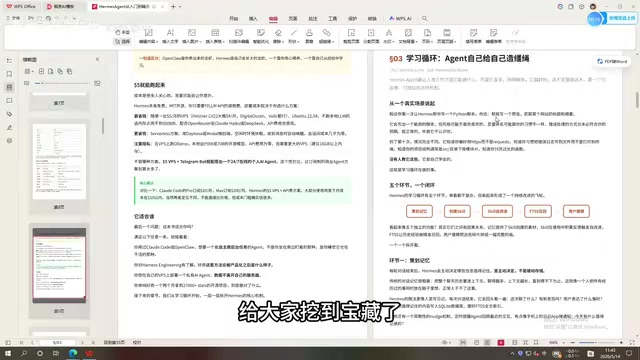
This article provides an in-depth analysis of the Orange Book's core content, helping readers quickly grasp the technical essence and practical key points of Hermes Agent.
What is Hermes Agent? Definition and Core Advantages
Definition
Hermes Agent is an intelligent agent framework developed by ByteDance. Its core philosophy is to transform AI from a passive question-answering system into an intelligent entity capable of proactive planning, task execution, and self-evolution. Unlike traditional chatbots or simple LLM calls, Hermes Agent possesses complete capabilities for task decomposition, tool invocation, and memory management.
Core Advantages
The Orange Book clearly articulates several core advantages of Hermes Agent over similar AI Agent frameworks:
- Self-Evolution Loop: The Agent continuously learns and optimizes its behavior during task execution, rather than remaining at the static Prompt template level
- Three-Layer Memory System: A three-tier architecture of short-term memory, long-term memory, and working memory gives the Agent genuine "contextual understanding" capabilities
- Skill Ecosystem: Supports skill creation, evolution, and reuse, forming an extensible tool ecosystem
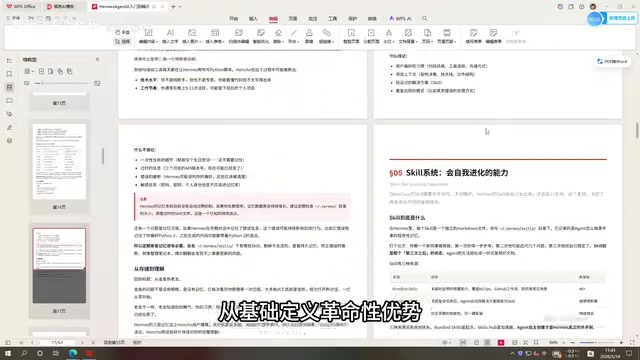
These design principles enable Hermes Agent to demonstrate significantly better stability and flexibility than traditional Agent frameworks when handling complex, multi-step tasks.
Core Architecture: Self-Evolution Loop and Three-Layer Memory System
Self-Evolution Loop Explained
The most research-worthy section of the Orange Book is its Self-Evolution Loop design. A major pain point of traditional AI Agent frameworks is that the Agent's capability boundaries are fixed at deployment time, unable to dynamically improve based on actual usage scenarios.
The theoretical foundation of the self-evolution loop traces back to "Experience Replay" in reinforcement learning and Meta-Learning concepts. Traditional Agent frameworks like LangChain primarily rely on predefined Chains and Prompt templates, with behavior patterns essentially fixed after deployment. While AutoGPT introduced autonomous planning capabilities, it lacks a systematic experience accumulation mechanism and easily falls into ineffective loops. Hermes Agent's self-evolution loop essentially engineers the cognitive process of "reflection-distillation-solidification," enabling the Agent to transform implicit knowledge accumulated at runtime into explicit Skills or strategy updates. This aligns closely with the "Double-loop Learning" theory in cognitive science.
Hermes Agent's self-evolution loop breaks this limitation. Its core process can be summarized as:
- Task Execution: The Agent receives and attempts to complete tasks
- Result Evaluation: Automated evaluation of execution results
- Experience Extraction: Extracting reusable insights from both successful and failed cases
- Capability Update: Solidifying experiences into new Skills or optimizing existing strategies
This "learning by doing" mechanism enables the Agent's capabilities to continuously improve over time, which is the key differentiator between Hermes Agent and frameworks like LangChain and AutoGPT.
Three-Layer Memory System Architecture
The memory system is crucial to whether an agent can handle complex tasks. Hermes Agent's three-layer memory architecture is elegantly designed, directly drawing from the Multi-Store Model proposed by cognitive psychologists Atkinson and Shiffrin:
- Short-term Memory: Handles current conversation context, similar to human working memory. At the engineering level, short-term memory is typically managed through the Context Window, constrained by the LLM's token length limit
- Long-term Memory: Stores persistent information such as cross-session user preferences and interaction history. Its underlying implementation relies on vector databases (such as Milvus, Pinecone, ChromaDB) for semantic retrieval, using RAG (Retrieval-Augmented Generation) technology to recall relevant information when needed
- Working Memory: Dynamically maintained intermediate states during task execution, supporting multi-step reasoning. This is the most innovative design — similar to computer registers or a Blackboard Architecture, it dynamically maintains task states, intermediate results, and reasoning chains during multi-step reasoning, solving the pain point of traditional Agents "forgetting intermediate steps" in long-chain tasks
The collaborative operation of the three memory layers enables the Agent to maintain conversation coherence while sustaining consistent execution strategies in long-cycle tasks.
Practical Guide: From Skill Creation to Multi-Platform Deployment
Skill Creation and Tool Ecosystem Building
The Orange Book dedicates considerable space to explaining Skill creation and management. Skills are the fundamental units through which Hermes Agent executes specific tasks — think of them as the Agent's "hands and feet."
The Skill concept builds upon LLMs' Function Calling capabilities. Since OpenAI introduced Function Calling in 2023, enabling LLMs to autonomously select and invoke external tools has become standard in Agent frameworks. But Hermes Agent's Skill system goes further: it not only supports static tool registration but also introduces version management and evolution mechanisms for Skills. This means a Skill can automatically optimize its parameter descriptions, error handling logic, and even execution strategies based on usage feedback. This design resembles service governance in microservice architecture, modularizing, making observable, and enabling evolution of the Agent's capabilities, laying the engineering foundation for enterprise-grade Agent applications.
The document covers the following in detail:
- Skill definition specifications and interface design
- How to wrap existing APIs as Skills
- Skill version management and evolution strategies
- Building tool ecosystems and third-party integrations
Installation, Configuration, and Multi-Platform Deployment
The Orange Book provides step-by-step installation and configuration tutorials covering mainstream development environments and deployment platforms. Whether for local development and debugging or cloud production deployments, detailed instructions and common troubleshooting guides are included.
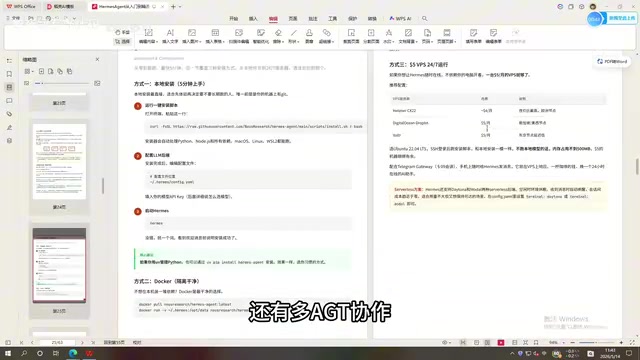
Multi-Agent Collaboration
In complex business scenarios, a single Agent often cannot independently complete all tasks. The Orange Book includes a dedicated Multi-Agent Collaboration chapter explaining how multiple Hermes Agents can work together through division of labor.
Multi-Agent collaboration is a frontier research direction, with the core challenge being how to enable efficient task distribution among Agents with different capabilities. The industry currently has three main collaboration paradigms: first, Hierarchical, where a master Agent assigns tasks to sub-Agents, similar to a project manager and executors; second, Peer-to-Peer, where multiple Agents negotiate as equals, reaching consensus through voting or debate; third, Hybrid, dynamically switching collaboration modes based on task complexity. Microsoft's AutoGen and CrewAI represent different collaboration design philosophies.
The Orange Book specifically covers these collaboration points:
- Communication protocol design between Agents
- Task allocation and load balancing strategies
- Conflict resolution and consistency guarantees
- Concurrent access control for shared memory
- Arbitration mechanisms when multiple Agents produce contradictory decisions
Advanced Content: Framework Comparison and Common Pitfall Guide
Comparison with Mainstream Agent Frameworks
The Orange Book doesn't shy away from competition — it candidly compares Hermes Agent with mainstream Agent frameworks on the market. This objective attitude actually enhances the document's credibility and helps developers make more informed technology choices. Current mainstream frameworks each have their strengths: LangChain excels with its rich ecosystem and flexible chain-based invocations, ideal for rapid prototyping; AutoGPT pioneered autonomous Agents but lacks stability; Microsoft AutoGen features elegant multi-Agent conversation design; CrewAI specializes in role-playing-style Agent collaboration. Hermes Agent's differentiated positioning lies in its self-evolution capabilities and engineered memory management, making it better suited for enterprise scenarios requiring long-term operation and continuous optimization.
Capability Boundaries and Pitfall Guide
This is one of the most practically valuable sections of the entire document. The Orange Book explicitly identifies Hermes Agent's current capability boundaries, including which scenarios are suitable, which require caution, and common pitfalls with their solutions.
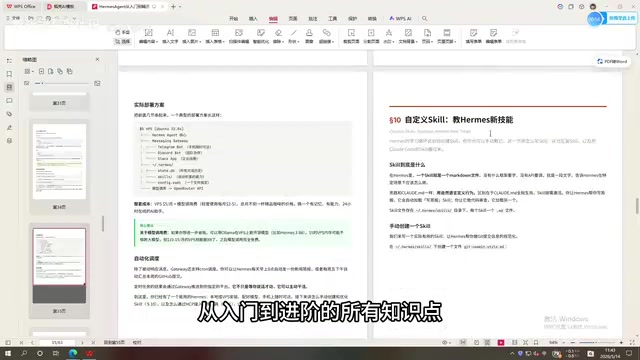
Common pitfalls to avoid include:
- Common mistakes and optimization tips in Prompt design: Including vague instructions leading to uncontrollable Agent behavior, and overly long system prompts diluting key information
- Memory system capacity management and cleanup strategies: Unlimited growth of long-term memory leads to decreased retrieval accuracy and rising costs, requiring well-designed forgetting mechanisms and importance scoring strategies
- Deadlock prevention in multi-Agent scenarios: Deadlocks can occur when multiple Agents are waiting for each other's output, requiring timeout mechanisms and fallback strategies
- Performance optimization recommendations for production environments: Including LLM call caching strategies, rate limiting for concurrent requests, and token consumption cost monitoring solutions
Conclusion: Reading Recommendations for Different Skill Levels
ByteDance's 198-page Hermes Agent Orange Book truly achieves complete coverage from beginner to advanced levels. It's not a simple API document but a systematic technical guide for intelligent agent development, balancing theoretical depth with practical value.
Recommended reading paths for different skill levels:
- Beginners: Start with the basic definitions and installation/configuration chapters to quickly get your first Demo running
- Intermediate Developers: Focus on the self-evolution loop and three-layer memory system to understand the architectural design philosophy
- Advanced Practitioners: Dive deep into multi-Agent collaboration and advanced techniques to explore deployment solutions for complex business scenarios
In today's rapidly evolving AI Agent landscape, this Orange Book provides developers with a rare systematic learning resource that's worth bookmarking and revisiting.
Related articles
Deep Dive into AI Agent Skill Design: …
Deep Dive into AI Agent Skill Design: Engineering Practices from Anthropic and Perplexity
A deep dive into Skill design philosophy from Anthropic's Claude Code team and Perplexity's Agent team, covering the Tax Test, Gotchas Flywheel, progressive disclosure, and Eval-First practices for building high-quality AI Agent skill systems.
Deep Dive into OpenAI's Official GPT-5…
Deep Dive into OpenAI's Official GPT-5.6 Prompting Guide: The Shift from Manual to Automatic
A deep dive into OpenAI's official GPT-5.6 Sol prompting guide: conciseness-first, outcome-oriented design, autonomy boundaries, tool routing, and reasoning intensity tuning.
 Deep Dives
Deep Dive into How OpenClaw (Open-Source Crayfish) AI Agent Works
Deep analysis of OpenClaw AI Agent internals: System Prompt, tool calling, SubAgents, Skill system, memory, and Context Engineering explained.