Deep Dive into Google AgentGravity 2.0: Dynamic Sub-Agents, SDK, and the Controversial Product Split

Google launches AgentGravity 2.0, splitting it into multiple standalone apps with a multi-agent collaboration system.
Google announced AgentGravity 2.0 at its developer conference, splitting it into four independent products — a desktop app, code editor, CLI tool, and SDK — each competing against Claude, Cursor, and other rivals. The core innovation is the dynamic sub-agent system, which breaks through single context window limitations through parallel multi-agent collaboration. A free AgentGravity SDK was also released, enabling developers to build custom agents. However, the product split has sparked controversy over UX fragmentation and tighter usage limits.
Google Developer Conference: The Complete AgentGravity Brand Split
Google dropped a bombshell at its latest developer conference — AgentGravity 2.0 is officially released. Meanwhile, the Gemini 2.5 Flash model, the new Omni video model, and a series of other AI updates also debuted simultaneously. However, what confused the developer community the most was Google's sweeping overhaul of AgentGravity.
In short, Google split the previously unified AgentGravity into multiple standalone applications:
- Standalone Desktop App (similar to Claude Desktop): An AI assistant focused on chat and autonomous task execution
- Code Editor (VS Code/Cursor-style): A standalone AI programming environment
- AgentGravity Satellite (formerly Gemini CLI): A command-line terminal tool
- AgentGravity SDK: A programming interface for developers
The intent behind this split strategy is obvious — Google wants a competing product in every lane: the desktop assistant targets Anthropic's Claude, the code editor targets Cursor, and the CLI tool targets various terminal AI assistants. But based on community feedback, a large number of users say they're "completely lost."
It's worth noting that behind this battle for market position lies the white-hot competition in the entire AI coding tools market. Cursor has rapidly built a loyal user base through its deeply integrated code completion and conversational programming experience; Anthropic's Claude Desktop is renowned for its powerful long-document processing and task automation capabilities; GitHub Copilot holds significant enterprise market share by leveraging the Microsoft ecosystem. The core competitive dimensions in this market include model coding ability, context window size, tool integration depth, response speed, and pricing strategy. Google has the technical advantage of the Gemini model, but has historically been considered weak in productization and developer experience. Whether this split can truly improve competitiveness remains to be tested by the market.
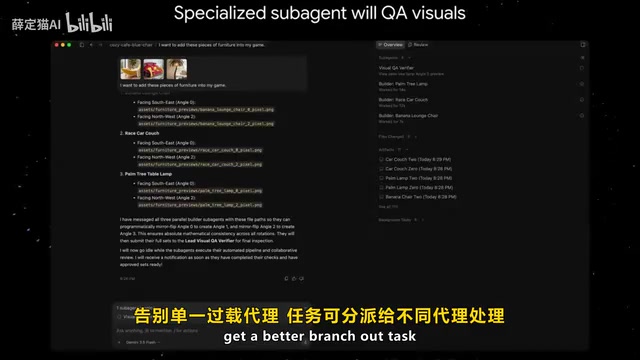
Core New Feature: Dynamic Sub-Agent System
Farewell to the Single-Agent Era
The most groundbreaking feature of AgentGravity 2.0 is the Dynamic Sub-Agents system. Traditional AI coding assistants use a single-agent model — all information is crammed into one massive context window for processing. The new system allows the main AI assistant to automatically spin up auxiliary agents in real-time, dispatching tasks to different specialized agents for parallel processing.
This design represents a paradigm shift in AI architecture from "monolithic models" to "multi-agent collaboration." The context window of traditional large language models is their core bottleneck — even the most advanced models today face limited token capacity constraints. When task complexity exceeds the information a single context can handle, model performance degrades significantly, and it may even "forget" earlier information. Multi-agent architecture fundamentally circumvents this limitation by decomposing large tasks into subtasks and distributing them to specialized sub-agents for parallel processing. This design philosophy mirrors the microservices architecture in software engineering — each agent focuses on a specific domain, while the main orchestrator handles task distribution and result integration.
This means:
- Complex tasks are no longer limited by the capacity of a single context window
- Different types of subtasks can be handled by specially optimized agents
- Multiple agents can work collaboratively, dramatically improving development efficiency
The New Slash Command System
Google has added several practical slash commands to AgentGravity 2.0's workflow:
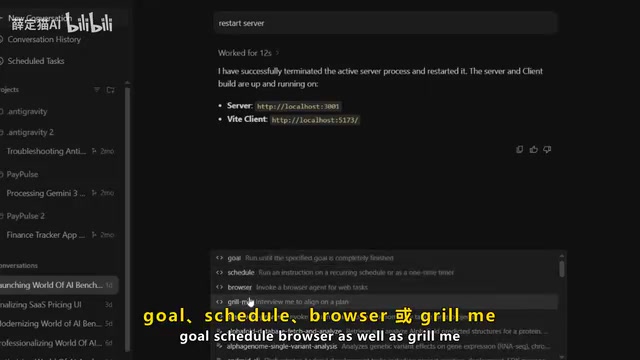
/go: Instructs the AI to keep working until the task is fully completed, without repeated confirmations/pause: Forces the AI to ask clarifying questions before starting execution, avoiding directional drift/browser: Forces browser invocation within the workflow/schedule: Sets up scheduled tasks
This slash command system reflects an important human-AI collaboration design philosophy — finding a balance between AI autonomy and human control. The /go command represents a "high-trust mode," suitable for scenarios with clear task boundaries and controllable risk; the /pause command embodies the "verification-first" principle, forcing human confirmation before executing high-risk or ambiguous tasks. This design echoes the core concept of "Human-in-the-Loop" in AI safety — as AI agent capabilities continue to strengthen, how to design reasonable control interfaces that let users finely tune the degree of AI autonomy is becoming a critical product design challenge.
Additionally, a new real-time voice transcription feature has been added, allowing developers to speak prompts directly to the agent without manual input. This feature further lowers the interaction barrier, taking another step toward the vision of "natural language as operating system."

Project Management and Plugin Ecosystem Upgrades
Cross-Repository Project System
AgentGravity 2.0 fundamentally changes how projects are handled. Previously, conversations were confined to a single codebase; now everything is organized under a broader "project" concept. These projects can span multiple folders and have independent custom permissions and rule configurations.
When starting a project, users can add specific rules for the entire project, which is highly valuable for team collaboration and unifying code standards.
Recommended Plugin Ecosystem
When installing AgentGravity 2.0, the system recommends a series of official Google plugins, several of which deserve special attention:
- Modern Web Guide: Gives the AI coding assistant up-to-date Web development best practices and provides agents with references to the latest packages
- Chrome DevTools: Provides reliable web browsing automation capabilities
- AgentGravity SDK Plugin: Provides low-level interfaces for advanced developers
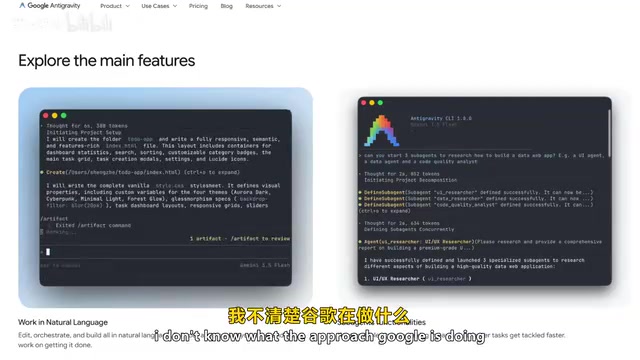
AgentGravity SDK: The Most Underrated Major Release
In the entire announcement, the AgentGravity SDK is probably the most underrated yet most important part. This SDK provides direct programmatic access, letting developers tap into the same agent framework that powers Google's own AgentGravity products.
The release of the AgentGravity SDK reflects the "platformization" transformation underway across the entire AI industry. Following OpenAI's launch of the Assistants API and Anthropic's opening of Claude API tool-calling capabilities, all major AI vendors are competing for dominance of the developer ecosystem. The core value of an Agent Framework lies in providing foundational capabilities like Tool Use, Memory Management, Task Planning, and Multi-step Reasoning, freeing developers from building these complex mechanisms from scratch. Making the SDK freely available is a strategic move by Google — by lowering the developer barrier, it rapidly expands ecosystem coverage, creating network effects similar to the Android open strategy, and ultimately building a moat in the enterprise AI application market.
What does this mean for developers? Instead of being limited to consumer-grade desktop apps, they can:
- Build fully customized autonomous agent systems
- Integrate AI agent capabilities into their own applications and products
- Leverage Google's core orchestrator system to power their own workflows
- Develop internal tools and automation pipelines
And all of this is completely free — a point many people have overlooked. Google AI Studio has also quietly launched a new agent model called "AgentGravity Preview," which runs on Google's remote Linux hosts. It's not just a regular chatbot, but a general-purpose autonomous AI agent capable of executing code, using tools, and processing massive amounts of tokens.
Controversy and Confusion: Google's Product Strategy Problem
The UX Fragmentation Caused by the Split
Although the standalone app model can indeed make workflows clearer, this split also brings significant issues:
Stricter usage limits — The new version's usage limits are much stricter than before, already frustrating a large number of users. For developers who rely on AI coding tools for daily development, this is a substantive regression.
Overlapping product positioning — Google's standalone desktop app copies Claude's model, the code editor copies Cursor, and the cloud code portion doesn't offer much new. This "must have a product in every lane" approach
Related articles
 Tech Frontiers
A Rare Quiet Day in AI: Recursive Self-Improvement Stirs Beneath the Surface
A rare quiet day in AI sees multiple sources go silent simultaneously. Behind the calm, Recursive Self-Improvement (RSI) research continues. What this means for the industry.
 Tech Frontiers
Reve 2 vs. Ideogram 4: A Deep Dive into Layout Control in AI Image Generation
A deep comparison of Reve 2 and Ideogram 4's layout control capabilities, covering technical approaches, real-world use cases, and industry trends for designers and creators.
 Tech Frontiers
In the Weights: Check Your Influence Score in the AI World
In the Weights is an AI influence search engine that quantifies your presence in the AI world with a score. Explore how it evaluates practitioners and what it means for digital identity.