Deep Dive into GRPO: An Efficient Alignment Method for LLM Reinforcement Learning

GRPO removes the value network and uses group-relative advantage for more efficient LLM reinforcement learning.
GRPO (Group Relative Policy Optimization), popularized by DeepSeek, eliminates the value network required by PPO and instead samples multiple candidate responses per prompt, using within-group reward normalization to compute relative advantages. This significantly reduces memory overhead and architectural complexity for large model training. GRPO excels on reasoning tasks with verifiable signals (math, code) and was central to DeepSeek-R1's capabilities. Its evolution from RLHF to PPO to GRPO reflects ongoing trade-offs between effectiveness, efficiency, and engineering feasibility.
What Is GRPO
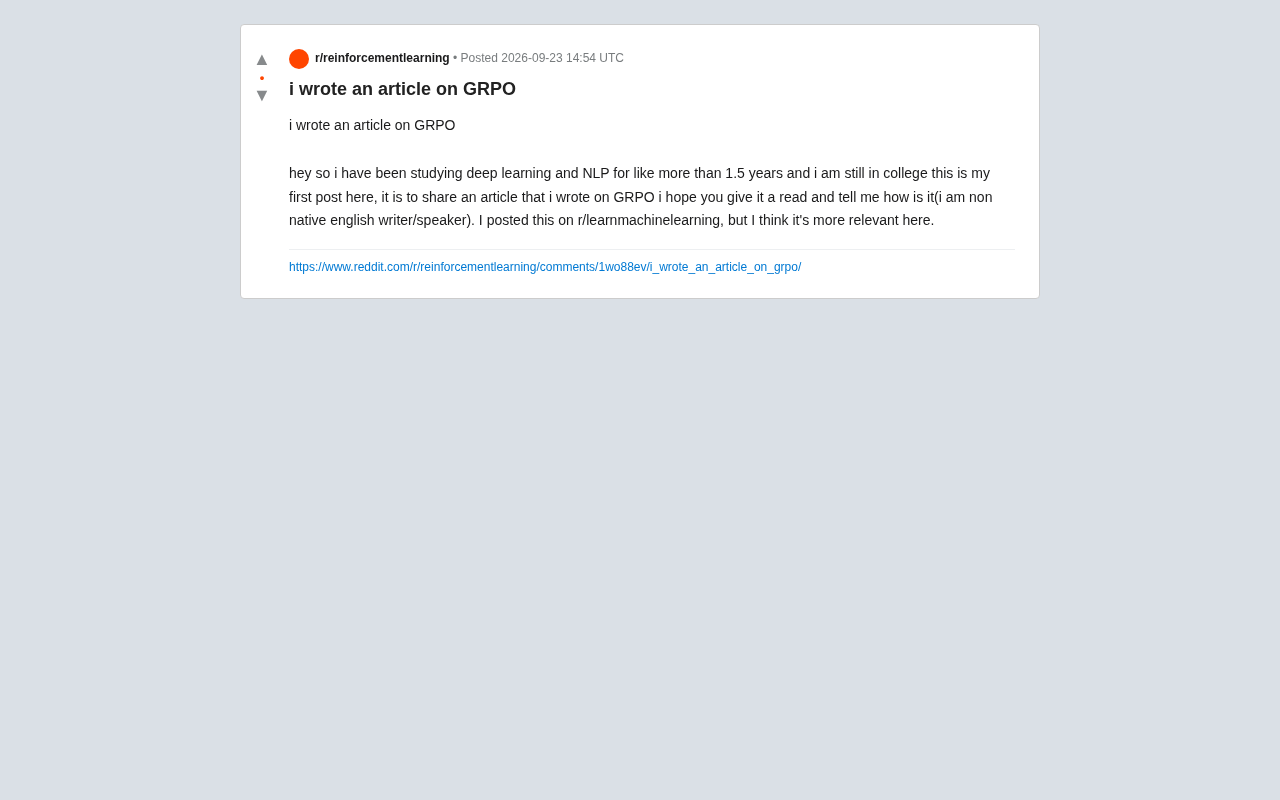
GRPO (Group Relative Policy Optimization) is a reinforcement learning algorithm that has gained widespread attention in large language model training in recent years. Popularized by the DeepSeekAd team in their model training pipeline, it has emerged as an important alignment technique following PPO (Proximal Policy Optimization). A developer currently pursuing a degree with over a year and a half of focus on deep learning and NLP research shared an article they wrote about GRPO on Reddit, sparking discussion among the machine learning community.
For anyone looking to understand how modern LLMs improve reasoning ability through reinforcement learning, GRPO is a foundational concept. Compared to traditional approaches, it makes key trade-offs in computational efficiency and implementation complexity.
Core Differences Between GRPO and PPO
Eliminating the Value Model
Traditional PPO requires simultaneously training both a policy network (Policy Model) and a value network (Critic/Value Model). The value network estimates the expected return for each action, which is used to compute the advantage function. This introduces significant memory overhead and training complexity — you need to maintain an additional network comparable in scale to the policy model itself.
The core innovation of GRPO is completely removing the value network. Rather than relying on a separate model to estimate a baseline return, GRPO samples multiple responses to the same prompt (forming a "group") and uses the mean reward within that group as the baseline. This approach directly reduces the computational resources required for training — a significant benefit when working with models that routinely have billions of parameters.
The memory cost of a value network is especially pronounced in large model settings. Take a 7-billion-parameter policy model as an example: the accompanying value network typically requires a comparable number of parameters, meaning just these two models alone demand twice the GPU memory. Factor in gradients, optimizer states, and other training overhead, and the actual memory pressure is often 4 to 8 times that of inference. By removing the value network, GRPO not only saves this memory but also eliminates the gradient coordination problem between the two networks — in PPO, if the policy network updates too quickly, the value network's estimates become inaccurate, and vice versa. This coupling makes hyperparameter tuning extremely tedious. For researchers with limited resources or small-to-medium teams, this simplification makes it feasible to run experiments on a single multi-GPU machine or even a single high-end GPU.
Computing Group-Relative Advantage
The phrase "Group Relative" in GRPO's name captures its essence. For each input prompt, the model generates a group of candidate responses (e.g., 8 or 16), and a reward score is computed for each. The advantage function no longer comes from a value network's predictions — instead, it is derived through within-group normalization:
Subtract the group's mean reward from each response's reward, then divide by the group's standard deviation. The resulting relative advantage naturally reflects "how much better this response is compared to others in the same group." Responses scoring above average are encouraged; those below average are suppressed.
The elegance of this design lies in using sampling diversity as a substitute for explicit value estimation — preserving the effectiveness of the training signal while dramatically simplifying the system architecture.
PPO itself evolved from the earlier TRPO (Trust Region Policy Optimization). TRPO uses mathematical constraints to ensure policy updates don't deviate too far from the current policy, but solving the constrained optimization problem is computationally expensive. PPO approximates the same effect with a simple "clipped objective function," greatly reducing computational cost and making it the dominant baseline method in reinforcement learning. In the context of large language model alignment, PPO is typically paired with a reward model to form a complete RLHF (Reinforcement Learning from Human Feedback) pipeline. Understanding PPO's clipping mechanism and the role of the value network is an important prerequisite for deeply appreciating why GRPO is able to make these simplifications.
GRPO's Application in Reasoning Models
Much of GRPO's prominence stems from its strong performance in enhancing model reasoning capabilities — particularly on math and coding tasks. In these domains, answer correctness can be definitively judged by rules or verifiers, providing a clear reward signal for reinforcement learning.
By generating multiple solution attempts for the same problem, the model can learn better reasoning paths from "which solutions are closer to the correct answer." This outcome-based reward mechanism, combined with GRPO's within-group comparison, allows models to self-improve without requiring large amounts of human annotation.
This training paradigm that relies on verifiable reward signals is sometimes referred to as "Outcome-supervised RL," or the Outcome Reward Model (ORM) framework — as opposed to a Process Reward Model (PRM). In math problem settings, a verifier only needs to check whether the final answer matches the ground truth, without requiring human scoring of each reasoning step. This dramatically lowers annotation costs. DeepSeek-R1's training report explicitly documents GRPO's use alongside this type of reward function: a correct answer earns +1, while formatting errors or wrong answers receive 0 or a negative score. Such binary or sparse reward signals can cause training instability in traditional RL settings, but GRPO's within-group relative normalization partially mitigates the vanishing gradient problem that comes with sparse rewards.
The Value of Learning GRPO and Recommendations
For machine learning practitioners, understanding GRPO is not just about mastering one specific algorithm — it's a window into how reinforcement learning has evolved in the era of large models. From RLHF to PPO to GRPO, each step reflects trade-offs between effectiveness, efficiency, and engineering feasibility.
The fact that the article's author — a non-native English-speaking student — independently wrote and shared a technical piece is itself an admirable approach to learning. Converting understanding into written output is an effective way to verify whether you've truly grasped a concept. For readers looking to enter this field, the recommendation is to first build a solid foundation in PPO, then understand GRPO's simplifications by contrast — this will give you a much deeper appreciation of its design motivations.
Summary
By eliminating the value network and using within-group relative advantage in its place, GRPO offers a lighter, more efficient path for reinforcement learning with large models. It has played a key role in improving the reasoning capabilities of models like DeepSeek, and has become a focal point of current research and practice. For learners, the best way to master cutting-edge methods like this is to actively read high-quality technical articles and then try to restate and implement the ideas yourself.
Related articles

curl 8.23.0 Fixes 24 CVEs, AI-Assisted Research Contributed 20
curl 8.23.0 fixes 24 CVEs, 20 found by AI-assisted research, including a High-severity HTTP/2 use-after-free that could become RCE. Here's the source, fix details, and upgrade checklist.

MP3 vs WAV: Which Format Should You Choose for Voice Recording
MP3 vs WAV for voice recording: compare lossy vs uncompressed formats for interviews, transcription, and archiving—and learn the common mistake of converting formats after the fact.

Multi-Agent Voice Command Center in Practice: Deconstructing the VAPI + Supabase Architecture
Deconstructing the Load Bearing Empire multi-agent voice command center: VAPI voice pipeline, Supabase Edge Functions for Webhooks, 8 Postgres tables tracking agent state, and Vercel-managed frontend design.