Deep Dive into Hermes Agent: The Secret Behind This Self-Evolving AI Agent Framework's Victory Over OpenCloud

Hermes Agent is a self-evolving open-source AI Agent framework with persistent long-term memory.
Hermes Agent is an open-source AI Agent framework launched in February 2025 that surpassed 120K GitHub stars in under two months. Compared to OpenCloud, it offers two core advantages: dramatically lower token consumption through streamlined prompt engineering, and persistent long-term memory powered by vector databases and RAG technology that remembers user preferences across sessions. Its built-in self-learning loop automatically generates and optimizes skill libraries, truly achieving an Agent that "grows with its user."
What Is Hermes Agent? An AI Partner That Evolves
In late February 2025, an open-source AI Agent framework called Hermes Agent burst onto the scene. In less than two months after launch, it surpassed 120,000 GitHub stars—a jaw-dropping growth rate. Its functionality is positioned similarly to the previously popular OpenCloud (commonly known as "the Lobster" in the community), but it surpasses it in several key dimensions.
Let's quickly review the background: the AI tools we use daily—like Doubao and DeepSeekAd—are essentially "idea generators." They help you write proposals and make plans but can't actually take action. These tools are traditional LLM frontend wrappers that can only output text suggestions within a chat window, unable to produce real interactions with external systems. AI Agents, on the other hand, possess a complete "perception-decision-execution" closed-loop capability. They can control browsers, read and write file systems, call APIs, and execute code—transforming "thinking" into "action." This represents one of the most important technological paradigm shifts in AI during 2024-2025. OpenCloud is a flagship product in this direction: it can actually control your computer—organizing documents, creating files, sending and receiving emails, and scraping information via browsers—truly achieving the unity of "mind and hands."
So if OpenCloud is already so powerful, why do we need Hermes Agent? The answer lies in this: Hermes Agent isn't just a tool—it's a partner that evolves.
Hermes Agent vs OpenCloud: Two Core Advantages Explained
Advantage 1: Dramatically Lower Token Consumption
There's a vivid comparison video online: OpenCloud burns through 10,000 tokens just to check the weather—a true "big spender." To understand this issue, you first need to grasp what tokens are: tokens are the basic units that large language models use to process text, roughly equivalent to "word fragments"—approximately 4 English characters equal 1 token, and 1-2 Chinese characters equal 1 token. When calling commercial model APIs like GPT-4o or Claude, costs are directly calculated based on input + output token count.
When AI Agents execute tasks, they need to pack the current state, tool list, historical context, and more into the prompt, causing token consumption per operation to far exceed normal conversations. OpenCloud's phenomenon of "burning 10,000 tokens to check the weather" happens precisely because it stuffs massive amounts of system state and tool descriptions into the context window—this isn't an exaggeration; in actual use, its token consumption is indeed quite substantial. Hermes Agent, through more streamlined prompt engineering and state compression strategies, requires noticeably fewer tokens to accomplish the same tasks.
For users who rely on API calls, this means real cost savings. Especially in high-frequency usage scenarios, the difference in token consumption scales to a very significant number.
Advantage 2: Long-Term Memory and Self-Evolution Capability
This is Hermes Agent's most disruptive feature. OpenCloud has a fatal weakness: after closing the dialog box or restarting your computer, opening it again gives you a "brand new tool"—all previous context and interaction memory is completely lost, like a "7-second memory." The root cause of this problem lies in the physical limitations of AI systems' context windows—while current mainstream large models have expanded context windows to hundreds of thousands of tokens, they still cannot infinitely contain all historical interactions, and state in memory is completely cleared when the process closes.
Hermes Agent is completely different. Its persistent long-term memory relies on vector databases (such as Chroma, Qdrant) combined with RAG (Retrieval-Augmented Generation) technology: historical interactions, user preferences, skill descriptions, and other information are vectorized and stored, with the most relevant memory fragments dynamically retrieved and injected into context during each conversation. This architecture means memory capacity is theoretically unlimited, and retrieval precision continuously improves as data accumulates. Specifically, it can:
- Remember your previous interactions and preferences
- Understand your habits better as usage time grows
- Automatically accumulate and optimize its skill library
- Maintain deep understanding of users across sessions
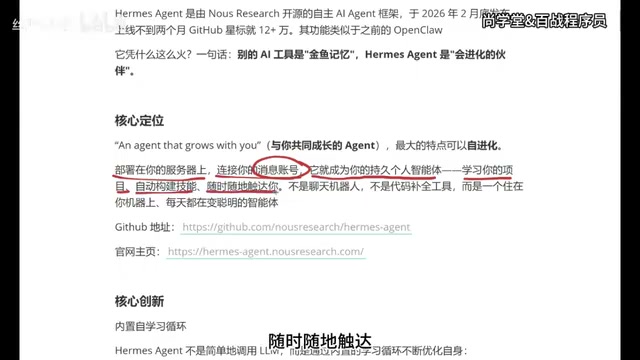
In official terms, its core positioning is "an Agent that grows with you." Not a chatbot, not a code completion tool, but an intelligent entity living on your machine that gets smarter every day.
Core Innovation: How the Built-in Self-Learning Loop Works
Hermes Agent no longer simply calls large models—it continuously optimizes itself through a built-in learning loop. This self-evolution mechanism manifests across four levels:
1. Automatically Generating Skills from Interactions
During your daily interactions with Hermes Agent, it automatically identifies reusable operation patterns and abstracts them into Skills. This mechanism is essentially a combination of Meta-Learning and Program Synthesis: after the Agent completes a complex task, the system performs retrospective analysis on the action trajectory, identifies abstractable and reusable operation sequences, and encapsulates them as structured Skill objects—including trigger conditions, execution steps, expected outputs, and other fields. This approach is highly similar to Stanford University's Voyager framework, which also achieves continuous capability expansion through automatically generating and verifying skill libraries. You don't need to teach it manually—it learns on its own.
2. Continuously Iterating and Optimizing Existing Skills
Existing skills aren't set in stone. As usage frequency increases and scenarios change, Hermes Agent continuously iterates on these skills, making execution results increasingly precise.
3. Automatically Persisting Knowledge and User Preferences
Based on your personal usage habits, it gradually builds a user profile to deliver personalized service experiences. The longer you use it, the better it understands you.
4. Building Deep User Understanding Across Platforms
Hermes Agent supports integration with multiple messaging platforms—QQ, WeChat, Feishu, and more. Regardless of which channel you use to interact with it, all this information converges into a complete understanding of you.
Real-World Demo: From Search to Website Building in One Go
Here's a real use case. The task: have Hermes Agent search the internet for popular AI Agent projects from the past two years, summarize them into a document with important links to official websites, GitHub repos, and blogs, and finally generate a static webpage that can run locally.

Three highlights are worth noting about the entire process:
- Zero rework: From information search, document generation, to webpage construction, the entire process was completed in one pass with no "regenerate" needed.
Related articles
Deep Dive into AI Agent Skill Design: …
Deep Dive into AI Agent Skill Design: Engineering Practices from Anthropic and Perplexity
A deep dive into Skill design philosophy from Anthropic's Claude Code team and Perplexity's Agent team, covering the Tax Test, Gotchas Flywheel, progressive disclosure, and Eval-First practices for building high-quality AI Agent skill systems.
Deep Dive into OpenAI's Official GPT-5…
Deep Dive into OpenAI's Official GPT-5.6 Prompting Guide: The Shift from Manual to Automatic
A deep dive into OpenAI's official GPT-5.6 Sol prompting guide: conciseness-first, outcome-oriented design, autonomy boundaries, tool routing, and reasoning intensity tuning.
 Deep Dives
Deep Dive into How OpenClaw (Open-Source Crayfish) AI Agent Works
Deep analysis of OpenClaw AI Agent internals: System Prompt, tool calling, SubAgents, Skill system, memory, and Context Engineering explained.