Deep Dive into Microsoft MAI-Transcribe-2: Leading in Speed, Cost, and Accuracy Across the Board
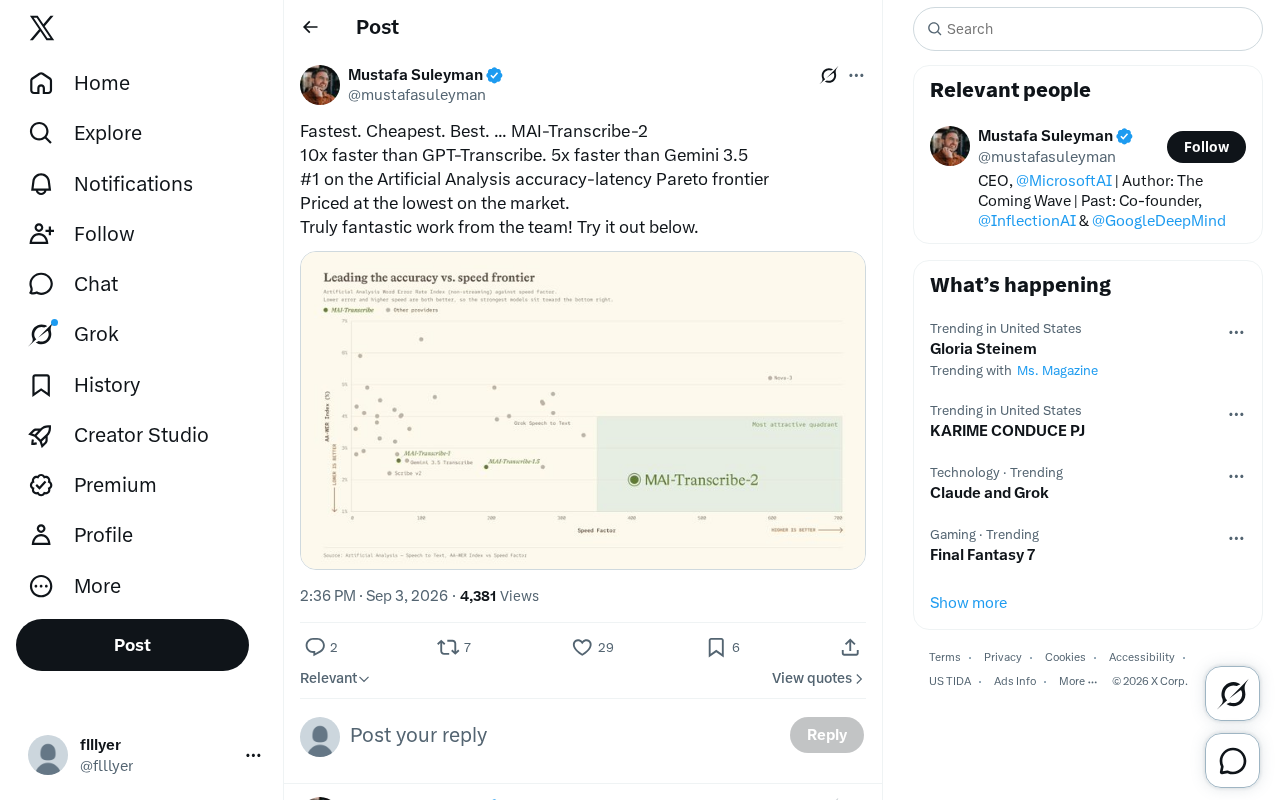
Microsoft's MAI-Transcribe-2 claims 10x speed over GPT-Transcribe at the lowest price with top accuracy.
Microsoft has released MAI-Transcribe-2, a speech transcription model claiming 10x speed over GPT-Transcribe and 5x over Gemini 3.5, while ranking #1 on Artificial Analysis's accuracy-latency Pareto frontier at the market's lowest price. This article analyzes the underlying technical optimizations, Microsoft's dual-track strategy of self-developed MAI models alongside its OpenAI partnership, and offers practical guidance for evaluating these claims against real-world use cases.
Microsoft Strikes Again: MAI-Transcribe-2 Takes Aim at the Speech Transcription Market
As the arms race in large models intensifies, speech-to-text — a seemingly mature field — is being redefined. Speech transcription technology has undergone a fundamental evolution from Hidden Markov Model (HMM)-based systems to deep learning end-to-end models. Early systems relied on cascaded architectures of acoustic models, language models, and pronunciation dictionaries, while modern solutions like OpenAI's Whisper and Google's Universal Speech Model use Transformer architectures for end-to-end modeling, dramatically simplifying the pipeline and improving generalization. The current state of the art has shifted toward multimodal large models that directly process audio input, blurring the boundary between traditional ASR and general-purpose language models. Microsoft's recently launched MAI-Transcribe-2 model is a product of this very trend, debuting with the bold tagline "Fastest, Cheapest, Best" and directly challenging OpenAI's GPT-Transcribe and Google's Gemini series.
According to official figures, MAI-Transcribe-2's performance is nothing short of aggressive: transcription speed 10x faster than GPT-Transcribe and 5x faster than Gemini 3.5, while ranking #1 on the "accuracy-latency" Pareto Frontier in benchmarks from Artificial Analysis, a third-party evaluation firm — all at the lowest price on the market. Artificial Analysis is an independent benchmarking organization focused on AI model performance, using standardized methodologies to conduct side-by-side comparisons of large language models, speech models, image generation models, and more from various providers. Their evaluation dimensions typically cover three core axes: quality (accuracy), speed (latency and throughput), and price, presented visually through Pareto frontier charts to illustrate each model's overall competitiveness. Due to its third-party positioning independent of major cloud providers, its evaluation results carry significant credibility in the developer community. If these metrics hold true, this represents one of the most consequential product iterations in the speech processing space in recent years.
What Core Pain Points Does MAI-Transcribe-2 Address in Speech Transcription
Speech transcription services have long faced two fundamental tensions in real-world deployment: latency and cost.
Why Transcription Speed Is So Critical
For use cases like real-time captions, meeting transcription, customer service voice analytics, and medical dictation, transcription latency directly determines user experience. Traditional high-accuracy models often require significant processing time, making it difficult to meet real-time or near-real-time requirements. MAI-Transcribe-2's claimed "10x speed" means that transcription results that previously took several seconds could now be returned in just a few hundred milliseconds. This is hugely significant for scenarios like live streaming and meetings that require subtitles generated as speech occurs.
Dramatic speed improvements coupled with simultaneous price reductions typically point to fundamental optimizations in the underlying inference architecture. Possible technical approaches include: Knowledge Distillation, where a large model guides the training of a smaller but equally efficient model; Quantization, compressing model weights from floating-point precision to low-bit representations to accelerate computation; Speculative Decoding, using a small draft model to speed up the autoregressive generation process of a larger model; and deep operator-level optimizations for specific hardware (such as Microsoft's custom Maia AI chips or NVIDIA's latest GPUs). Additionally, Streaming Architecture allows the model to incrementally output transcription results while audio is still being input, rather than waiting for the entire audio to be processed — this is critical for latency optimization in real-time scenarios. MAI-Transcribe-2's simultaneous breakthroughs in speed and price most likely stem from a combined application of multiple such approaches.
Cost Determines Whether Speech Transcription Can Scale
Speech transcription is a classic "high-frequency, high-volume" task. When enterprises process massive amounts of audio data, even tiny differences in unit pricing get amplified by enormous call volumes into staggering bills. Microsoft's positioning of MAI-Transcribe-2 at "the lowest market price" is clearly designed to use pricing as leverage to win over enterprise customers who have been hesitant due to cost concerns. When speed improvements and price reductions happen simultaneously, it usually signals a substantive breakthrough in underlying inference architecture or model efficiency.
What Does Ranking #1 on the Pareto Frontier Mean
Microsoft specifically highlights that MAI-Transcribe-2 ranks first on the "accuracy-latency Pareto Frontier" in Artificial Analysis benchmarks. This claim deserves its own unpacking.
The Pareto Frontier refers to the set of optimal solutions in a multi-objective tradeoff where "improving one metric is impossible without sacrificing another." This concept originates from Pareto optimality theory in economics, proposed by Italian economist Vilfredo Pareto. In multi-objective optimization problems, each solution on the Pareto frontier has the property of "non-dominance" — meaning no other solution exists that can simultaneously outperform it on all objectives. In AI model evaluation, this concept is widely used to characterize the tradeoffs between accuracy and latency, or performance and cost.
In speech transcription, accuracy and latency are typically at odds — pursuing higher accuracy often comes at the cost of longer processing times. Sitting on the Pareto frontier means that MAI-Transcribe-2 has the lowest latency at any given accuracy level, or the highest accuracy at any given latency level, with no other model able to surpass it on both dimensions simultaneously. Ranking first on the frontier typically indicates that the model occupies the most advantageous position on the frontier curve — meaning no competitor can comprehensively outperform it when multiple dimensions are considered together.
This is more convincing than simply claiming "highest accuracy" or "fastest speed," because it reflects comprehensive engineering capability rather than brute-force optimization on a single metric. Of course, Pareto frontier rankings depend on specific test sets and evaluation methodologies, and real-world business performance still needs to be validated against your own audio characteristics (accents, noise, domain-specific terminology, etc.).
Microsoft's Strategic Positioning with the MAI Model Series
The "MAI" in MAI-Transcribe-2 stands for Microsoft AI and is part of Microsoft's ongoing effort to build a proprietary model portfolio. Over the past few years, Microsoft has been heavily reliant on its partnership with OpenAI in the generative AI space, but the recent rollout of a series of MAI-branded models signals that Microsoft is accelerating the establishment of autonomous, self-controlled model capabilities.
While Microsoft's partnership with OpenAI has granted exclusive cloud deployment rights for the GPT series, it has also created a high degree of dependency on a single supplier. The launch of the MAI brand marks Microsoft's move to build a multi-layered model supply system: the top tier leverages OpenAI's frontier large models, the middle tier uses MAI proprietary models to cover high-frequency vertical scenarios, and the bottom tier uses Phi-series small models (like Phi-4) for edge computing and lightweight deployment needs. This "in-house R&D + partnership" dual-track strategy is analogous to Apple's transition from Intel chips to its custom M-series silicon — gaining control over product experience and commercial destiny by mastering core technology. It also gives Microsoft more leverage in commercial negotiations with OpenAI.
From a strategic perspective, speech transcription is an ideal entry point:
- The technology is relatively mature, and Microsoft has deep expertise in speech recognition (Azure Speech services have been around for a long time). Microsoft's investment in speech technology dates back to Microsoft Research in the 1990s. The Speech service in Azure Cognitive Services (formerly Bing Speech API and Project Oxford) has been continuously iterating since 2015, now supporting speech recognition for over 100 languages and dialects, along with advanced features like Custom Speech models, speech translation, and speaker recognition. Microsoft's numerous research achievements in speech — including achieving human-level speech recognition error rates on the Switchboard benchmark for the first time in 2016 — provide deep technical foundations for MAI-Transcribe-2.
- Demand is rigid and high-frequency, making it easy to achieve scaled commercial monetization through the Azure cloud ecosystem.
- Differentiation opportunities are clear — speed and price are quantifiable, comparable hard metrics that facilitate building market awareness.
By delivering a "fastest, cheapest, best" combination punch in this niche, Microsoft can both strengthen its cloud service competitiveness and reduce dependency on third-party models.
Selection Advice for MAI-Transcribe-2: Critical Thinking Beyond the Marketing Numbers
Faced with such impressive marketing claims, practitioners should maintain a healthy dose of skepticism.
First, multiplier comparisons like "10x faster" and "5x faster" are highly dependent on test conditions — audio length, language, concurrency scale, and hardware configuration all affect results. Different vendors' benchmark methodologies may not be consistent.
Second, speech transcription "accuracy" varies enormously in real-world scenarios. Standard English in a quiet environment versus multilingual mixing in noisy conditions with domain-specific terminology represents entirely different difficulty levels. Being #1 on a leaderboard doesn't necessarily mean being #1 in your specific business scenario. It's worth noting that the industry typically uses Word Error Rate (WER) as the core metric for speech transcription accuracy, which comprehensively accounts for substitution errors, insertion errors, and deletion errors. However, WER itself has limitations — for example, different handling of punctuation, capitalization, and number formatting can lead to discrepancies across different evaluation frameworks.
Finally, whether the pricing advantage is sustainable, along with long-term service stability, API ecosystem maturity, and multilingual coverage capabilities, are all factors that enterprises need to consider holistically when making their selection.
That said, the release of MAI-Transcribe-2 is still a positive signal: it demonstrates that the "performance-cost" frontier of speech transcription continues to be pushed forward, ultimately benefiting developers and enterprise users alike. Teams with relevant needs are advised to actually integrate and trial the service — let your own data speak for itself, as that's the only way to make a truly reliable judgment.
Conclusion
MAI-Transcribe-2 enters the arena with a triple advantage in speed, cost, and overall performance, representing another major push by Microsoft on its path toward proprietary AI models. At a time when OpenAI and Google dominate the narrative, Microsoft's choice to enter through the pragmatic lane of speech transcription demonstrates both technical confidence and clear commercial logic. For developers, intensifying market competition is always a good thing — faster speeds, lower prices, and higher accuracy are the most direct gifts that technological progress can offer.
Related articles
AI Agent Cost Optimization in Practice: Engineering Wisdom That Saved $1 Million in One Hour
Databricks eliminated $1M/year in wasted AI Agent spend in just one hour. Learn the root causes of Agent cost overruns and key strategies like model tiering, context pruning, and caching.
How the FDA Is Building an AI-Ready Data Foundation on Databricks
Explore how the FDA leverages Databricks for Government to build a unified Lakehouse architecture and AI-ready data foundation while meeting federal security and compliance standards.
The Power of Security Collaboration: Why Vulnerability Discovery Cannot Do Without Human Intelligence
Explore how security collaboration outperforms tool dependency, the value of vulnerability stories, cross-team knowledge sharing practices, and building stronger defenses by investing in people and collaboration.