Deep Dive into OpenAI Agent Kit: Can It Really Replace Dify and n8n?

OpenAI Agent Kit carries more strategic weight than product value—it won't replace Dify or n8n anytime soon.
OpenAI's Agent Kit is a visual workflow system that sparked heated debate by entering the AI workflow automation space. However, it currently only supports conversation scenarios and text workflows, with basic functionality and limited flexibility—still at the prototype stage and far from replacing mature products like Dify and n8n. Its core value lies in strategic positioning: helping OpenAI transition from a model company to a platform company, while building a data collection flywheel through its Evaluate module.
OpenAI's second developer conference just wrapped up, and among the four major updates, the most talked-about was Agent Kit—a visual workflow building system. Many online voices claim it will "crush" startups like Dify, Coze, and n8n, but is that really the case? Let's take a cool-headed look at the product's true capabilities and strategic intent.
Quick Overview of OpenAI Developer Conference's Four Major Updates
The OpenAI developer conference announced four main items:
- Solar2 API Release: Now available for developers to call directly
- Codex Full Launch: No longer restricted to limited users. Codex is OpenAI's cloud-based AI coding agent that can autonomously read code repositories, write code, run tests, and submit Pull Requests in a sandboxed environment. Its core difference from GitHub Copilot is that Copilot acts as a real-time "co-pilot" helping developers write code line by line, while Codex is more like a "remote colleague" that can independently pick up tasks and asynchronously complete entire development subtasks. Previously, Codex was in limited access, only available to select Pro and Team users. The full launch means all developers can now delegate repetitive coding tasks to Codex, representing a significant boost to software development efficiency.
- App SDK: Think of it as an upgraded version of GPTs, allowing developers to build embedded applications within GPT, with the core goal of connecting 800+ million users with the developer ecosystem. Looking back at GPTs' history, it was a custom ChatGPT feature launched at OpenAI's first DevDay in 2023, allowing users to create personalized AI assistants through natural language instructions, upload knowledge files, and configure external API calls. However, GPTs faced two core problems after launch: developers struggled to build truly complex interactive experiences within them, and GPT Store's traffic distribution fell far short of expectations. The App SDK launch is essentially a major architectural upgrade to GPTs—it gives developers the ability to embed custom UI components, handle payment flows, and manage user state within the ChatGPT interface, evolving ChatGPT from a conversational tool into an application platform similar to WeChat Mini Programs.
- Agent Kit: The visual workflow building system that is the focus of this article's analysis
Among these, Agent Kit generated the most discussion because it directly enters the fiercely competitive AI workflow automation space. AI Workflow Automation refers to using visual orchestration or code to chain multiple AI model calls, data processing steps, and external service integrations into an automatically executing pipeline. This space heated up rapidly in 2023-2024, primarily driven by the leap in large language model capabilities—when a single API call can already handle translation, summarization, code generation, and other tasks, developers naturally want to combine multiple capabilities to handle more complex business scenarios. Dify positions itself as an open-source LLM application development platform offering RAG pipelines, Agent orchestration, and model management; Coze (under ByteDance) focuses on low-code Bot building; n8n is a veteran open-source workflow automation tool with over 400 pre-built integration nodes. Each has its own focus, but together they constitute the main players in today's AI workflow market.
Agent Kit's Interface and Core Feature Breakdown
From the interface perspective, Agent Kit is a typical visual workflow editor. Developers can add custom nodes and define workflow execution paths, with the overall form very similar to products like Dify and n8n.

This type of visual workflow editor adopts a Directed Acyclic Graph (DAG) programming paradigm, where each node represents a processing unit (such as API calls, conditional logic, data transformations), and the connections between nodes define data flow and execution order. This paradigm was first widely applied in ETL (Extract-Transform-Load) tools and CI/CD pipelines, with Apache Airflow and Prefect being classic implementations. In the AI domain, this pattern has been further extended: nodes include not only traditional data processing logic but also LLM inference, vector retrieval, tool calling, and other AI-native operations. The advantage of visualization is reducing the cognitive burden of orchestrating complex processes, but its limitations are also clear—when workflows involve dynamic branching, recursive calls, or complex state management, graphical interfaces often become more cumbersome than pure code approaches.
But upon deeper exploration, you'll find that Agent Kit's core processing module is essentially just an OpenAI API Call. This API Call supports tool calling and various configurations, but interestingly, it doesn't even include support for image generation models.
It's worth elaborating on the "Tool Calling" (also known as Function Calling) mechanism here—it's one of the core technologies for building AI Agents today. The principle works as follows: developers pre-define a set of function names, parameter descriptions, and purpose explanations, sending these definitions as part of the system prompt to the large language model; when the model generates a response and determines it needs to call an external tool, it outputs a structured JSON object (containing the function name and parameter values) rather than natural language text; the application captures this JSON, executes the actual function call, and returns the result to the model for continued reasoning. This mechanism enables LLMs to interact with the external world—querying databases, calling APIs, manipulating file systems, etc.—and is the key bridge from "chatbot" to "intelligent agent."
Additionally, Agent Kit provides an Evaluate module, which is essentially a user feedback scoring system. After interacting with an Agent, users can give positive or negative ratings, and this scoring data is automatically stored in a database for later use in model fine-tuning.
Once a workflow is built, clicking Preview takes you to a conversation interface where the workflow executes during the conversation. This means—Agent Kit currently targets conversation scenarios only, supporting only text-related workflows.
Is "Simple Enough" a Strength or a Limitation?
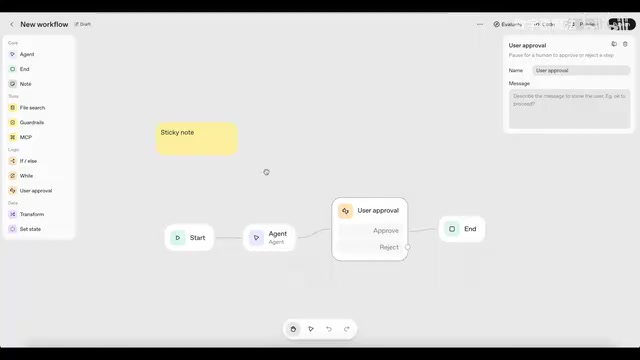
If there's one standout quality of Agent Kit, after hands-on experience it comes down to one word: simple.
Anyone who's used n8n knows its learning curve is quite steep—mountains of documentation, complex configurations, and many developers would rather write Python code directly than wade through n8n's docs. Since Agent Kit was just released, its features are basically foundational with few configuration options, making the barrier to entry very low.
But here's a key question: Is this simplicity a deliberate product design choice (feature), or merely a result of the initial version's lack of functionality (bug)? It's impossible to tell right now.
From a workflow flexibility standpoint, Agent Kit doesn't offer anything exceptional. Its simplicity is both its biggest selling point and its biggest limitation.
Agent Kit vs. Dify and n8n: Can It Replace Them?
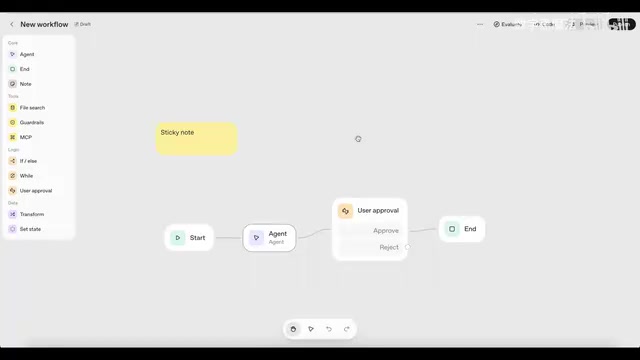
Many online claim that Agent Kit's launch will defeat products like n8n, Dify, and Coze, but this claim is clearly an overstatement.
The reasons are clear:
- Scenario limitations: Currently only supports conversation scenarios and text workflows, unable to cover complex needs like image processing or multimodal tasks
- Insufficient flexibility: Once workflows become complex, Agent Kit clearly lacks the processing capability
- High user migration costs: Users already proficient with Dify or n8n most likely cannot replicate their existing workflows on Agent Kit, making their willingness to switch extremely low
It may handle simple tasks, but claiming it can "replace" mature workflow platforms—Agent Kit is currently still at the prototype or even toy stage.
Why Did OpenAI Build Agent Kit? Two Layers of Strategic Intent
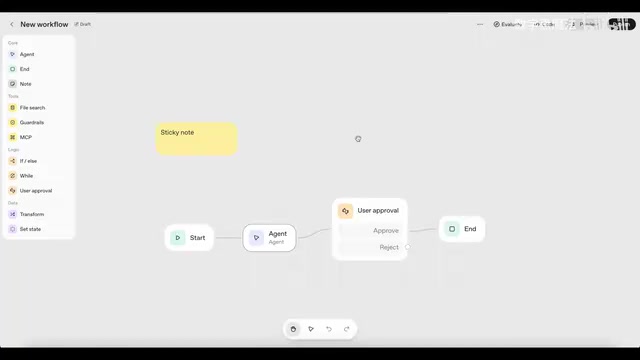
Since the product itself is still quite basic, why did OpenAI launch it at a developer conference? There are two layers of strategic consideration:
Transitioning from a Model Company to a Platform Company
OpenAI is learning to build products. It's no longer content being just a model company—it wants to become a large-scale platform with multiple products and business lines. In the hot AI workflow automation space, Agent Kit is its move to imitate mature products and claim ecosystem territory.
This transition follows the classic tech industry "infrastructure → platform → ecosystem" three-stage trajectory. Similar cases include: AWS expanding from cloud computing infrastructure into a developer platform with hundreds of services, and Apple evolving from a hardware manufacturer into the operator of the App Store ecosystem. For OpenAI, a pure model API business faces two structural risks: first, the commoditization of model capabilities—as competitors like Meta Llama, Google Gemini, and Anthropic Claude continue closing the gap, pure model calls become increasingly difficult to maintain at premium pricing; second, the fragility of customer relationships—if developers only interact through API calls, switching to competitors costs very little. By building platform tools like Agent Kit and App SDK, OpenAI is trying to increase developers' switching costs, transforming one-off API call relationships into deep platform dependencies.
Building a Data Flywheel Loop
Through Agent Kit's Evaluate module, OpenAI can systematically collect feedback data from user-Agent interactions. As task complexity increases, this data becomes a valuable resource for training stronger models. Rather than purchasing data externally, building in-house tools to create a data loop—this is Agent Kit's deeper value.
The Evaluate module may seem like just a simple thumbs-up/thumbs-down feature, but behind it lies RLHF (Reinforcement Learning from Human Feedback)—a core training paradigm. RLHF is one of the key technologies behind ChatGPT's success: first, human annotators rank model outputs by preference to train a Reward Model; then this Reward Model serves as a signal to fine-tune the language model through reinforcement learning algorithms like PPO (Proximal Policy Optimization). Traditional RLHF data collection is extremely expensive, requiring professional annotation teams. Through the evaluation system embedded in Agent Kit, OpenAI can collect user preference data at scale and low cost in real business scenarios, forming a positive flywheel of "user usage → feedback collection → model optimization → experience improvement → more user usage."
From every angle, Agent Kit's launch is more of a strategic positioning move than a current product competition play.
The Developer Conference's Awkwardness: The Gap Between Ambition and Reality
Looking back at the entire developer conference, compared to the first one, this edition was clearly underwhelming.
The reason isn't hard to understand: in today's intensely competitive environment, truly heavyweight announcements (like new model releases) can't wait for a developer day—they're released as standalone news well in advance. What's showcased at developer day is more about future positioning and ecosystem vision—"I hope everyone will contribute to this ecosystem together."
This precisely illustrates one fact: OpenAI is undoubtedly the leader at the model layer, but at the product layer, it still has a long way to go. Leading model capabilities don't automatically translate into product competitiveness—bridging that gap requires deep understanding of user needs, continuous polishing of product details, and long-term investment in ecosystem building.
Conclusion: Strategic Significance Outweighs Product Significance
Agent Kit is OpenAI's first step in the AI workflow space, with strategic significance far outweighing product significance. For everyday developers, if you just want to quickly build a simple conversational Agent, its low barrier to entry is genuinely attractive; but if you need complex automated workflows, mature tools like Dify and n8n remain the better choice for now.
As for whether Agent Kit can truly threaten these startups in the future, it depends on whether OpenAI can dramatically improve flexibility while maintaining simplicity—and that is precisely the hardest balance to strike in product design.
Key Takeaways
- OpenAI Agent Kit is a visual workflow building system that currently only supports conversation scenarios and text workflows, with relatively basic functionality
- Agent Kit's biggest feature is its simplicity, but its flexibility falls far short of mature products like Dify and n8n—it's still at the prototype stage
- Agent Kit's launch is more of a strategic play—helping OpenAI transition from a model company to a platform company while building a data collection flywheel
- Existing workflow tool users have low migration willingness, making it difficult for Agent Kit to replace current startup products in the short term
- The developer conference overall felt underwhelming, reflecting that while OpenAI leads in models, its product capabilities still have significant room for improvement
Related articles
Deep Dive into AI Agent Skill Design: …
Deep Dive into AI Agent Skill Design: Engineering Practices from Anthropic and Perplexity
A deep dive into Skill design philosophy from Anthropic's Claude Code team and Perplexity's Agent team, covering the Tax Test, Gotchas Flywheel, progressive disclosure, and Eval-First practices for building high-quality AI Agent skill systems.
Deep Dive into OpenAI's Official GPT-5…
Deep Dive into OpenAI's Official GPT-5.6 Prompting Guide: The Shift from Manual to Automatic
A deep dive into OpenAI's official GPT-5.6 Sol prompting guide: conciseness-first, outcome-oriented design, autonomy boundaries, tool routing, and reasoning intensity tuning.
 Deep Dives
Deep Dive into How OpenClaw (Open-Source Crayfish) AI Agent Works
Deep analysis of OpenClaw AI Agent internals: System Prompt, tool calling, SubAgents, Skill system, memory, and Context Engineering explained.