Deep Dive into OpenAI Agent Kit: Can It Replace Dify or n8n?

OpenAI Agent Kit is still basic and won't disrupt existing workflow platforms soon, but its strategy runs deep.
OpenAI's Agent Kit is a visual workflow building tool that's easy to start with but limited in capability—supporting only conversational scenarios and text processing, falling far short of mature platforms like Dify, Coze, and n8n in flexibility and ecosystem richness. OpenAI's strategic intent is to transition from a model company to a platform company while building a data flywheel through user feedback. The short-term threat is limited, but its 800M+ user base makes it impossible to ignore long-term.
OpenAI announced several updates at its second developer conference, among which Agent Kit—a visual workflow building tool—sparked widespread discussion. Some believe it will disrupt existing workflow platforms like Dify, Coze, and n8n, while others dismiss it as merely a "toy." This article provides an in-depth analysis of Agent Kit's real capabilities, strategic intent, and its actual impact on the existing AI workflow ecosystem.
Quick Overview: Four Major Updates from the OpenAI Developer Conference
The conference featured four main announcements:
- Sora 2 API Release: The video generation model officially opens its API
- Codex Fully Available: The code generation tool is no longer restricted in scope
- App SDK: Think of it as an upgraded version of GPTs, allowing developers to build embedded applications within ChatGPT, with the goal of connecting 800+ million users to the developer ecosystem
- Agent Kit: A visual workflow building system, and the focus of this article
The strategic intent behind App SDK is crystal clear—OpenAI wants to build an App Store-like ecosystem where developers contribute value to the platform. This approach closely mirrors Apple's playbook when it launched the App Store in 2008: Apple transformed the iPhone from a hardware product into a platform-level gateway by opening up to third-party developers. OpenAI currently has over 800 million users, a number that even exceeds the user base when the App Store first launched. However, it's worth noting that OpenAI's previous attempt with GPTs (custom GPT applications) wasn't exactly successful—the GPT Store failed to generate the expected thriving ecosystem after launch, with most GPTs seeing extremely low usage. App SDK can be viewed as a major correction to the GPTs strategy, shifting from "let users build it themselves" to "let professional developers build it." Whether this pivot will succeed remains to be seen.
Agent Kit, on the other hand, cuts directly into the red-hot AI automation workflow space.
What Exactly Is Agent Kit?
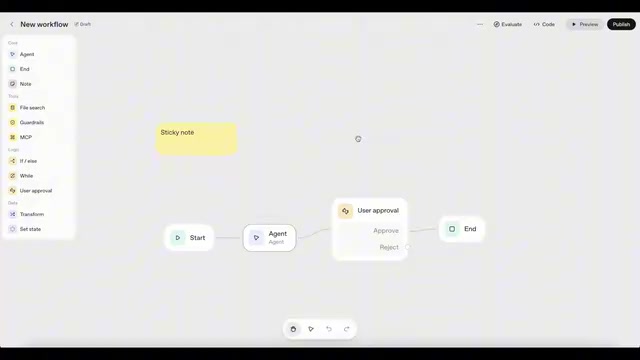
Agent Kit is essentially a visual workflow building system. Developers can define workflows by dragging and dropping nodes, including what processing nodes to add and how the workflow executes.
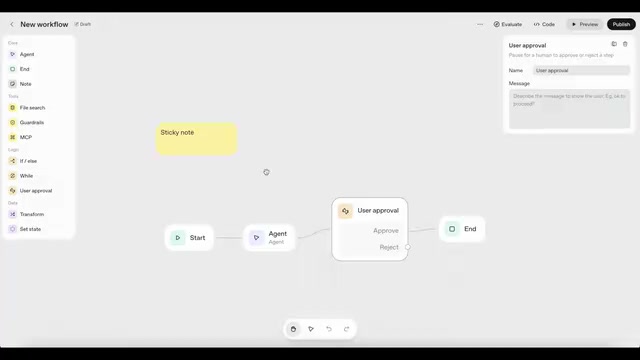
From an architectural perspective, Agent Kit currently has three core modules:
Agent Module: The Core Processing Unit
This is the system's core processing unit, essentially an OpenAI API call. It supports Function Calling and various parameter configurations, but there's a notable detail: the currently supported models do not include image generation models—it's limited to text-related workflow processing.
It's worth explaining Function Calling, a key technology here. Function Calling is a capability OpenAI introduced in 2023 that allows large language models to recognize user intent during conversations and generate structured JSON parameters to call external functions or APIs. This technology is the foundation for AI Agents to interact with the real world—the model no longer just generates text but can trigger actual actions like search engine queries, database operations, and sending emails. In Agent Kit, Function Calling serves as the "glue" between workflow nodes, enabling AI to automatically decide which tool to call next based on context. This is what fundamentally distinguishes it from traditional rule engines.
Evaluate Module: User Feedback Loop
This is a user feedback collection system. After interacting with an Agent, users can rate their experience, and the rating data is automatically stored in a database. Developers can use this positive and negative feedback data to fine-tune models, creating a continuous optimization loop.
Fine-tuning refers to further training a pre-trained large model using domain-specific or task-specific data to improve its performance in particular scenarios. Compared to training from scratch, fine-tuning requires significantly less data and computational resources while delivering substantial performance improvements. OpenAI currently offers fine-tuning APIs for models like GPT-4o, allowing developers to upload their own conversation data to customize model behavior. Agent Kit's Evaluate module productizes this process—every thumbs-up or thumbs-down from users automatically becomes a training signal for fine-tuning. This "use-it-to-train-it" model dramatically lowers the barrier to continuous optimization.
Conversation Interface: The Interaction Entry Point
After configuring the workflow, what's ultimately presented is a conversation interface. Users trigger workflow execution through dialogue, with the entire interaction model centered around conversational scenarios.
Agent Kit's Real Capabilities: Easy to Start, Limited in Function

After hands-on experience, Agent Kit's biggest advantage can be summed up in two words: simple enough and foolproof enough.
This precisely addresses a pain point of existing workflow tools. Take n8n as an example—many users find the learning curve far too steep, with extensive documentation to read and complex configurations to understand. For developers who can code, rather than spending time learning n8n's documentation system, it's often faster to just do it in Python.
When Agent Kit first launched, it had only basic functionality with limited configuration options and flexibility, but conversely, this made it extremely easy to get started. However, there's an interesting question here: Is this simplicity intentional product design (a Feature) or early-version incompleteness (a Bug)? It's currently impossible to tell.
The Core Gap Between Agent Kit and Dify, Coze, n8n
To understand this gap, you first need to know the competitive landscape of current AI workflow platforms. Dify is an open-source LLM application development platform focused on RAG (Retrieval-Augmented Generation) and Agent orchestration, with extremely high activity in the Chinese developer community. Coze is ByteDance's AI Bot building platform that leverages its massive user ecosystem and emphasizes zero-code AI application building. n8n is a more general-purpose automation workflow tool, similar to Zapier but with self-hosting support, featuring over 400 pre-built integration nodes that can connect to virtually all mainstream SaaS services. These three represent three different paths: open-source community-driven, big-tech ecosystem-driven, and general automation-driven.
Objectively speaking, Agent Kit currently has clear gaps compared to these mature workflow platforms:
- Limited scenarios: Only supports conversational scenarios, not multimodal workflows involving images or video
- Insufficient flexibility: Limited node types, unable to handle complex business logic
- Closed ecosystem: Currently only supports OpenAI's own models, unlike Dify and n8n which can integrate multiple models and third-party services

Therefore, claims online that Agent Kit will "beat n8n, beat Dify, beat Coze" are indeed exaggerated. It may handle simple tasks adequately, but once workflows become complex, Agent Kit clearly lacks the processing capability. At this stage, it's more like a prototype or proof-of-concept product.
Why OpenAI Built Agent Kit: Two Layers of Strategic Thinking
Since Agent Kit's current capabilities are limited, why did OpenAI launch it? There are two layers of strategic thinking worth examining.
Transitioning from a Model Company to a Platform Company
OpenAI is gradually transforming from a pure model company into a multi-product, multi-business-line tech giant. In the AI automation space, it's choosing to emulate and learn from product forms that have already been proven successful. Agent Kit represents OpenAI's initial foray into the workflow automation space.
This transformation isn't unique to OpenAI—it's a shared trend across the entire AI industry. The business model of relying purely on model API fees faces serious challenges: on one hand, open-source models (such as Meta's Llama series, Mistral, etc.) are continuously narrowing the performance gap with closed-source models, compressing API pricing power; on the other hand, model capability homogenization is becoming increasingly apparent, with various large models showing diminishing performance differences on routine tasks. This forces AI companies to extend upstream, creating higher user stickiness and commercial value by building application and platform layers. Anthropic launched Claude Artifacts and Projects, Google built the enterprise-grade AI platform through Vertex AI—all different implementations under the same logic.
Strategic Data Flywheel Layout
Through Agent Kit, OpenAI can collect massive amounts of real workflow interaction data. As task complexity increases, this data becomes increasingly valuable. Rather than purchasing training data externally, building their own tools to acquire first-hand user feedback enables training more powerful complex-task processing models. The Evaluate module's design is a direct manifestation of this strategy.
The Data Flywheel is a core business and technical concept in AI, originally evolved from Amazon's "flywheel effect." The basic logic is: more users use the product → more interaction data is generated → data is used to train better models → better models attract more users, forming a self-reinforcing positive cycle. Tesla's autonomous driving is a classic data flywheel example—every Tesla on the road contributes training data to its self-driving system. By collecting positive and negative user feedback on AI outputs through Agent Kit's Evaluate module, OpenAI is essentially acquiring human preference data at extremely low cost. This data can be directly used for RLHF (Reinforcement Learning from Human Feedback) training, continuously improving model performance in complex task scenarios.
Impact on Existing Workflow Platforms Like Dify and n8n
For existing platforms like Dify, Coze, and n8n, Agent Kit's emergence is both a threat and an opportunity.
In the short term, the threat is limited. Users who have already mastered these tools will most likely not switch to Agent Kit, because their existing complex workflows simply cannot be replicated on Agent Kit. The users Agent Kit can currently attract are primarily those who have never touched workflow tools before.
In the long term, it cannot be ignored. With over 800 million users and powerful model capabilities, once Agent Kit continues to iterate and improve, its low barrier to entry and ecosystem integration capabilities could very well erode a portion of the market share.
For existing platforms, the top priority is to continue building moats in flexibility, multimodal support, and multi-model compatibility—precisely the areas where Agent Kit will struggle to catch up in the short term.
Conclusion: Model Pioneer, Product Novice
Looking at the developer conference as a whole, OpenAI's ambition is clearly visible, but so is its struggle. In a fiercely competitive environment, truly blockbuster news (like new model releases) often can't wait for a developer conference and gets announced separately. What's shown at conferences tends to be more about future positioning and ecosystem vision, which is why many felt this round of updates was "underwhelming."
OpenAI is undoubtedly a pioneer and leader in the model space, but in product building, it still has a long way to go. Agent Kit is an early attempt in the right direction, but it still needs multiple iterations and market validation before it can truly disrupt the existing workflow ecosystem. For developers, staying attentive but not rushing to migrate is the most rational choice right now.
Key Takeaways
- OpenAI Agent Kit is a visual workflow building system that currently only supports conversational scenarios and text workflows, with relatively basic functionality
- Agent Kit's biggest advantage is ease of use, but it falls far short of mature platforms like Dify, Coze, and n8n in flexibility and feature richness
- OpenAI's strategic intent behind Agent Kit includes transitioning from a model company to a platform company and building a data flywheel through user interaction data
- In the short term, Agent Kit poses limited threat to existing workflow platforms—complex workflows built by existing users cannot be replicated on Agent Kit
- OpenAI is a pioneer in the model space but still in a learning and catching-up phase when it comes to product building
Related articles
Deep Dive into AI Agent Skill Design: …
Deep Dive into AI Agent Skill Design: Engineering Practices from Anthropic and Perplexity
A deep dive into Skill design philosophy from Anthropic's Claude Code team and Perplexity's Agent team, covering the Tax Test, Gotchas Flywheel, progressive disclosure, and Eval-First practices for building high-quality AI Agent skill systems.
Deep Dive into OpenAI's Official GPT-5…
Deep Dive into OpenAI's Official GPT-5.6 Prompting Guide: The Shift from Manual to Automatic
A deep dive into OpenAI's official GPT-5.6 Sol prompting guide: conciseness-first, outcome-oriented design, autonomy boundaries, tool routing, and reasoning intensity tuning.
 Deep Dives
Deep Dive into How OpenClaw (Open-Source Crayfish) AI Agent Works
Deep analysis of OpenClaw AI Agent internals: System Prompt, tool calling, SubAgents, Skill system, memory, and Context Engineering explained.