Deepfake Detectors Fail in the Diffusion Model Era: Why AUC Is No Longer a Reliable Metric

Red team testing shows deepfake detectors collapse under real-world conditions, exposing AUC's limits.
A researcher's red team benchmark reveals that mainstream deepfake detectors, often boasting high AUC scores, suffer massive performance collapse when tested with platform-realistic perturbations like JPEG recompression and resolution scaling. The study highlights why AUC is a misleading metric for high-stakes applications like KYC, and how diffusion models pose fundamentally new challenges for detection. With open-sourced datasets on HuggingFace, the research invites the community to collaboratively stress-test detectors under real-world conditions.
A Red Team Test That Exposed the Industry's Achilles' Heel
As AI-generated images become increasingly realistic, deepfake detectors are seen as the last line of defense for digital trust. Whether in academic papers or commercial products, these detection models often tout their capabilities with impressively high AUC (Area Under the Curve) scores. However, a benchmark test recently shared by a researcher on Reddit has thrown cold water on these seemingly stellar report cards.
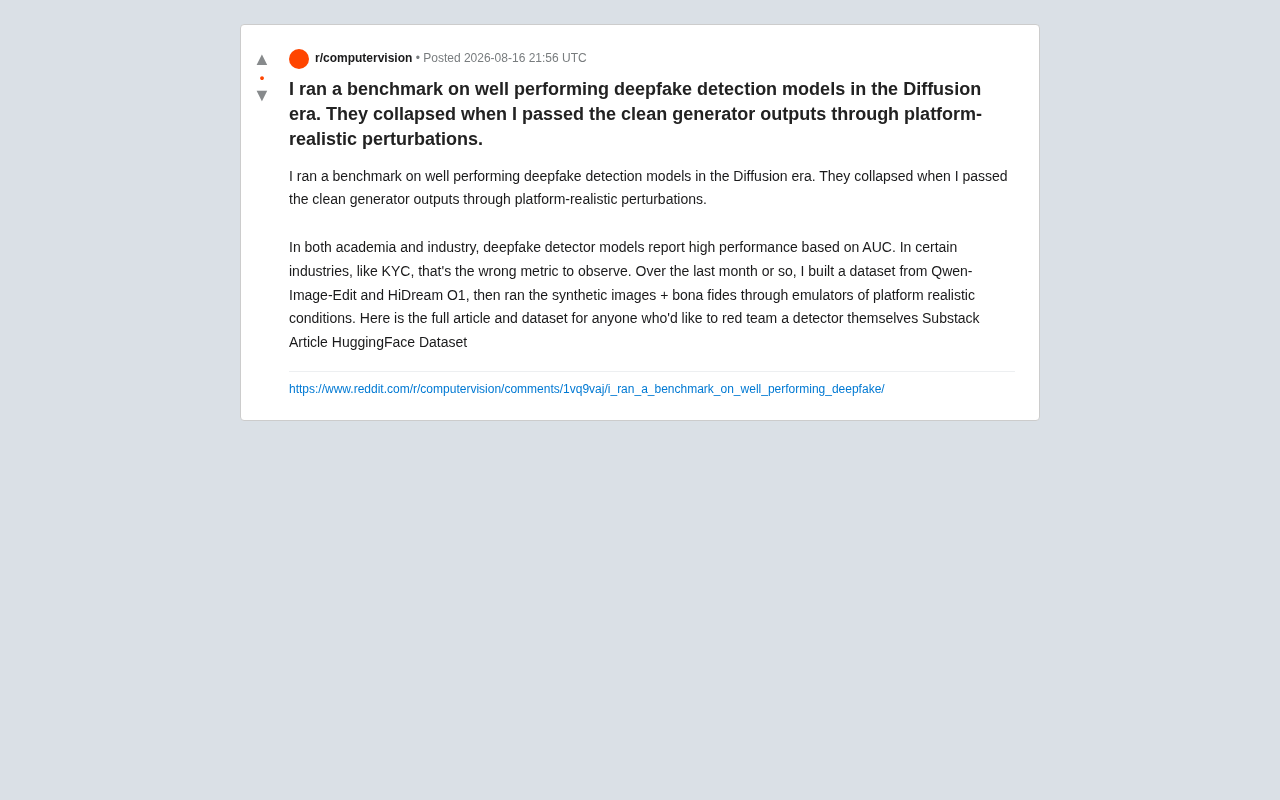
The researcher spent about a month building a comprehensive evaluation pipeline centered on today's mainstream diffusion models. They used Qwen-Image-Edit and HiDream O1 — two generative models — to create synthetic images, then fed these alongside real images (bona fides) through a processing pipeline that simulates real-world platform conditions. The results were alarming: detection models that performed brilliantly on standard tests experienced massive performance collapse when confronted with image perturbations that mimic real-world scenarios.
Why AUC Is a Misused Metric for Deepfake Detection
The researcher's core argument is highly insightful: in certain high-risk industries, AUC is simply the wrong metric to be watching.
AUC (Area Under the ROC Curve) is one of the most commonly used evaluation metrics in machine learning classification tasks. The ROC curve plots the False Positive Rate on the x-axis against the True Positive Rate on the y-axis, illustrating model performance across different classification thresholds. An AUC of 1.0 represents perfect classification, while 0.5 represents random guessing. Its strength lies in being threshold-agnostic, providing a holistic overview of a model's discriminative ability. However, this is also its fatal flaw: in real-world deployment, the system must select a specific threshold to make binary decisions, and AUC tells us nothing about how the model actually performs around that threshold. In scenarios with severe class imbalance or where the business has near-zero tolerance for a particular type of error, AUC can produce misleadingly optimistic assessments.
Why AUC Doesn't Work for KYC Identity Verification
Take KYC (Know Your Customer) as an example — this is a critical compliance step in industries like finance and cryptocurrency. KYC is a core regulatory requirement in the financial system, mandating that financial institutions verify a customer's true identity before establishing a business relationship. In the digital age, remote KYC processes typically involve users uploading ID document photos, undergoing liveness detection, and face-to-document matching. Deepfake technology poses a direct threat to KYC — attackers can use AI to generate convincing fake ID photos, or even use real-time face-swapping to fool liveness detection cameras. Once a forged identity passes verification, attackers can open accounts for money laundering, fraud, and other illegal activities. A single missed detection could result in losses of millions of dollars and severe regulatory penalties.
In such scenarios, a single false negative (classifying a forged identity as real) could mean massive financial losses or serious compliance risks. AUC measures a model's overall ranking ability across all classification thresholds — it reflects a kind of "good on average" performance while masking what really happens at specific operational thresholds.
In other words, a model with an AUC as high as 0.99 could perform terribly in the low false-positive-rate range required for actual deployment. For applications like KYC that are extremely sensitive to specific operating points, we should focus on recall at fixed false positive rates (e.g., how many forged samples can be caught at a 0.1% false positive rate), or precision and miss rates at specific thresholds — not a sweeping area under a curve.
Platform-Level Image Perturbations: The Real-World Litmus Test for Detection Models
The most valuable part of this test was the introduction of platform-realistic perturbations.
The Vast Gulf Between Clean Lab Output and the Real World
The vast majority of deepfake detection models are trained and evaluated on "clean" generator outputs. In reality, however, an image has typically undergone multiple rounds of transformation before it ever reaches a detection system. When users upload images to social platforms or messaging apps, the images go through a series of automated processes: first, JPEG recompression (typically reducing the quality factor to 70-85 to save bandwidth and storage), then resolution scaling (large images are downsampled to the platform's maximum allowed size), possibly color space conversion (e.g., from Adobe RGB to sRGB), EXIF metadata stripping (removing device info, GPS data, etc.), and certain platform-specific sharpening or denoising algorithms. These processes are nearly imperceptible to the human eye, but they can be catastrophic for deepfake detectors — detectors typically rely on pixel-level micro-anomalies, high-frequency noise patterns, or generator signatures embedded in compression artifacts, and platform processing systematically destroys or overwrites these signals.
The researcher exposed the fragility of detection models by simulating precisely these common platform image processing pipelines. After synthetic images go through this "baptism," the subtle generator fingerprints that detectors rely on are largely wiped away, causing a dramatic decline in discriminative ability. This finding demonstrates that a detector that performs perfectly in the lab may become virtually useless once it enters a real content distribution environment.
The Entirely New Challenges Diffusion Models Bring to Deepfake Detection
It's worth noting that this test specifically chose generation models from the diffusion era. Diffusion Models work by gradually adding Gaussian noise to data through a forward process until it becomes pure noise, then training a denoising network to learn the reverse process — progressively recovering clean images from noise. Representative architectures include DDPM, Stable Diffusion, DALL·E 3, and others. Unlike GANs (Generative Adversarial Networks), diffusion models don't rely on adversarial training, producing more stable generation processes and outputs whose pixel-level and frequency-domain statistics more closely match those of real photographs.
Compared to earlier GANs, diffusion model-generated images exhibit superior texture coherence and detail naturalness, leaving behind detectable traces that are inherently fewer and more subtle. GAN-generated images often leave "fingerprints" in the high-frequency spectral range that detectors can capture, whereas diffusion models — due to their step-by-step denoising generation mechanism — produce frequency-domain anomalies that are weaker and more irregularly distributed, significantly undermining the effectiveness of traditional frequency-domain analysis or GAN fingerprint-based detection methods. When these already elusive traces are compounded with platform perturbations, detection difficulty increases exponentially. This explains why detection methods that "used to work" face the risk of systematic failure in the diffusion era.
Open Datasets: Inviting the Community to Red Team Together
The researcher didn't stop at identifying problems. They published a full analysis article on Substack and open-sourced the constructed dataset on HuggingFace, openly inviting anyone interested to red team the detectors.
HuggingFace is currently the world's largest open-source platform for sharing AI models and datasets, often called the "GitHub of AI." The platform hosts over 500,000 pretrained models and 100,000 datasets spanning natural language processing, computer vision, audio processing, and more. By open-sourcing the dataset on HuggingFace, the researcher made it freely downloadable for anyone to test their own detection models, dramatically lowering the barrier to reproduction and verification.
Red Teaming originates from adversarial simulation concepts in military exercises, has been widely adopted in cybersecurity, and in recent years has become a key methodology for AI safety evaluation. In the AI domain, red teaming refers to professional personnel or community members proactively attempting to break, deceive, or circumvent an AI system's safety mechanisms to discover potential vulnerabilities. Organizations like OpenAI and Google DeepMind conduct large-scale red team testing before releasing major models. For deepfake detectors, red teaming means systematically constructing adversarial samples that can evade detection, including but not limited to: adversarial perturbations, image post-processing, and outputs from novel generators. Open red teaming, by inviting a broad range of external participants, can cover attack vectors that internal teams might overlook.
This open attitude deserves recognition. The offense-defense dynamic of deepfake detection is fundamentally a continuous arms race, and no single team can cover every attack surface. By open-sourcing the dataset, the researcher enables more developers to validate their models' robustness under near-real-world conditions, rather than continuing to bask in inflated AUC scores from the lab.
Three Core Takeaways for the Deepfake Detection Industry
Although modest in scale, this test strikes at several critical pain points in the current deepfake detection landscape:
First, evaluation metrics must align with business scenarios. For high-risk applications like KYC and content moderation, a blanket AUC should not serve as the sole or primary acceptance criterion. Instead, more business-relevant metrics should be adopted, such as recall at fixed false positive rates (e.g., TPR@FPR=0.01%), partial AUC (pAUC, calculating curve area only within the low false positive rate range), and others. These metrics directly reflect model performance at actual decision points, preventing teams from being misled by aggregate statistics.
Second, robustness evaluation should be standard practice. Any detection model claiming production readiness should be tested under platform-level perturbation conditions, not just benchmarked on clean generator outputs. Evaluation protocols should include combinatorial testing across multiple compression qualities, multiple resolution scaling ratios, and multiple social platform simulation pipelines, forming a systematic robustness assessment matrix.
Third, adversarial offense-defense requires open collaboration. Facing the ever-evolving generative capabilities of diffusion models, siloed detection research is destined to fall behind. Open-source datasets and red teaming mechanisms are viable paths to ensuring detection technology truly keeps pace with generation technology. Official evaluation programs like NIST's FRVT (Face Recognition Vendor Test) should also promptly update their testing conditions to incorporate the latest generative models and real-world perturbations.
As generative model capabilities continue to leap forward, our standards for evaluating detection technology should become equally rigorous and pragmatic. This seemingly modest benchmark test serves as a pointed reminder to the entire industry: don't be dazzled by beautiful numbers — the real world is far harsher than any test set.
Related articles

Why Does the Tesla Roadster Need to Fly? A Deep Dive into Musk's Wild Demo
Tesla's Roadster launch showed wall-climbing, upside-down driving, and flying stunts—but The Vergecast notes the demo car may lack a battery, the Rocket version is invite-only and not street-legal, and the website terms don't guarantee delivery. After nine years of delays, why does this car still need to exist?

AI Is Not a Replacement: Human-AI Collaboration Through the Lens of Factory Root Cause Analysis
Starting from factory root cause analysis, this article explains how AI accelerates evidence chain construction rather than replacing human experts, exploring the pragmatic implementation logic and business value of 'AI supporting people rather than replacing them.'

AI Agent Decision Auditing: Building an Evidence Chain in Regulated Workflows
Starting from a Reddit discussion, this article analyzes three core issues in AI agent decision auditing within regulated workflows: what fields audit records should contain, how to handle feedback latency for erroneous decisions, and how to continuously calibrate LLM judge consistency with human judgment.