DeepSeek 1017 Hands-On: All 11 Benchmarks Up, Costs Down 91%, Ready to Ship Projects

DeepSeek 1017: all 11 benchmarks up, costs plunge, moving toward direct project delivery.
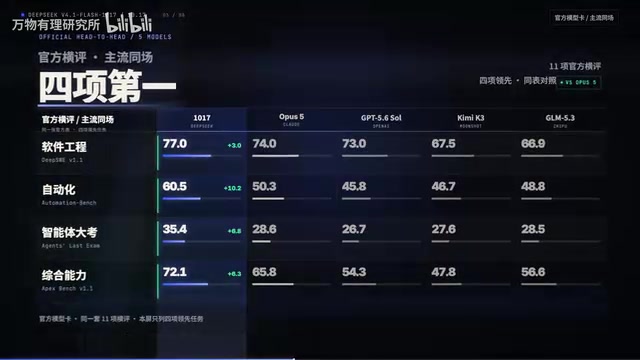
DeepSeek's October 17 1017 release officially claims all 11 benchmarks rose, averaging 5.2 points, with terminal tasks up 11.1 and coding up 8.8 most notably, plus four leads over Opus 5 in cross-comparison. Costs dropped 76-91%, with a creator testing 460M tokens for about 24 yuan. More critically, it generates complete runnable projects like a web racing game, portal, and 3D Forbidden City from a few prompts, 1.3-14x faster. Specs remain 552B parameters, 1M context, image input, and MIT open source. The article sees this as a systematic enhancement around executability, though official details need third-party verification.
DeepSeek's 1017 release, pushed on October 17, comes with an official scorecard showing gains across all 11 capability benchmarks, averaging a 5.2-point improvement, while driving costs down to roughly one-tenth of previous levels. The more important shift is in project delivery capability—generating complete, runnable projects from just a few prompts—which moves it a step closer from "assisting with code" to "actually delivering work." This article combines official evaluation data with creator hands-on tests to break down the real value of this upgrade.
All 11 Up, Terminal and Coding Are the Biggest Winners
Official cross-comparison shows the 1017 version improved on all 11 benchmarks, averaging a 5.2-point gain. Among these, terminal tasks rose 11.1 points and coding capability rose 8.8 points—the two most notable improvements.
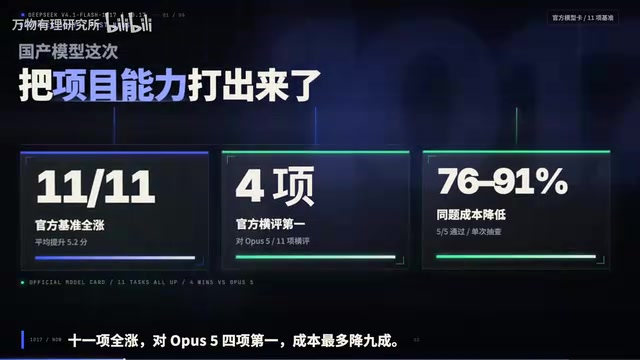
This distribution is worth noting: terminal tasks and coding happen to be the most demanding areas for Agent deployment—the former tests the model's stability in multi-step command execution, while the latter determines whether generated code can actually run. Both surging at once suggests this upgrade isn't a single-point tune-up but a systematic enhancement built around "executability."
Compared with competitors in the same table, 1017 takes four leads over Opus 5. GPT, Kimi, and GLM also appear in the same comparison table—the fact that the official team chose to put them all together itself signals confidence in these results. However, the cross-comparison is official-led, and the specific test set composition and scoring details aren't fully disclosed; readers should remain cautious about the "four firsts" conclusion and wait for third-party reproduction before making a final judgment.
From Prompt to Complete Project: The Significance of Four Demo Projects
In the official demos, 1017 built four complete projects directly from a few prompts: a web-based racing game, a portal, a 3D Forbidden City, and a historical scene. The same tasks passed all five tests, with execution 1.3 to 14 times faster.
"Generating a complete project from a few prompts" and "completing a snippet of code" are capabilities of different magnitudes. The former requires the model to handle requirement decomposition, file organization, dependency management, and debugging loops on its own—if any link breaks, nothing runnable gets delivered. Projects like a web racing game involve physics simulation and interaction logic, while 3D scenes involve rendering pipelines—both are tasks with little room for error.
The 1.3 to 14 times speed range is wide, likely related to task complexity: simple tasks see limited gains, while complex multi-step tasks benefit from reduced back-and-forth trial and error, yielding more obvious speedups. The practical significance for development is that the waiting cost for long-chain tasks is significantly compressed.
Agent capability is the key background for understanding this upgrade. Agents refer to models that no longer just passively respond to a single prompt, but can autonomously plan steps, call tools, execute multiple rounds of operations, and check results until the goal is complete. Terminal tasks are the typical proving ground for agents: the model needs to understand the semantics of shell commands, judge the next action based on output, and self-correct when errors occur. Such tasks demand extremely high long-chain stability—any misjudgment at any step can lead to total failure downstream. 1017's 11.1-point gain on terminal tasks means its fault tolerance and self-repair capabilities in multi-step command execution have substantively improved. This is also the technical foundation that makes "generating complete projects directly from prompts" possible—generating a project is essentially a long-chain agent task requiring decomposition, execution, and debugging loops.
Costs Down 76% to 91%, 460 Million Tokens for About 24 Yuan
The cost side has seen equally aggressive changes. Official data shows costs reduced by 76% to 91%. One creator used it to consecutively complete three types of tasks—modeling, Lego, and short film—consuming a cumulative 460 million tokens at a cost of about 24 yuan.
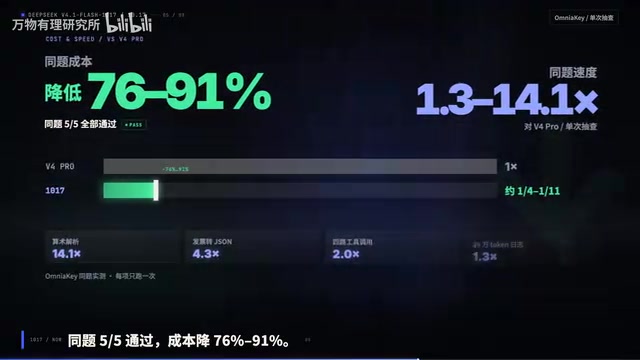
Put these two numbers together: 460 million tokens for 24 yuan means the per-token cost has been pushed to an extremely low level. In the past, "letting the model repeatedly trial-and-error until it runs" was a luxury usage; now this iterative development approach has become economically viable. Cost reduction and project capability improvement compound—what actually changes is the workflow: developers can more confidently hand complete modules to the model for repeated refinement, rather than just having it write scattered functions.
It's worth noting that the 76% to 91% reduction range is wide; actual savings will vary by task type and invocation method, so budgets shouldn't be estimated directly at the upper bound.
Specs Haven't Shrunk: 552B Parameters, 1M Context, MIT Open Source
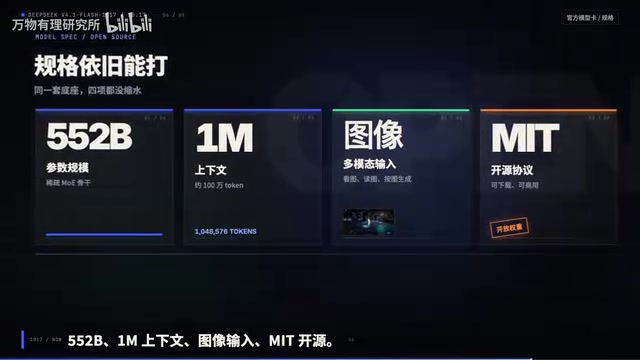
While capabilities rose, the base specs remain unchanged: 552B parameters, 1M context, image input support, and the MIT open-source license.
Each of these carries weight. The 1M context allows the entire codebase of a medium-sized project to fit into context at once—the model doesn't need to rely on fragmented retrieval to understand the global structure, which is one of the prerequisites for "directly delivering projects." Image input lets the model read design mockups, UI screenshots, and even error screenshots, reducing description costs. The MIT license is especially friendly for commercial teams, with minimal legal barriers to integration and redistribution.
Parameter scale didn't balloon while capabilities improved, indicating the gains come mainly from training methods and data quality rather than brute-force compute. This is also good for inference cost control.
Context window refers to the total number of tokens a model can hold simultaneously in a single inference pass—it directly determines "how much the model can see at once." A 1M-token context roughly corresponds to hundreds of thousands of Chinese characters or the scale of a medium-sized code repository. In traditional development workflows, the model can only see code snippets that are retrieved or pasted in, making it hard to grasp inter-module call relationships and global architecture; a million-level context allows the entire project to be loaded at once, enabling the model to perform dependency analysis and consistency modifications with a complete view. However, context length isn't entirely equivalent to actual effective utilization capability—the "lost in the middle" phenomenon in long contexts may still exist. So this spec is a necessary prerequisite, but whether the model can truly grasp the whole picture depends on the quality of its long-range attention.
The MIT open-source license is an extremely permissive software license that allows users to freely use, modify, merge, publish, and redistribute code, including for commercial closed-source products, with the main obligation being to retain copyright and license notices. For commercial teams, this means minimal legal review burden when integrating the model into internal tools or external products, and no worry about copyleft-style viral open-source obligations. However, "open-sourcing model weights" and "open-sourcing training data and methods" are different matters—the MIT license covers code and weight distribution, and usage boundaries should still be confirmed against specific release terms before commercial use.
Getting Started Tips and What Needs Verification
For developers, the most worthwhile scenario to try with 1017 is end-to-end small projects: give it a clear requirement and see whether it can independently complete the entire process from scaffolding to a runnable state. The 11.1-point gain on terminal tasks means agent-style multi-step operations are more reliable—suitable for running automation scripts and build processes.
At the same time, several things need independent verification: the specific test sets in the official cross-comparison, the distribution of the 1.3 to 14 times speedup, and the full task complexity of the 460-million-token case. Official data typically uses favorable conditions, and real-world experience will have discounts—but even with discounts, this round's improvement magnitude and cost reduction remain considerable.
From "can write code" to "can deliver projects," what lies between is long-chain stability and trial-and-error cost. 1017 has delivered improvements on both fronts simultaneously—worth running through yourself before drawing conclusions.
One-line Summary
DeepSeekAd 1017 sees all 11 benchmarks rise, costs plunge, moving toward direct project delivery.
Paragraph Summary
DeepSeek's 1017 release, pushed on October 17, officially claims all 11 benchmarks rose, averaging a 5.2-point improvement, with terminal tasks up 11.1 points and coding up 8.8 points being the most prominent, and takes four leads over Opus 5 in cross-comparison. Costs dropped 76% to 91%, with one creator testing 460 million tokens for only about 24 yuan. More critically, project delivery capability: complete runnable projects like a web racing game, portal, and 3D Forbidden City can be generated from just a few prompts, 1.3 to 14 times faster. Base specs remain 552B parameters, 1M context, image input, and MIT open source. The article views this upgrade as a systematic enhancement around "executability," but official cross-comparison details aren't fully disclosed, and speedup ratios and cost cases still need independent third-party verification.
Related articles

Gemini 4 Argon Hands-On: AI Builds Board Games, Constructs Temples, and Trains Robots Autonomously
Gemini 4 Argon hands-on roundup: AI autonomously builds a desk racetrack and temple in Blender, writes a ray tracing engine, trains a humanoid robot to sink 7 shots, plus API pricing and developer access.

The Magic Octagonal Coin: Why Only 9% of People Can Predict Its Flip?
Only 9% of people can correctly predict the Magic Octagon coin flip. This article explains its spatial rotation mechanism, common cognitive pitfalls, and a new hypothesis based on Relevance Theory, exploring the limits of human spatial reasoning.

Sam Altman: AI Is Entering the Era of Scientific Discovery — Math Breakthroughs Will Replicate in Biology and Energy
Sam Altman says AI is entering the era of scientific discovery — math breakthroughs will replicate in biology, materials science, and energy to help develop new drugs and energy sources.