DeepSeek + Cursor + DevBox: Complete Project Development and Deployment with Zero Coding Experience
Build and deploy complete projects with zero coding using DeepSeek + Cursor + DevBox.
This article introduces a zero-code project development workflow using three core tools: DeepSeek (handling database and API design), Cursor (an AI-driven code editor that generates full-stack code from natural language and intelligently fixes bugs), and DevBox (cloud-based environment setup and deployment built on Sealos). It also analyzes AI's dual impact on the IT industry: basic CRUD roles face replacement pressure, while demand is surging for hybrid talent who understand business and can leverage AI tools.
In the AI Era, You Don't Need to Code to Build Projects
Want to quickly build a website or application but have absolutely no programming background? Racing to finish your graduation project but stuck on the technical side? Or simply curious — can you really build a project without writing code?
The answer is: yes, and the barrier is much lower than you might think.
This article introduces a proven zero-code project development workflow built around three core tools: DeepSeekAd + Cursor + DevBox. From project design and front-end/back-end development to deployment, the entire process requires no hand-written code, enabling someone with zero technical background to independently deliver a complete project.
The AI Model Explosion: Challenges and Opportunities for the IT Industry
Since ChatGPT launched in late 2022, AI large language models have entered an explosive growth phase. Internationally, the GPT series continues to iterate, while domestically China has seen products like Baidu's ERNIE Bot, Alibaba's Tongyi Qianwen, iFlytek's Spark, and ByteDance's Doubao. But the most talked-about model around Chinese New Year 2025 was undoubtedly DeepSeek — matching OpenAI O1 in performance while costing less than 3% to train, leading many to call it "a national-level scientific breakthrough."
DeepSeek was developed by the company DeepSeek (深度求索). Its core breakthrough lies in adopting a Mixture of Experts (MoE) architecture and Multi-head Latent Attention (MLA). The MoE architecture is key to understanding DeepSeek's low-cost, high-performance approach: traditional dense models activate all parameters during inference, whereas MoE models partition parameters into multiple "expert networks," activating only a few experts per inference while the rest remain dormant. DeepSeek-V3 has 671B total parameters but activates only about 37B per token during inference, maintaining the expressive power of a super-large model while reducing computational cost by approximately 80% — this is the fundamental reason its training and deployment costs are far lower than comparable models, and how it matches OpenAI O1 on benchmarks like mathematical reasoning and code generation at a fraction of the cost.
AI is profoundly transforming finance, healthcare, education, transportation, and virtually every industry. For IT professionals, the impact is even more direct.
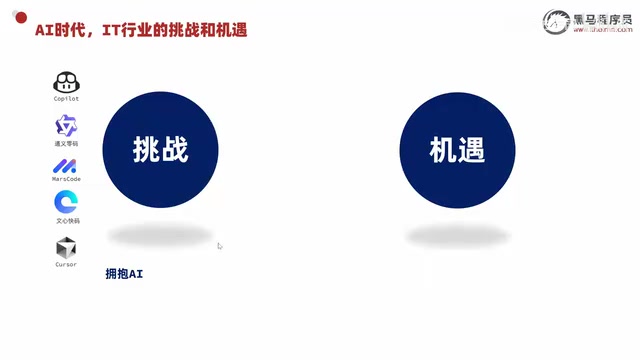
Challenge: Entry-Level Development Roles Face Replacement Pressure
Copilot, Tongyi Lingma, Cursor, Baidu Comate… AI code generation tools are becoming increasingly mature, and junior developers who only know how to write CRUD genuinely face the risk of being replaced.
CRUD stands for Create, Read, Update, and Delete — the four basic database operations — and refers to the most fundamental, repetitive business logic implementation in software development: writing CRUD APIs, assembling SQL statements, handling form submissions, etc. These tasks follow fixed patterns with simple logic, which is precisely the scenario where current AI code generation tools excel. A 2023 McKinsey research report shows that approximately 60-70% of coding tasks in software development can be automated by AI tools, creating substantial career pressure for junior developers whose primary work consists of CRUD operations.
Developers in this new era need to shift their learning focus to higher-level capabilities:
- Project architecture design
- Debugging and performance optimization
- Solution design for complex business scenarios
These are the core competencies that AI cannot fully replace in the short term.
Opportunity: AI Is Creating Massive New Demand
AI is driving innovation and reshuffling across industries. Large numbers of software systems need upgrades or even complete rebuilds, and market demand is being rapidly unleashed. Hybrid talent who understands business and can proficiently use AI tools is exactly what companies need most urgently.
Breaking Down the Trio: What DeepSeek, Cursor, and DevBox Each Do
The core philosophy of this workflow is to let each tool handle its specialty, forming a complete closed loop from design to development to deployment.
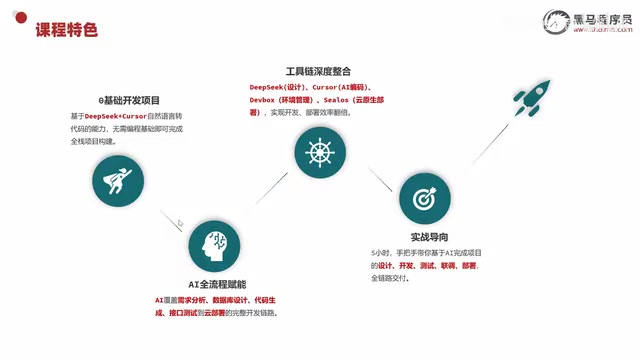
DeepSeek — Handles Project Design
DeepSeek plays the role of "AI architect" in the workflow, primarily accomplishing two things:
- Database schema design: Feed it page prototypes and requirements documents, and it automatically outputs well-structured table designs
- API documentation design: Combining page prototypes, requirements documents, and interface templates, it generates complete API documentation
This work previously required experienced architects or senior developers to spend significant time on. Now, as long as you describe the requirements clearly, DeepSeek can deliver a usable design in minutes. DeepSeek's powerful capabilities in code generation and logical reasoning stem from deep learning on large-scale code corpora and mathematical reasoning data during training, enabling it to understand business semantics and map them into standardized technical design documents.
Cursor — Handles Code Generation
Cursor is the most critical component in this workflow. It's essentially an AI-driven code editor developed by Anysphere, deeply rebuilt on the VS Code open-source framework. Unlike plugin-based approaches like GitHub Copilot, Cursor embeds AI capabilities directly into the editor core, enabling it to perceive the entire project's code context and generate code with higher coherence and accuracy. Its Agent mode can even autonomously plan tasks, invoke terminal commands, and iteratively fix errors, achieving an experience close to "autonomous programming."
Its core capabilities include:
- Writing code in natural language: Describe the functionality you want in plain language, and Cursor automatically generates front-end and back-end code
- Intelligent bug fixing: When you encounter an error, just screenshot it and send it to the AI — it will automatically analyze the cause and fix it
- Full-stack coverage: Front-end pages, back-end APIs, and database operations can all be accomplished through natural language instructions
Behind this is the true realization of the natural language programming concept. Natural language programming isn't new — scholars proposed the idea of describing program logic in English as early as the 1970s, but it remained theoretical due to NLP technology limitations. The real turning point came after the Transformer architecture (2017) and the rise of large-scale pre-trained language models — current mainstream LLMs can cover approximately 70-80% of routine business logic in code generation, making "tell it what you want without needing to know how to implement it" a reality.
DevBox — Handles Environment Setup and Deployment
DevBox is built on the Sealos cloud operating system and specifically solves the most frustrating problem in development: environment configuration. Sealos is a cloud operating system built on Kubernetes as its kernel, developed by a Chinese team and fully open-source. DevBox's core philosophy is containerizing development environments — each project runs in an independent container sandbox, completely eliminating the "it works on my machine" problem.
Related articles
 Tutorials
ChatGPT Plus Subscription Guide: Are GPT-5.5, image-2, and Codex Worth the Upgrade?
A detailed look at ChatGPT Plus features — GPT-5.5, image-2, and Codex — with a Plus vs Pro comparison and a complete step-by-step subscription guide for users outside the US.
 Tutorials
Harness AI Engineering in Practice: Using Claude Code to Master Enterprise-Level E-Commerce Development
Deep dive into Harness AI Engineering: master enterprise e-commerce development with Claude Code using the Rules, Skills, Wiki, and Changes framework.
 Tutorials
Cursor + Codex Dual-IDE Collaboration: A Practical Methodology for Open-Source Project Customization
A complete methodology for open-source project customization based on real-world experience, detailing the Cursor+Codex dual-IDE workflow, seven-stage process, MVP validation, and AI source code reading techniques.