DeepSeek Harness: 230K Stars in 40 Days — But Hold Off on Production

DeepSeek's official MIT-licensed Agent framework hit 230K stars in 40 days — but it's still Alpha.
DeepSeek has moved beyond models to build its own runtime layer: DeepSeek Harness (DH) separates intelligent decision-making from execution under the formula "Model + Harness = Agent." Built on a microkernel "everything is a plugin" architecture with 54 pluggable modules and 64 tool types, it's model-agnostic under MIT license and includes compatibility layers for both Claude Code and Codex hooks. It hit 230K stars in 40 days. That said, DH remains at v0.1.7 Alpha with breaking changes explicitly warned, and its command execution and file I/O capabilities make it unsuitable for production — best treated as an ecosystem position to watch, not deploy.
An Official Agent Framework from DeepSeek
DeepSeekAd isn't just building models anymore — this time, they've stepped into the runtime layer themselves. The open-source project known as DeepSeek Harness (DH) launched on August 13th and hit 230,000 GitHub stars in just 40 days, surpassing the combined star count of their two most popular model repositories. According to hands-on analysis by Bilibili creator Tianji, these numbers reflect an enormous amount of community excitement around an official Agent ecosystem.
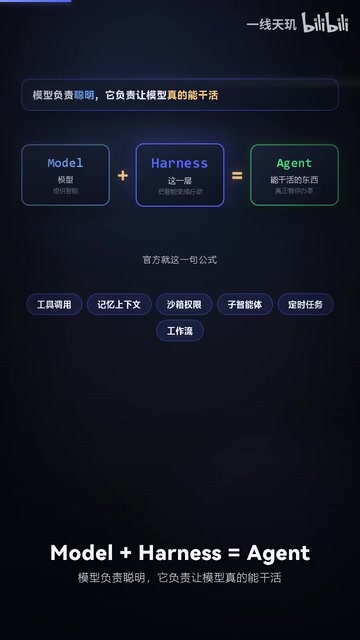
The positioning is refreshingly blunt. The official one-liner: Model + Harness = Agent. The model handles the intelligence; Harness handles getting things actually done. In other words, DeepSeek wants to separate "thinking" from "acting" into two distinct layers — the model outputs decisions, and Harness translates those decisions into real actions: calling tools, running sandboxes, reading and writing files, executing commands.
The project is MIT-licensed, written in TypeScript, and still receiving active commits. The startup flow is minimal — a single command opens the interface directly in your browser on a local port. But that one command also pulls down 63 official plugin packages. This isn't a framework "with plugins" — it's a framework that is plugins, all the way down.
The Philosophy: Everything Is a Plugin
DH's core design principle is "everything is a plugin." The repository contains 54 packages covering tools, memory, sandboxes, agents, scheduled tasks, and more — with 64 tool types exposed to the model. Even something as basic as "ask the user a question" has been broken out into its own standalone plugin.
This extreme modularity makes the system highly composable. You can assemble exactly the Agent capability stack you need. The trade-off is complexity and dependency bloat — initializing 63 plugin packages carries real maintenance overhead and potential compatibility headaches.
The most noteworthy design decision is the compatibility layer. DeepSeek built two dedicated packages: one for Claude Code hooks and one for Codex hooks. That means hooks you've already written for either of those systems work in DH out of the box. This is a smart move — it lowers the migration barrier and gives developers already invested in other ecosystems a smooth on-ramp.
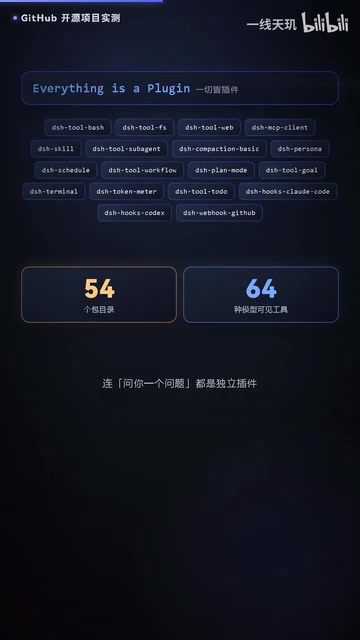
"Everything is a plugin" maps directly to the Microkernel Architecture pattern in software engineering: keep the core runtime minimal and load all functionality as dynamically pluggable modules. This approach has been widely validated by tools like VS Code and Webpack — the core stays stable while extensions remain flexible. The downside is that version compatibility, load ordering, and side-effect management between plugins become long-term maintenance challenges.
With 54 packages all designed as pluggable modules, the community can publish third-party plugins to extend DH's capabilities. But it also means that during an Alpha phase with no stable API contract, a single interface change in any core package can trigger cascading incompatibilities. This is the structural reason behind the official "breaking changes" warning — it's not just that features aren't mature yet; it's the nature of the architecture itself.
Versus Claude Code: The Key Difference Is Model Freedom
The natural comparison is Claude Code. The core distinction comes down to openness: Claude Code is effectively tied to a single model provider, while DH's MIT license means you can swap in whatever model you want.

The smarter play is not to pick sides at all. DH even supports the hook formats from the competing ecosystem, meaning you don't have to make an either/or decision between the two systems. You can use DH as an integration layer and keep your options open. This "compatible rather than competitive" strategy may be precisely why it attracted community adoption so quickly.
On launch day, the community immediately spun up peripheral projects: a desktop client at 28,000 stars, a curated plugin list at 16,000 stars, and several others — quickly building an ecosystem of around 73,000 additional stars. For comparison, the conceptually similar OpenHarness project has only 15,800 stars, and it's mostly read for learning purposes. DH's 230,000 stars represent active usage intent — roughly 14× the volume.
A note on "hooks": In this context, a hook refers to a callback interface exposed at specific lifecycle points in a toolchain — allowing external code to inject custom logic at moments like "before a task starts," "after a tool is called," or "when a session ends." Common use cases include logging, permission interception, and post-processing results. Claude Code and Codex each define their own hook format specifications. Developers who've built plugins or automation workflows around those formats are effectively locked into that ecosystem. DH's compatibility packages let developers reuse that existing work without rewriting anything — just swap the runtime to DH. This is a classic late-mover compatibility strategy: reduce switching friction first, then build new stickiness on your own merits.
Slow Down: The Version Is Still Alpha
The hype is real, but the maturity needs to be stated clearly. DH is currently at version 0.1.7 Alpha. There are 25 published versions on npm — and not a single stable release among them. The official changelog explicitly warns that breaking changes are coming.

The security documentation is even more direct: DH can execute model-generated commands, load third-party plugins, and potentially modify your files. Together, these amount to an official caution from the team itself — don't run this in production. For any Agent framework involving command execution and file I/O, these risks demand serious consideration, especially without a stable release to stand behind.
On Semantic Versioning: Under SemVer, a major version of 0 (e.g., 0.1.7) is an industry-standard signal that the public API is unstable and backward-incompatible changes can happen at any time. A "breaking change" specifically means existing calling code will error out or behave unexpectedly — things like changed function signatures, removed interfaces, or restructured configuration formats. For production environments, this means every upgrade requires a full regression test cycle, making maintenance extremely costly. Twenty-five npm versions with zero stable releases signals that DH is still in rapid exploration mode, with the architectural direction not yet finalized. This doesn't mean the project is low quality — it means the team is still using community feedback to refine the core abstractions. Adopting it now means being prepared to absorb frequent migration costs.
Who Is This Actually For?
Given where the project stands, DH is best suited for three groups:
- Teams building Agent products who want to anchor to the DeepSeek ecosystem — get in early and move with the official roadmap.
- Developers locked into Claude Code hooks who want an exit ramp — use the compatibility layer to build migration optionality.
- Enthusiasts who want to explore a polished out-of-the-box experience — just be prepared for breaking changes to interrupt your flow.
If you need something stable, formally released, and capable of handling production traffic, the answer is simple: wait. DH shows clear directional conviction and an architecturally ambitious Agent runtime — and the fact that DeepSeek is building it themselves is a significant signal. But right now, it's still an Alpha. If you're interested, search for DeepSeek Harness on GitHub and watch how it evolves.
(Note: The analysis above is primarily based on a single source — hands-on testing by Bilibili creator Tianji. Specific details such as plugin counts and star figures should be verified against the original video.)
Related articles

A Single Prompt Triggers a Global PHP Security Storm: Is AI a Savior or a Hidden Risk?
A single AI prompt triggered a global PHP security crisis affecting Wikipedia and the Internet Archive. This article reviews the incident, analyzes the OpenAI-Amazon controversy, and explores the security paradox of lowered vulnerability discovery barriers in the AI era and developer response strategies.

When AI Is Taken Away: How Reliance on Shortcuts Undermines Your Problem-Solving Resilience
A study of 1,222 people found that after using AI to answer questions, once AI was removed, people gave up on more problems than a control group that never used AI. The article analyzes the impact of AI reliance on learning resilience and metacognition, and explores design implications for AI learning tools.

Carta and NewView Partner to Let Startup Employees Cash Out Equity Early
Carta and NewView Capital partner to simplify startup tender offers, helping employees sell equity early. Analysis of the mechanism, liquidity pain points, and impact.