DeepSeek Harness Goes Open Source: A Modular Coding Agent Framework Where Everything Is a Plugin
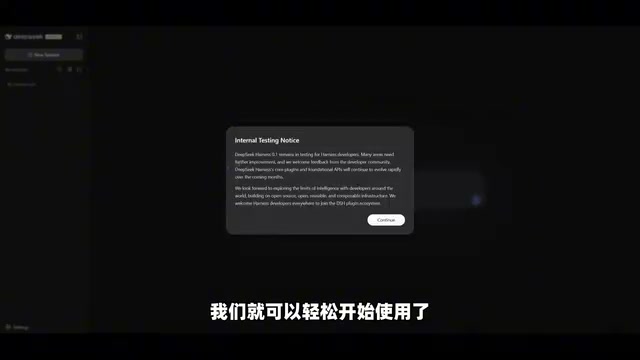
DeepSeek open-sources Harness, a fully modular coding agent framework where everything is a plugin.
DeepSeek has released Harness v0.1, an MIT-licensed modular coding agent framework powered by Codex. Its core philosophy—everything is a plugin—lets developers freely swap models, tools, sandboxes, memory, and UI components. With one-command installation via NPX, a full-featured Web UI, powerful trajectory debugging, and remote coding capabilities, Harness has quickly attracted over 1,200 GitHub stars and thousands of community plugins.
DeepSeek Harness Makes Its Debut
As the DeepSeek team previously promised, they have officially released the first developer preview (version 0.1) of DeepSeek Harness. This is a project open-sourced directly under the MIT license, positioned as a fully modular coding agent framework powered by the Codex framework under the hood.
The MIT license is one of the most permissive open-source software licenses available, allowing anyone to freely use, modify, distribute, and even commercialize the software—with the only requirement being to retain the original copyright notice. Compared to "copyleft" licenses like GPL, the MIT license imposes virtually no restrictions on businesses or individual developers, which is why mainstream frameworks like React, Node.js, and Vue.js have adopted it. DeepSeek's choice of the MIT license means enterprises can embed Harness directly into commercial products without being required to open-source their own code—a strategy that dramatically lowers the barrier to community participation and commercial adoption.
Codex was originally a code generation system launched by OpenAI that later evolved into a broader coding agent infrastructure. In the architecture of AI coding tools, the "framework" layer manages the interaction logic between models and external tools, including code execution, file operations, version control, and more. DeepSeek Harness uses the Codex framework as its underlying engine, meaning it inherits a mature code execution pipeline and tool-calling protocol while building its own plugin-based architecture on top.
What's most striking about this project is its growth velocity—the GitHub repository garnered approximately 1,220 stars within just a few days. For a developer preview that was just released, this level of community response is quite remarkable. Even more noteworthy is that a large number of community plugins (reportedly thousands, according to video introductions) have already been loaded into the Harness ecosystem, demonstrating the powerful aggregation capability of the open-source community.
This also confirms a viewpoint increasingly recognized across the industry: the model itself is only half of the intelligence; most of the work that truly maximizes a model's capabilities happens at the Harness (agent framework) level. In the AI programming domain, large language models (LLMs) are responsible for understanding intent and generating code logic, but models themselves cannot execute code, read/write files, or call external APIs. The agent framework serves as a bridge between the model and the real development environment, defining how the model plans tasks, invokes tools, handles errors, and maintains context across multi-step tasks. The same model can perform drastically differently under different frameworks—a good framework can multiply the effective output quality of a model several times over through more precise prompt engineering, smarter task decomposition, and more reliable error recovery mechanisms. An excellent framework can make the same model produce vastly different results.
Core Philosophy: Everything Is a Plugin
The core philosophy established during the design of DeepSeek Harness is remarkably simple and direct—everything is a plugin.
Plugin Architecture is a classic software design pattern whose core idea is to decouple system functionality into modules that can be independently developed, deployed, and replaced. In DeepSeek Harness, this means every core component interacts with the main system through standardized interfaces. For example, a "sandbox" plugin defines the isolated environment for code execution, a "memory" plugin manages how context is persisted, and an "orchestration" plugin determines the strategy for multi-agent collaboration. This design draws on the successful experiences of VS Code's extension system and WordPress's plugin ecosystem, allowing third-party developers to extend system capabilities without modifying the core code.
Models, tools, skills, sandboxes, file systems, agent loops, orchestration, memory—even the UI—can all be swapped, refactored, mixed, combined, and extended on demand. In other words, DeepSeek doesn't dictate how your coding engine should work; instead, it provides building blocks that let developers create their own version of Claude Code or Codex.
This modular design brings tremendous flexibility. You could say "create an emoji feature to help with communication" or "create a voice mode," and then enhance Harness through extension plugins in whatever way you prefer. Think of it as: customizing your own coding agent by combining plugins.
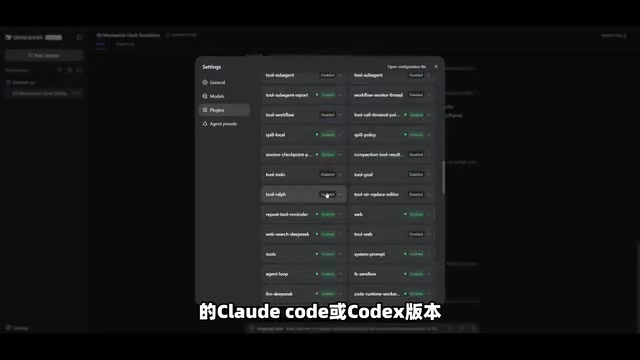
Notable Community Plugins
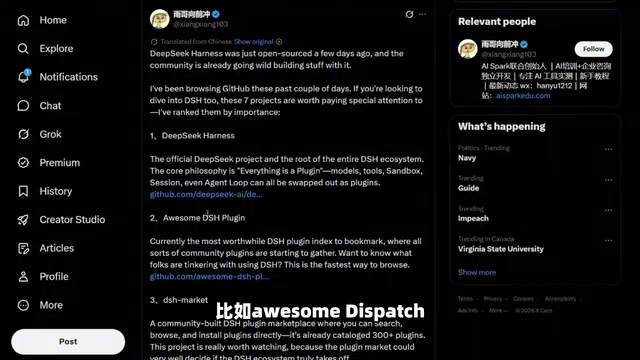
An initial plugin ecosystem has already formed around Harness, with several representative examples:
- Awesome DSH: A community directory for discovering new Harness plugins and seeing what developers are building.
- Harness Market: Adds an "app store" directly inside your Harness for browsing and installing plugins.
- OpenDesign: An excellent design-focused plugin that integrates easily into workflows.
- Webline Access: Exposes your local Harness Web UI to the network, enabling remote control of the agent running on your computer from a phone.
A word of caution: most of these community plugins have not been officially reviewed. Before installing tools like Webline Access that involve network exposure, be sure to review the code first to ensure it doesn't introduce malicious behavior that could steal data or compromise your system. This kind of security review is especially important in open-source ecosystems—since 2024, supply chain attacks have become increasingly frequent, with cases of malicious code infiltrating developer environments through seemingly legitimate third-party packages becoming all too common. Any plugin involving network permissions and file system access should be treated with extra caution.
Installation: Get Started with a Single Command
The barrier to getting started with DeepSeek Harness is extremely low—you really only need Node.js and a single command.
The recommended approach is to run it directly via NPX: open a new project in your IDE or terminal, paste the official NPX command, and the local installation is complete. NPX is a package execution tool bundled with npm, Node.js's package manager. Its core advantage is that it lets you run npm packages directly without global installation. When you execute an NPX command, it automatically downloads the specified package to a temporary cache directory and doesn't pollute the global environment after execution. This is particularly meaningful for development tools like DeepSeek Harness—developers don't need to manually manage dependency versions or deal with global installation conflicts; a single command provides a complete runtime environment. This is also the recommended "zero-config startup" best practice in the modern JavaScript ecosystem.
Within minutes, you can open its Web UI on localhost. After opening it for the first time, paste your API key (you can also configure it later), click save, and you're ready to go. The entire process is remarkably developer-friendly.
Web UI Feature Overview
The main interface works similarly to other coding agents, but offers a fairly complete feature set:
- Chat interface + workspace management: Create folders and host multiple sessions within a workspace.
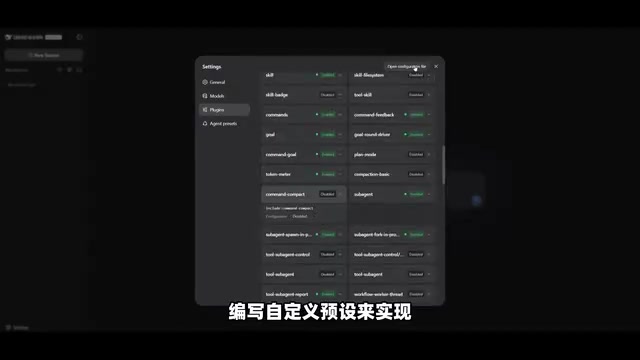
- Multiple mode switching: Code mode, minimal mode, creator mode, and more. In creator mode, you can create custom agent presets with runtime inspection and plugin extensions.
- Flexible model configuration: In settings, you can choose specific DeepSeek models (such as Flash or Pro versions), set up custom providers, or even connect to local small models. This provides great freedom in model and provider selection.
Powerful Observability: Trajectory Recording and Debugging
One particularly outstanding feature in DeepSeek Harness is its ability to record in detail every action the AI agent performs during a task.
Observability is an important concept borrowed from distributed systems and applied to the AI agent domain. Traditional software achieves observability through logs, metrics, and distributed tracing, while AI agent observability requires recording the reasoning process at each step, tool call parameters, return results, and decision branches. DeepSeek Harness's trajectory view is essentially an Event Sourcing system—all state changes are stored as immutable event sequences. This supports not only debugging and replay but also allows "forking" new execution paths from historical nodes. This capability is critical for debugging complex coding tasks, because the root cause of failure in multi-step AI agent tasks is often hidden at some intermediate decision node.
In the Trajectory view, you can inspect the model's prompts, view and modify tool calls, terminal results, sub-agent behavior, and more. Since all operations are stored as event histories, you can:
- Resume runs later
- Search for specific operations in the history
- Fork new paths from earlier nodes
- Replay sequences of operations that have already occurred
This makes inspecting and debugging agent workflows exceptionally clear and is extremely helpful for understanding what an agent "actually did."
Real-World Test: Building a 3D Mechanical Simulation in Minutes
To verify its capabilities, the author conducted a hands-on test using DeepSeek Harness paired with the new model.
He asked the agent to "build an interactive 3D mechanical clock simulation using Three.js, complete with gears, escapement mechanism, pendulum, hour and minute hands, and other components." Three.js is currently the most popular 3D graphics library for the web, rendering three-dimensional scenes in the browser using WebGL technology. Building an interactive 3D mechanical clock simulation with Three.js is a fairly complex programming task involving 3D geometric modeling (involute tooth profiles for gears), physics simulation (periodic motion of the escapement mechanism, simple harmonic motion of the pendulum), animation systems (coordinated rotation of hour and minute hands), and user interaction (camera controls, parameter adjustment panels). This type of task typically requires hundreds or even thousands of lines of code and demands that the developer possess knowledge of both 3D graphics and mechanical kinematics—making it a highly representative stress test for an AI coding agent.
The agent first used the Flash model to analyze the prompt, then ran commands through tools and completed operations directly on the canvas. During the process, it even deployed a sub-agent to handle related background tasks. Sub-agents are a key design pattern in modern AI agent architectures—when the main agent faces a complex task, it can delegate subtasks to specialized sub-agents, similar to the microservices architecture in software engineering. For example, in the 3D mechanical clock scenario, the main agent might handle overall architecture design and component integration, while sub-agents focus on specific background tasks like dependency installation, resource loading, or test validation. This division of labor allows agent systems to handle large projects that far exceed the context window limitations of a single model.
The final result was quite impressive: all gears and dials loaded completely, hands moved normally, and you could pause the mechanism, reset it, adjust simulation speed, display time intervals, and even switch camera presets. The entire generation process took about 30 to 40 minutes, but the quality of the result was remarkable.
The author specifically emphasized that only by combining the model with Harness can such results be achieved—once again confirming the decisive role that frameworks play in AI programming output quality.
Remote Coding Capabilities via Web UI
The Web UI design choice, which initially seemed somewhat "odd," actually brings enormous advantages.
You can run DeepSeek Harness on your main computer, deploy it to a server, and then access the same interface from another device—with everything syncing in real time. This means you can have the agent write code on your computer while remotely monitoring progress and controlling the session from a laptop, tablet, or even a phone.
Remote coding agents are becoming an important trend in AI development tools. Traditional IDE plugins (like GitHub Copilot) require developers to operate in a local environment, while remote agents host computation and execution environments on the server side, with the client needing nothing more than a browser. The advantages of this architecture are clear: computational resources aren't limited by local hardware, development environments can seamlessly switch between any devices, and long-running tasks won't be interrupted by shutting down the local device. Claude Code's remote mode and GitHub Codespaces are both moving in this direction, and DeepSeek Harness natively supports this mode through its Web UI, giving it an inherent architectural advantage.
This makes DeepSeek Harness an exceptionally powerful remote coding agent, with capabilities similar to Claude Code's remote control and what Codex offers.
Conclusion
As a just-released version 0.1 developer preview, DeepSeek Harness demonstrates a surprising level of completeness and ecosystem vitality. With its "everything is a plugin" modular philosophy, it hands the customization power of coding agent frameworks back to developers, while building a highly competitive open-source solution through minimal installation requirements, a polished Web UI, powerful trajectory debugging features, and remote coding capabilities.
Whether it can truly surpass Claude Code and Codex remains to be seen, but DeepSeek's decision to fully open-source the project is commendable in itself. As backend performance optimizations continue and community plugins keep growing, this framework's potential still has tremendous room for imagination. In the AI programming space, the collaborative power of open-source communities often leads to unexpected breakthroughs.
Related articles

A World First in Australia: Delivery Riders to Receive Minimum Wage Guarantee
Australia introduces the world's first minimum wage guarantee for delivery riders, balancing gig flexibility with income protection. Explore the agreement's details, platform impacts, and global regulatory trends.
DeepSeek Open-Sources Its First Vision Model, Dramatically Lowering the Bar for Multimodal Agents
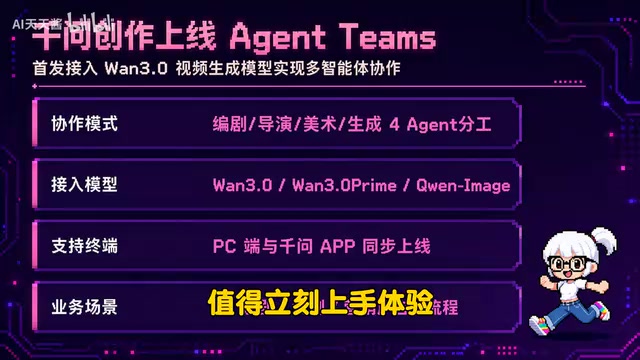
DeepSeek open-sources V-Flash-Vision-XP, its first vision model rivaling top closed-source models; Alibaba launches multi-agent video creation; sub-$400 bipedal robot goes open-source.
ReactOS 0.4.16 Released: Graphical Installer, 3D Hardware Acceleration, and Broader Hardware Support
ReactOS 0.4.16 ships with a new graphical installer, real hardware GPU 3D acceleration, and broader hardware compatibility for this Windows NT-compatible open-source OS.