DeepSeek Harness in Detail: DIY Your Own Software Like Building with LEGO

DeepSeek Harness is an underlying platform whose functional modules can be freely combined to DIY all kinds of software.
Using the metaphor of a "car assembly platform," the article introduces the positioning and value of DeepSeek Harness. Like configuring a Xiaomi SU7, it breaks functions into pluggable components; users can install wheels, robotic arms, or propellers as needed to assemble a car, a plane, a train, or even a robot, far exceeding traditional configurators. In essence, it is an underlying platform for DIY-ing all kinds of software, solving the pain point of downloading, installing, and chaining multiple programs for one task. Its technical foundation is the spatiotemporal composability paradigm proposed by Shi Yihuan and others: plugins remain independent and composable in time and space, with no effect on one another when attached or removed. For ordinary users, conceiving a function and finding the corresponding plugin lets them create exclusive software not on the market at extremely low cost; for developers, it means moving from hard-coded apps to an assemblable module ecosystem.
Introduction: What Exactly Is DeepSeek Harness?
In the evolution of the AI toolchain, "Harness" (a rig or gripping system) has gradually become a key concept connecting large models with business automation. DeepSeekAd Harness is a typical harness system opened up by the DeepSeek model. Its positioning is deeper and more specialized than the conventional Workbody, and its value is higher as well.
In one sentence: DeepSeek Harness is an equipment system whose functional modules can be freely combined, added, and removed. This sentence is concise, but not intuitive enough. In a tutorial, a Bilibili content creator used a vivid metaphor—think of it as a car assembly platform.
Workbody in this context refers to conventional AI workflow orchestration tools or automation execution frameworks. Their core idea is to chain together steps such as model calls, data reads and writes, and conditional judgments in a linear or tree-like flow to form a fixed task pipeline. Such tools emphasize "getting one flow running," but their functional units are usually bound to a specific flow and are hard to reuse across flows; extensibility depends on predefined node types. By contrast, Harness is positioned closer to a low-level equipment system: it does not presuppose any particular flow, but instead provides pluggable functional components and an attribute configuration mechanism, leaving it to users to decide how to assemble them. This is why the article calls it "deeper, more specialized, and more valuable"—the former solves "how to string tasks together," while the latter solves "how to freely assemble functions into any software."
The Core Metaphor: From "Configuring a Car" to "Assembling Everything"
Choosing Features Like Configuring a Xiaomi SU7
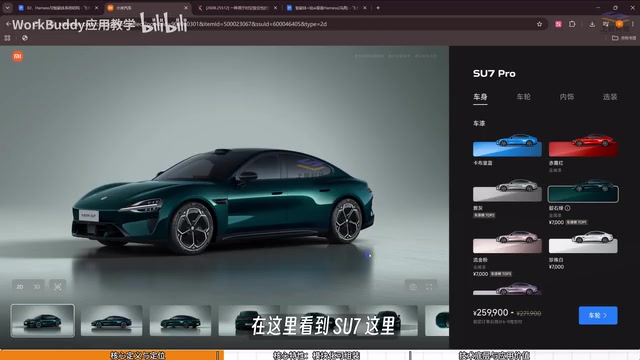
Take the Xiaomi SU7 as an example: on the official website, you can choose paint colors such as Cabri Blue, Elegant Gray, Oxford Pink, and Pearl White; choose plum-blossom wheels or rice-character wheels; and you can also add options like a 56-inch HUD, automatic steering wheel adjustment, auto-dimming exterior mirrors, and electric soft-close doors. "Optional equipment" means it can be installed or left out. Through this kind of assembly and configuration, you can put together a Xiaomi SU7 that fits your needs.
The initial logic of DeepSeek Harness is similar—breaking functions down into pluggable components and letting users combine them as needed.
But Harness Has Far More Assembly Dimensions
Xiaomi car assembly is limited to a finite set of dimensions such as wheel color and interior options, and may yield a few dozen models. Harness is different: it can be assembled into a car, but also into a plane, a train, or even a robot. Add wheels and it is a car; add a robotic arm and it is a Transformer; add a propeller and wings and it is a plane; add towed cars and it is a train.
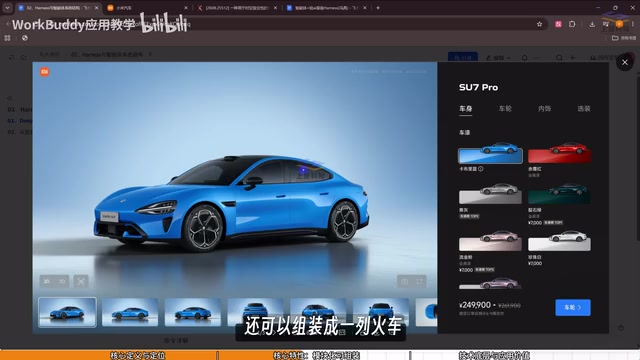
More importantly, for components like wheels, you can also tune parameters—a five-petal plum-blossom wheel can be changed to six petals, and the size can be adjusted too. This composability far exceeds that of traditional configurators.
Plugin architecture is the key background for understanding Harness's assemblability. In traditional software engineering, a plugin usually refers to an independent module that attaches to a host program and extends its functionality through predefined interfaces; the host handles lifecycle management and interface invocation, while the plugin only cares about its own logic. Harness pushes this model to a more thorough form: not only do functions exist as plugins, but even plugin attribute parameters (such as the number of petals and the size of the wheels mentioned above) are exposed as tunable items, so the same component can behave differently under different configurations. This two-layer configurability of "component + attributes" is exactly why it can assemble the same underlying set into a car, a plane, a train, or even a robot—the differences in form come from the combination of component choices and parameter settings, rather than developing a separate system for each form.
The Essence: An Underlying Platform for DIY-ing All Kinds of Software
DeepSeek Harness is essentially a DIY software platform that can DIY all kinds of software you need. This solves a major limitation of using software in the past.
Previously, if you needed features such as video editing, image processing, or audio processing, you had to search online for software in each category separately, download it, pay for it or crack it, install it, and then string multiple programs into one workflow to solve a problem. In many cases, I need many pieces of software to solve a single problem.
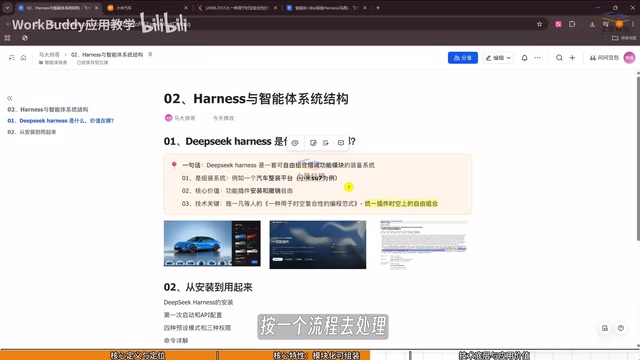
Now it is different: if you need editing features, find an editing plugin; if you need image processing, find an image-processing plugin; if you need audio adjustment, find an audio plugin—and combine them. You can combine functions into software that no one has ever made before—software that does not exist on the market can also be DIY-ed by you.
The significance is enormous: in the future, everyone will be able to create the software they want at extremely low cost.
Technical Foundation: A Programming Paradigm for Spatiotemporal Composability
The core of this capability is based on a programming paradigm for spatiotemporal composability proposed by Shi Yihuan and others (explained in detail in their paper). In short, it achieves composability within unit components in both time and space: in different time periods such as morning and afternoon, and in different spatial locations such as page A and page B, installing or removing a plugin does not affect the effects of other functions.
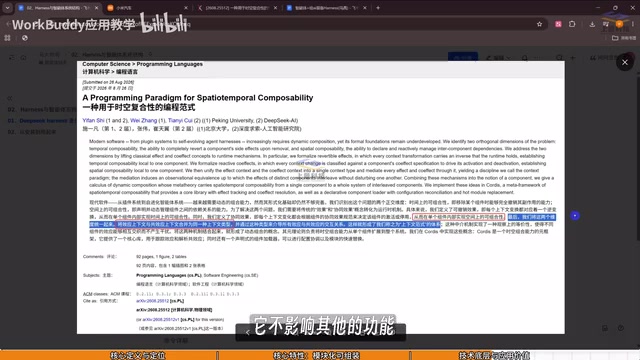
In traditional software, functions such as data reading, data display, and data input are coupled together; breaking one function affects the others. Harness components, by contrast, remain relatively independent: plugins can be attached and removed while maintaining both independence and composability. This architecture makes dynamic addition and removal of functions possible.
Spatiotemporal composability can be understood along two dimensions. Spatial composability refers to the ability of different functional components to coexist and be spliced together in the same interface or the same data context: component A handles reading, component B handles display, and component C handles input, and none of them intrudes on the responsibility boundaries of the others; attaching or removing any one component does not damage the state of the others. Temporal composability refers to the dynamic addition and removal of components in runtime sequence: the same page mounts plugin A in the morning and switches to plugin B in the afternoon, or a function is inserted into or removed from the middle of a flow, while the rest of the system retains its original behavior. This contrasts sharply with traditional monolithic software—the latter couples reading, display, input, and other logic in the same codebase, so changing one place often affects the whole system. By defining interfaces and state isolation between components, this paradigm makes "install and use, remove and go" an achievable default behavior in engineering.
Value for Ordinary Users and Developers
For ordinary users, the greatest use of DeepSeek Harness is this: you can use it to create software that does not exist on the market. As long as you can figure out what functions a piece of software needs and can find the corresponding functional plugins and attribute configurations, you can DIY them into a brand-new piece of software that fits your business needs.
For developers, this means moving from hard-coded applications to an ecosystem of assemblable functional modules, greatly lowering the threshold for customized development.
Follow-up Learning Path
The tutorial series will subsequently cover installation, enabling, API configuration, preset modes, permissions, and detailed command explanations, helping users get started with DeepSeek Harness from zero. If you want SuperAgent to truly do the work for you, this assembly-oriented mindset is the first threshold you must cross.
One-line Summary
DeepSeek Harness is an underlying platform whose functional modules can be freely combined and that can DIY all kinds of software.
Paragraph Summary
Using the metaphor of a "car assembly platform," the article introduces the positioning and value of DeepSeek Harness. Like configuring a Xiaomi SU7, it breaks functions into pluggable components; users can install wheels, robotic arms, or propellers as needed and assemble a car, a plane, a train, or even a robot, with assembly dimensions far beyond those of traditional configurators. In essence, it is an underlying platform for DIY-ing all kinds of software, solving the pain point of having to download, install, and chain multiple programs together to complete a single task in the past. Its technical foundation is the spatiotemporal composability programming paradigm proposed by Shi Yihuan and others: plugins remain independent and composable in time and space, and attaching or removing them does not affect one another. For ordinary users, as long as they can conceive a function and find the corresponding plugin, they can create exclusive software that does not exist on the market at extremely low cost; for developers, it means moving from hard-coded applications to an ecosystem of assemblable functional modules.
Related articles

On-Device LLM + ESP32: Build a DIY Calorie Reminder
A Bilibili creator open-sourced a calorie intake reminder: a phone app uses the open-source miniCPM model to locally recognize food photos and estimate calories, while an ESP32 mini screen syncs data and shows intake status with green/yellow/red rings — magnetically attachable to the fridge door for constant reminders.

Running 125B MoE on a 12GB GPU? Inside Strata's Three-Tier Cooperative Engine
Open-source C++ engine Strata runs 125B MoE models locally on 12-16GB consumer GPUs at 40-95 tokens/s. Here's how its VRAM/memory/SSD three-tier pipeline works.

Running Audio and Vision Locally with a 2B Model: LFM3 Hands-On Revealed
A blogger tests Liquid AI's LFM3 Audio 2B and Omni 2B on a MacBook Air: 2B parameters run speech and vision offline, tool calling exceeds expectations, but noise transcription and hallucination issues are evident.