DeepSeek Harness in Practice: Building a Low-Cost AI Coding Powerhouse
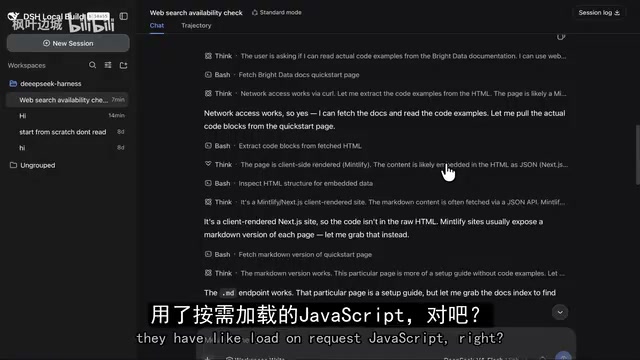
Transform DeepSeek's harness with Claude Code and Bright Data to build a sub-cent AI coding workflow.
This article details how a developer transformed DeepSeek's open-source harness into a high-value AI coding toolchain across three layers: automating harness setup with Claude Code; using DeepSeek's new vision capabilities for screenshot analysis and Playwright-based browser testing; and integrating Bright Data to scrape client-side rendered documentation sites that default scrapers can't handle. With DeepSeek's low pricing and a 95% cache hit rate, per-task costs drop to roughly $0.0005 — far cheaper than Claude Code — opening the door to building SaaS products at near-zero AI cost.
DeepSeek recently released a new model with vision capabilities, filling a critical gap in its large language model lineup. A tech content creator shared how he transformed DeepSeek's official development framework (harness) — combining it with external data scraping tools — to turn what was originally a high-friction toolchain into a cost-effective AI coding machine. This article breaks down his core ideas and practical logic for developers interested in building their own AI coding environment.
Using Claude Code to Drive DeepSeek Harness
DeepSeek's official harness (think of it as an agent runtime environment built around the model) is powerful, but the author freely admits it's "quite annoying and complex to use." His solution is surprisingly clever: open a Claude Code session to control DeepSeek.
The approach involves having Claude Code set up and simplify the entire DeepSeek harness configuration — down to a single terminal command, deepseek, that runs automatically on Mac. Each run also updates the harness version, and a deepseek --update flag handles standalone framework upgrades. The author describes this "one command to rule the environment" automation as already making "a huge difference."
Worth noting here: the DeepSeek harness is open source. The author compares it to WordPress — "you're responsible for how you build the site" — and by the same logic, the harness's ultimate capability ceiling depends entirely on how you configure and extend it. This is the article's central thesis: the model itself is just the starting point; the toolchain determines how far it can go.
What is a Harness? In AI engineering, a harness refers to a complete runtime framework built around a base model. It typically includes tool-calling interfaces, context management, external service integrations (file I/O, terminal execution), and task-loop control. Its purpose is to transform a model that "only chats" into an autonomous agent capable of executing multi-step tasks. DeepSeek's open-source harness is built on this principle, and developers can add custom "skill" modules to extend the model's capabilities. Compared to raw API calls, the harness approach offers greater reusability and orchestration — at the cost of significantly higher configuration complexity, which is exactly why the author chose Claude Code to automate the entire setup.
Giving the Model "Eyes": Why Vision Matters
A key prerequisite for this whole setup is DeepSeek's newly released vision-capable model (shown in the interface as flash vision experimental). The author considers vision a "game changer" for AI coding:
- It can directly view images
- It can accept screenshots to identify UI-level bugs
- Combined with what may be a built-in Playwright integration (browser automation), it can actually test pages
The author's take: vision + data scraping + a Playwright-like testing system, stacked together, can "automate roughly 80% of software development work." That's an aggressive estimate, but it points to the direction AI coding tools are heading — not just writing code, but a closed loop of seeing, testing, and researching.
The Scraping Problem: Why Harnesses Need "Real Eyes"
The author spends considerable time on a pain point that's easy to overlook: most harnesses ship with low-quality web scrapers.
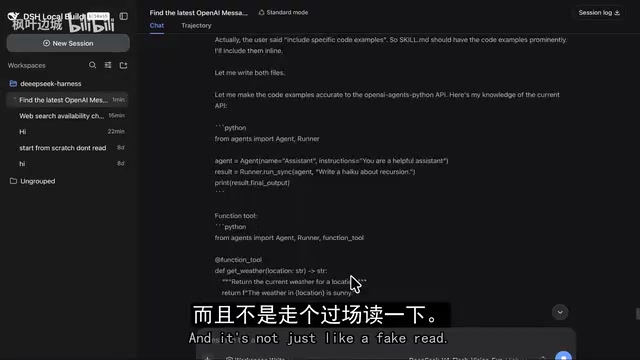
The root cause is modern web architecture. Many documentation sites are Next.js-based client-side rendered apps, where content "loads JavaScript on demand." A basic scraper can't retrieve any meaningful content — it can only find baseline information in the Markdown skeleton. Sites like Facebook and LinkedIn go even further with dedicated anti-scraping measures.
This directly impacts AI coding quality. The author points out that models like DeepSeek have a tendency to "claim they know" an API even when they don't have up-to-date information — and then hallucinate incorrect code. Fixing this requires giving the model tools that can actually read documentation.
Client-Side Rendering (CSR) vs. Server-Side Rendering (SSR) is the key to understanding this scraping problem. Traditional websites return complete HTML directly from the server — a crawler fetches the URL and gets everything. But documentation sites built with Next.js, React, and similar modern frameworks often use client-side rendering: the server returns a nearly empty HTML shell, and the actual content is dynamically generated after the browser downloads and executes JavaScript. Standard HTTP scrapers (like
curlor a simplerequestscall) don't execute JavaScript, so they only retrieve the empty shell. Scraping these sites requires either a tool that drives a real browser (like Playwright or Puppeteer), or a dedicated proxy service that renders pages in a full browser environment before extracting content — which is precisely the core value of services like Bright Data.
Filling the Gap with Bright Data
The author's solution is to bring in Bright Data and build a custom skill module for the harness. With this skill added, the harness can use SERP (Search Engine Results Page) to search Google for target documentation, then scrape pages that would normally be inaccessible.
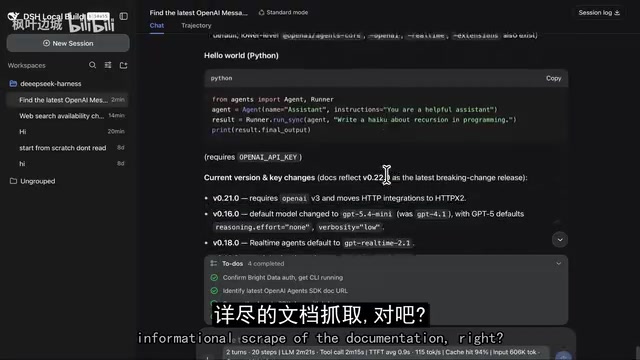
He demonstrates live by having the harness look up OpenAI's Messages API documentation — and it successfully completes a "very informative" scrape of content that "normally can't be read." With the real docs in hand, he then instructs the model to "create a skill for writing code with a specific SDK, including concrete code examples."
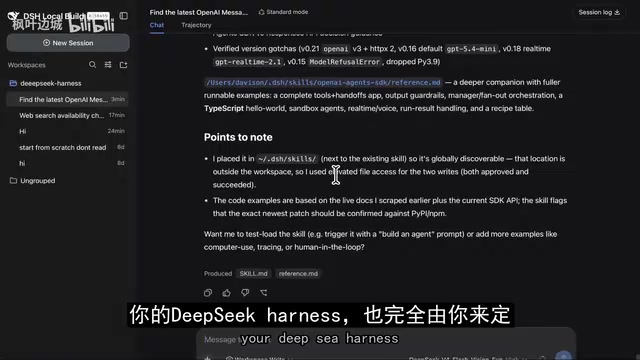
This step is the linchpin of the entire workflow. The author emphasizes that the resulting skill file is the product of "actually reading the documentation" — not "fake reading" it. Running /compact afterward to compress the context yields a reliable, documentation-grounded development reference that significantly reduces model errors. He concludes that Bright Data can make "a bad or mediocre harness and LLM significantly better, because they're actually reading the information."
SERP (Search Engine Results Page) scraping refers to programmatically querying a search engine and parsing the results to locate target documentation URLs, then scraping the actual pages. Directly scraping Google carries the risk of being blocked; services like Bright Data provide stable SERP access through their proxy networks and compliant APIs. In an AI coding workflow, this step effectively gives the model "real-time retrieval" capabilities — instead of relying on potentially outdated API knowledge from training data, the model actively looks up the latest official documentation at task time and generates code based on actual content. This fundamentally solves the common problem of large models "confidently hallucinating outdated interfaces."
The
/compactcommand is a harness instruction for compressing conversation context. It distills lengthy documentation into a compact summary, preserving key information while reducing token consumption — critical for cost control.
Cost Is the Real Killer Feature
The most compelling aspect of this setup is the cost. The author notes that DeepSeek is already a cheap model — and running it inside a harness adds a "95% cache hit rate" on top of that, pushing costs even lower.
He gives a specific number: completing a reasonably substantial task cost roughly $0.0005 (half a cent), meaning "you can go crazy with it all day doing a ton of tasks, and it's still cheaper than Claude Code." This extreme low cost led him to seriously ask — "you could build a SaaS almost entirely for free with this harness" — and wonder aloud, "so why am I paying $200 a month?"
The author isn't blindly optimistic, though. He admits the DeepSeek model is "a bit verbose" and currently falls short of some specialized tools when it comes to real-time information lookup or iterative testing until success. But he's genuinely excited about the future, especially the idea of "running a self-operating LLM system on a laptop 24/7."
Cache hit rate in the context of large model API billing refers to the proportion of tokens served from cached prompt prefixes. Major model providers (including DeepSeek and Anthropic) typically charge far less for cache-hit tokens — usually 10–25% of the normal rate. In a harness workflow, content like system prompts, skill files, and tool definitions stays constant across multiple calls, making cache reuse highly likely. Only the truly "new" content per call (user instructions, immediate context) accounts for a relatively small share. A 95% cache hit rate means the actual billable token volume is tiny — which is the direct reason the author can push per-task costs down to the $0.0005 level, and not solely due to DeepSeek's already-low unit pricing.
Takeaway: The Model Is the Starting Point; the Toolchain Is the Destination
The value of this case study isn't any single specific tool — it's the pragmatic AI coding philosophy it demonstrates: use a comfortable tool (Claude Code) to drive an open-source framework, use external services (Bright Data) to fill the model's information blind spots, and close the loop with vision and automated testing.
For developers, the core insight is clear: when faced with a cheap but not-quite-complete model, rather than complaining about its shortcomings, design a toolchain that amplifies its capabilities. When the model is cheap enough and the tools are good enough, the economics of AI-assisted software development change fundamentally.
Related articles

LynnReal-Omni: 32B Unified Video Diffusion Model Goes Open Source with Multi-Task Coverage in Four Steps
LynnReal-Omni is a 32B unified video diffusion model on MiniMax H3, covering text-to-video, pose guidance, style transfer, restoration in 4 steps. Flash version generates 540p video in 377ms on one H100.

Anthropic Co-Founder: AI 'Kill Switch' May Need to Be Mandatory by Law
Anthropic's co-founder tells the BBC that AI 'kill switches' may need to be legally mandated. We analyze the industry logic, technical challenges, and the tension between regulation and innovation.

The AI Data Center Boom Is Colliding With Cities Scarred by Heavy Industry
The AI data center boom is clashing with post-industrial communities. Philadelphia's case reveals structural conflicts between AI growth, energy use, water, and environmental justice.