DeepSeek Harness: The Open-Source AI Agent Runtime That Hit 30K Stars in Three Days

DeepSeek quietly open-sourced AI Agent runtime Harness, reaching 33K stars in 3 days with its "everything is a plugin" design.
DeepSeek silently launched Harness, an open-source AI Agent runtime, on August 13th — earning over 33K GitHub stars in three days. Its core "Everything is a plugin" philosophy makes model adapters, tools, and even the agent's main loop fully replaceable, all under the MIT license. Built on a declarative dependency paradigm that eliminates plugin conflicts, Harness addresses pain points in LangChain's chaotic ecosystem and the closed walls of Claude Code and Codex. Its standout Trajectory transparency mode records every thought and tool call for frame-by-frame replay, giving developers full auditability — a critical requirement for enterprise AI deployments.
An Open-Source Bomb with No Launch Event
On August 13th, DeepSeekAd quietly dropped a repository on GitHub — no launch event, no hype buildup, no wall-to-wall PR copy. Three days later: 33,000 stars. That growth rate speaks for itself. Developer demand for something like this had been building for a long time.
It's called DeepSeek Harness — an open-source AI Agent runtime. If a large language model is a brain, then Harness is the nervous system that connects that brain to eyes, hands, and a toolbox. The model itself only handles "thinking." Everything else — how tools get called, how multiple agents are coordinated, how every operation gets logged — requires a runtime framework to handle the dirty work. Harness fills exactly that gap.
The Core Philosophy: Everything is a Plugin
DeepSeek sums it up in one line: Everything is a plugin. That means model adapters are plugins, tool libraries are plugins, log rendering is a plugin, and even the agent's main loop is a plugin. There is no single line of code in the entire system that counts as a "privileged core."
The value of this design is complete replaceability. Want to add a capability? Attach a plugin. Want to swap out the underlying model? Attach a different plugin. The whole thing runs under the MIT license — free for commercial use, with virtually zero barrier to entry.

This degree of "everything is a plugin" radicalism is genuinely rare in the existing Agent framework landscape. Most frameworks preserve a core that's off-limits, but Harness breaks the core itself into swappable modules.
Background: Plugin Architecture Plugin Architecture is a classic software engineering design pattern. The core idea is to split system functionality into independent, replaceable modules that communicate through agreed-upon interfaces rather than direct coupling. Its greatest engineering value lies in the "Open/Closed Principle" — open for extension, closed for modification. VS Code's extension system and Webpack's loader/plugin mechanism are canonical examples.
Most plugin-based systems, however, preserve an irreplaceable "host core" — plugins can only operate within the boundaries the core defines. Harness goes further by abstracting the agent's main loop itself into a plugin. This means you can replace the foundational logic governing how the agent thinks, when it terminates, and how it decides its next step — not just mount new tools on top. That level of replaceability is genuinely rare among mainstream Agent frameworks today.
Why the Current Agent Tooling Ecosystem Is So Painful
To appreciate Harness's value, it helps to understand the pain points in today's Agent ecosystem.
Claude Code is powerful, but its capability boundaries are drawn by the vendor. You can only dance within the given perimeter — extensibility is limited.
Codex is catching up, but its extension mechanism is hardcoded. Adding a new tool means modifying the main repository, which makes it extremely difficult for ordinary developers to extend functionality without touching the core.
LangChain is flexible — so flexible it borders on chaos. Install ten plugins, five of them conflict, three fight each other, and the only winner is usually your rising blood pressure. Ecosystem fragmentation and compatibility issues are the most common complaints from heavy LangChain users.
Harness is designed to break out of this "either closed or chaotic" dilemma.
The Foundation: A Spatiotemporally Composable Programming Paradigm
The foundation of Harness is a framework called Codex (short for what can be understood as a "spatiotemporally composable programming paradigm"). In plain terms: every plugin declares when it runs, what it depends on, and what it needs — and the system automatically wires those dependencies together.

Want to add a new feature? Don't touch the main code — just declare your dependencies. This approach is reportedly something OpenAI has used internally for years, and LangChain has been preaching it for years. DeepSeek claims to be the first to fully open-source it. Whether or not that's entirely accurate, the "declarative dependency + auto-orchestration" pattern is the correct engineering solution to plugin conflict problems.
Background: Declarative Dependency The difference between declarative dependencies and imperative programming is this: imperative code requires you to specify how to do something, while declarative code only requires you to state what you need — the runtime infers execution order and dependency resolution automatically. React in the frontend world (describe UI state rather than DOM operations) and Terraform in infrastructure (describe desired cloud resource state rather than procedural steps) are both expressions of this philosophy.
Applied to an Agent plugin system, declarative dependencies mean each plugin only needs to declare "I need a module with capability X" — the system automatically finds a matching implementation in the registry and assembles it. This fundamentally eliminates the LangChain-style conflict problem. Conflicts typically arise when multiple plugins try to directly manipulate the same global state; declarative injection puts the runtime in the middle as a mediator, centralizing dispatch and eliminating direct competition. The "temporal" dimension in "spatiotemporally composable" refers to automatic orchestration of execution sequencing; the "spatial" dimension refers to automatic assembly of the dependency graph — together, they describe automatic coordination of plugins across both time and space.
Four Working Modes — the Most Explosive One Is Transparent Replay
Harness ships with four default working modes:
- Standard conversation mode: Direct Q&A, just like using ChatGPT.
- Tool-calling mode: The model decides when to invoke search, file read/write, command execution, etc.
- Multi-agent collaboration mode: A primary agent spins up sub-agents to work in parallel, with Harness coordinating the communication between them.
- Trajectory transparency mode: Every conversation turn, every tool call, every moment of reasoning is fully recorded.

The fourth mode is the most worth paying attention to. In the UI, you can watch the agent's thinking process frame by frame, like playing back a recording — it even reflects on whether its last step went off course and whether it should backtrack.
This directly answers a question that has long plagued AI deployment in production: AI can get work done, but once it does, how do you audit it? Harness hands that auditing capability back to the developer. For enterprise scenarios that require compliance and traceability, this kind of observability is essentially non-negotiable.
Background: Trajectory "Trajectory" is a technical term in the AI Agent domain referring to the complete sequence of intermediate states recorded as an agent completes a task — including every Observation, Thought, Action, and Result. This concept is especially important in reinforcement learning, where trajectory data can serve as training material, allowing model strategy improvements by analyzing successful and failed trajectories.
Harness's Trajectory transparency mode brings this concept from the training side into production inference environments. For developers, being able to step through the agent's complete decision chain means debugging is no longer a "black box guessing game" — every anomalous behavior is traceable. For enterprise compliance needs, complete operational audit logs are a hard requirement in heavily regulated industries like finance, healthcare, and law. This is also a glaring weak point in most existing Agent frameworks — they focus on making agents capable of getting work done, while neglecting the equally critical engineering question of "how do you prove it did the work correctly."
The Onboarding Friction Is Almost Zero
Installation overhead is minimal. Once you have a Node environment set up, a single command — npx @deepseek-ai/ds — is all it takes. Open a browser and you're looking at your own local Agent console.
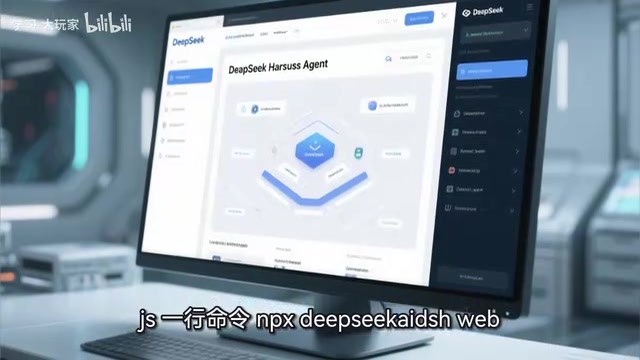
Want to dig into the source code? Just as easy: git clone the repo, follow the README, and you'll have a complete Agent workflow running within five minutes. The official repository is at github.com/deepseek-ai/harness — MIT license, free for commercial use.
(Note: Verify commands and repo paths against the official README before running anything in production.)
What DeepSeek Is Actually Doing
Looking back at this past year — from V3 to R1, to training methodology innovations, to Harness today — DeepSeek seems to have been doing the same thing the whole time: taking capabilities that the big players have locked behind closed doors, prying them open one by one, and handing them to the world for free.
When a repository grows 33k stars in three days, maybe the question to ask isn't "Is DeepSeek for real?" — it's: when tools are no longer scarce, what are you going to build with them that's actually your own?
The significance of open source was never just "free." It's about returning the power to choose and create to every individual developer. Whether Harness will truly "flip the table on Claude Code" still needs time to prove — but it has already demonstrated one thing: the critical category of Agent runtimes now has open-source forces that have arrived and intend to stay.
Related articles

Gemini 4 Argon Hands-On: AI Builds Board Games, Constructs Temples, and Trains Robots Autonomously
Gemini 4 Argon hands-on roundup: AI autonomously builds a desk racetrack and temple in Blender, writes a ray tracing engine, trains a humanoid robot to sink 7 shots, plus API pricing and developer access.

The Magic Octagonal Coin: Why Only 9% of People Can Predict Its Flip?
Only 9% of people can correctly predict the Magic Octagon coin flip. This article explains its spatial rotation mechanism, common cognitive pitfalls, and a new hypothesis based on Relevance Theory, exploring the limits of human spatial reasoning.

Sam Altman: AI Is Entering the Era of Scientific Discovery — Math Breakthroughs Will Replicate in Biology and Energy
Sam Altman says AI is entering the era of scientific discovery — math breakthroughs will replicate in biology, materials science, and energy to help develop new drugs and energy sources.