DeepSeek Ignites Sparse Computing, Domestic Chip Company Raises Nearly 1 Billion Yuan
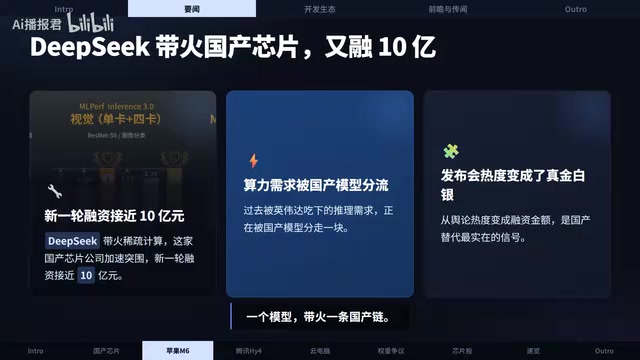
DeepSeek ignites sparse computing, domestic chip raises nearly 1B yuan; Apple touchscreen MacBook Pro and Tencent Agent ecosystem advance.
This article covers the day's key AI developments: DeepSeek's rise has brought unprecedented attention to sparse computing, with a domestic chip company focused on this approach raising nearly 1 billion yuan, signaling that compute demand is shifting toward domestic models and capital is embracing the specialized chip path. Apple's M6 iMac and MacBook Pro go on sale, with the first touchscreen MacBook Pro starting at 22,999 yuan for the high-end professional market. Tencent expands Agent capabilities tenfold on the developer ecosystem side. Open-source model ranking controversies and chip stock volatility reflect divided market views on domestic compute. All three threads point to AI competition shifting from model parameters to computing efficiency and ecosystem deployment.
DeepSeek Ignites Sparse Computing, Domestic Chip Company Raises Nearly 1 Billion Yuan
The domestic AI chip sector has received a noteworthy signal: DeepSeekAd has ignited interest in sparse computing, and a domestic chip company has promptly secured nearly 1 billion yuan in funding. Meanwhile, Apple's M6 chip devices have gone on sale, and Tencent is doubling down on its Agent ecosystem.
DeepSeek Ignites Sparse Computing, Domestic Chip Company Raises Nearly 1 Billion Yuan
DeepSeek's rise is changing the flow of computing power demand. Sparse computing, a technical approach that aligns closely with DeepSeek models' efficient inference characteristics, has gained unprecedented attention. A domestic chip company focused on sparse computing has leveraged this to raise nearly 1 billion yuan in funding.
The significance here isn't the funding amount itself, but the fact that computing power demand is being carved out by domestic models. In the past, the narrative around domestic chips was mostly confined to launch events and PowerPoint presentations. Now it has translated from media buzz into real, tangible funding. This is the most concrete signal of domestic substitution — far more meaningful than launch events or slide decks.
The core idea of sparse computing is to let model inference skip large amounts of unnecessary computation, achieving higher throughput efficiency on equivalent hardware. As domestic large models begin large-scale deployment on the inference side, purpose-built chips that match this need now have genuine commercial demand backing them. The funding event shows that capital markets are beginning to recognize the viability of this path.
Sparse Computing is a computing paradigm contrasted with dense computing. In deep learning — especially large model inference — input data or model weights often contain large numbers of zeros or negligible small values (such as routing sparsity in MoE architectures, or sparse activation patterns after ReLU activation). Sparse computing uses specialized hardware or algorithms to skip these invalid operations, significantly reducing computation and memory bandwidth requirements. DeepSeek models extensively adopt MoE (Mixture of Experts) structures during inference, activating only a subset of experts per forward pass, which is inherently highly sparse. To efficiently exploit this sparsity, general-purpose GPUs require additional software scheduling and struggle to fully utilize hardware efficiency — creating an opportunity window for dedicated sparse computing chips.
MoE (Mixture of Experts) is an important sparsification architecture in the large model field. Its core idea is to split the model into multiple "expert" sub-networks and use a gating network (Router) to dynamically select and activate a small number of experts for each input token. This allows the total parameter count to be very large while only a small fraction of parameters actually participate in computation during each inference, controlling computational cost while maintaining high performance. The DeepSeek series is one of the representative implementations of the MoE architecture, and its efficient inference characteristics rely heavily on underlying hardware support for sparse activation patterns — this is the technical background behind the attention sparse computing chips are receiving.
Apple M6 Chip Devices Go on Sale, First Touchscreen MacBook Pro Debuts
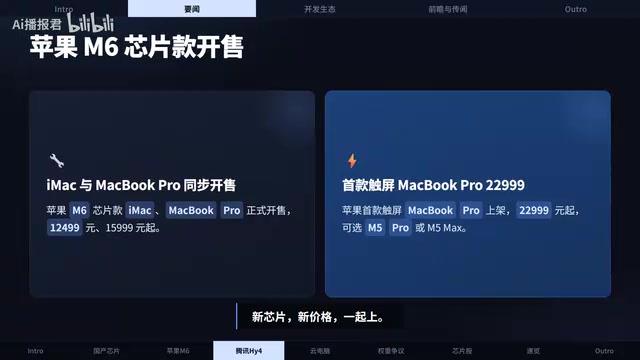
Apple has also been busy. The M6 chip iMac starts at 12,499 yuan, and the MacBook Pro starts at 15,999 yuan. More notably, Apple's first touchscreen MacBook Pro has officially gone on sale, starting at 22,999 yuan, with options for M5 Pro or M5 Max chips.
The arrival of the touchscreen MacBook Pro represents a significant adjustment in Apple's interaction paradigm. For developers and creative professionals, the combination of touchscreen and M-series chip performance could spawn new workflows. However, the 22,999 yuan starting price also indicates that this product is positioned in the high-end professional market and won't become a volume-driving model in the short term.
Tencent Doubles Down on Agent Capabilities, Developer Ecosystem Continues to Expand
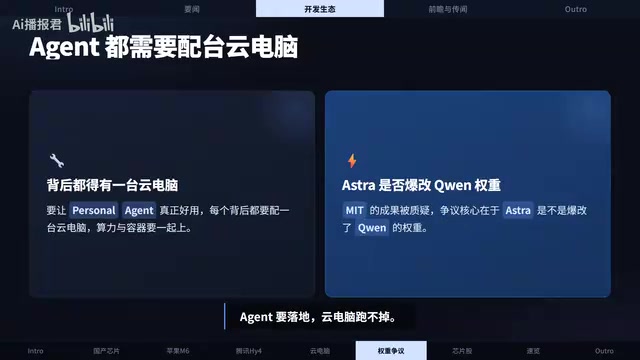
On the developer ecosystem front, Tencent's Hi4 invocation engine has expanded Agent capabilities tenfold. This direction aligns with industry trends — Agents are becoming the primary form of large model deployment, and each Agent requires supporting computing power and toolchain infrastructure.
Expanding Agent capabilities essentially means providing developers with a lower barrier to building intelligent agents. When platforms thicken foundational capabilities like invocation, orchestration, and scheduling, developers can focus their energy on scenarios and business logic. Open-source models ranking first also shows that open ecosystems remain a key competitive variable.
Agent refers to a software system that uses a large model as its "brain" and can autonomously plan, invoke tools, execute multi-step tasks, and perceive environmental feedback. Unlike single-turn Q&A, an Agent typically includes modules for task decomposition, tool invocation (such as search, code execution, API access), memory management, and reflective iteration. For Agents to run reliably, platforms need to provide infrastructure for model invocation orchestration, toolchain integration, runtime scheduling, and state management. Tencent's expansion of Agent capabilities is precisely about lowering the barrier for developers to build intelligent agents from the platform side, enabling developers to focus on business scenarios rather than underlying engineering.
Other Developments: Open-Source Models and Chip Stock Volatility
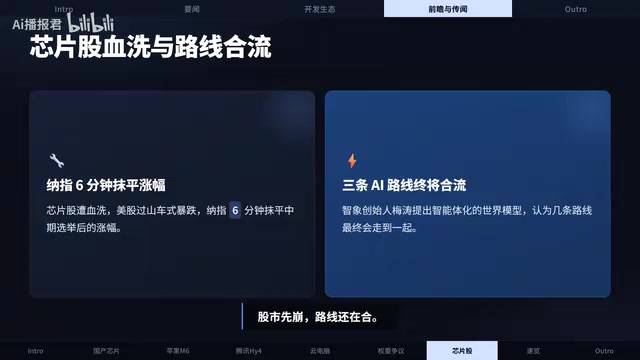
On the open-source model front, some argue that a certain open-source model ranks first, with MIT-related work being compared and sparking controversy. Additionally, news about AI short-range frost charge and eleven chip stocks being slaughtered also appeared in the daily report, reflecting sharp fluctuations in market sentiment around AI concepts. The short-term volatility in chip stocks contrasts with the hot funding environment, indicating that capital's judgment on domestic computing power remains divided.
Summary
The day's AI developments can be strung together into one narrative: domestic models ignite specific technical approaches, which in turn drive real funding demand for domestic chips; Apple expands hardware form factors with the touchscreen MacBook Pro; Tencent reinforces Agent infrastructure from the developer ecosystem side. All three lines point to one conclusion — AI competition is shifting from model parameters to computing efficiency and ecosystem deployment.
One-line Summary
DeepSeek ignites sparse computing, domestic chip company raises nearly 1 billion yuan, Apple's touchscreen MacBook Pro and Tencent's Agent ecosystem advance in parallel.
Related articles
 Tech Frontiers
Edge AI on Microcontrollers: When Is It Actually Worth Deploying?
Drawing on Reddit discussions and Arm case studies, this article analyzes the real-world use cases for edge AI on microcontrollers: when each device needs independent inference, when a gateway or cloud is more reasonable, and the costs and boundaries of specialized hardware.
 Tech Frontiers
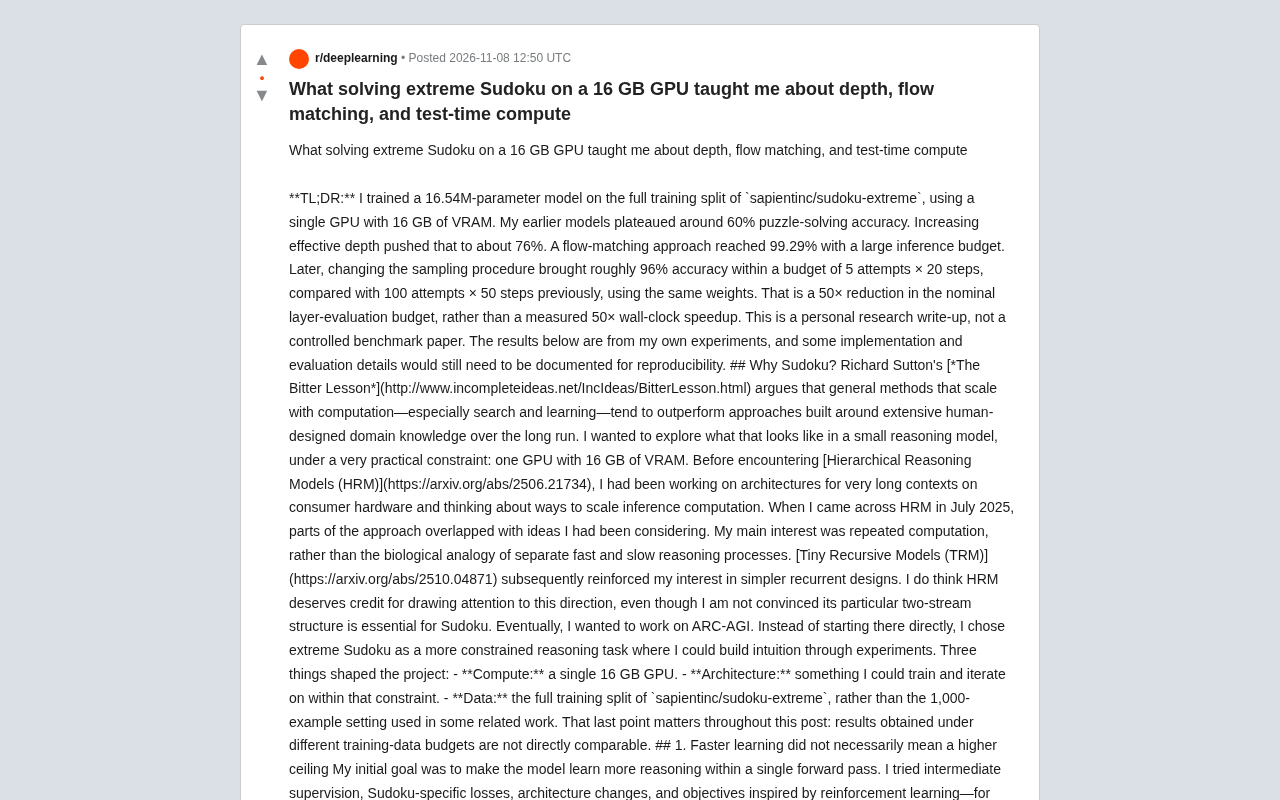
Pushing the Limits of Extreme Sudoku on a 16GB GPU: Insights from Depth and Flow Matching
A researcher trained a 16.54M-parameter model on a 16GB GPU to solve extreme Sudoku, finding effective depth breaks the 60% plateau and flow matching with improved sampling pushes accuracy past 99% with ~50× lower layer-evaluation budget.
 Tech Frontiers
AI Agent Approval Workflows: Why Human Confirmations Always Get Mindlessly Clicked
Why do AI agent approval workflows always get mindlessly clicked? A Reddit discussion shows that separating rules from keys, low-frequency high-risk approvals, and GitHub Environments-style gates are the keys to effective approvals.