DeepSeek Opens Full-Suite API for Open-Source Replication, Claude Suffers Global Outage | AI Daily

DeepSeek opens full-suite API, Claude goes down, OpenAI and the local inference ecosystem shift in tandem.
On November 13, multiple AI developments landed at once. DeepSeek opened its full-suite application interface platform, integrating web search, deep-thinking search, document and image-text parsing into the chat API, splitting Search, Fetch, OCR, ASR, and TTS into independent interfaces, open-sourcing Chat Demo, and significantly lowering the barrier to replicating apps with usage-based pricing. Anthropic's Claude suffered a major global outage due to an authentication layer failure, affecting the web client, console, coding tool, and collaboration product. OpenAI launched ChatGPT Wallet and disbanded its independent robotics team to focus on general models driving robotic hardware. llama.cpp and GGML released 1.0.0, moving local inference toward production readiness. In addition, Tencent Hunyuan, Meta, Ant, and others saw dense updates to agent and multimodal models, while Nvidia saw market volatility amid credit guarantee rumors.
DeepSeek Opens Full-Suite Capabilities, Letting Developers Replicate AI Apps in One Click
On the evening of November 13, DeepSeekAd officially launched its full-suite application interface platform, integrating the client's core interaction features directly into the existing API. Developers only need to enable parameters, and the server automatically handles tool calling and context assembly.
Its V4.1 Flash model now fully supports web search, deep-thinking search, PDF/Office and image-text parsing, link reading, and basic risk control in the chat interface. Meanwhile, Search, Fetch, OCR, ASR, and TTS are opened as independent interfaces. The team also open-sourced Chat Demo, a front-end example project that supports importing historical conversations, making it easy for developers to replicate a complete application.
On pricing, all tools are billed by usage: search and fetch at 5 yuan per thousand calls, OCR at 1.5 yuan per thousand pages, ASR at a limited-time 50% discount to 0.39 yuan per hour, and TTS at a limited-time 50% discount to 1.5 yuan per ten thousand characters. This pricing strategy significantly lowers the barrier for small and mid-sized teams to build AI applications.
Tool Calling and context assembly are key to understanding this opening. In the traditional API model, developers must write logic to decide when the model should search, when it should read a file, and manually feed retrieval results back into the conversation history. "Enabling parameters, with the server automating the rest" means the platform pushes this entire orchestration down into the inference service: the model autonomously decides based on user input whether to trigger web search, PDF parsing, and other tools, while the platform side takes the tool return results, assembles them into the context according to specification, and hands them back to the model to continue. For developers, interaction complexity drops from "building your own pipeline" to "a single request," at the cost of ceding some control and observability to the platform.
Search, Fetch, OCR, ASR, and TTS opened independently means these capabilities can be called separately from the chat model. Search corresponds to web retrieval, Fetch grabs the body text of a specified link, OCR does image text recognition, and ASR and TTS are speech-to-text and text-to-speech respectively. By splitting them into independent interfaces, developers can compose them on demand within their own business workflows, or replace just one link without binding to the entire chat service.
Claude Suffers Major Global Outage, Authentication Layer at the Center
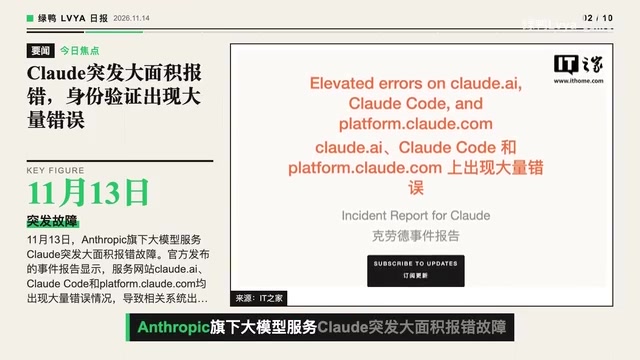
On November 13, Anthropic's large model service Claude experienced a sudden large-scale error outage. The official incident report shows that Claude.ai, Claude Code, and the platform website saw numerous errors, with the failure concentrated in the authentication layer.
The incident affected four services: the web client, console, coding tool, and collaboration product. The official announcement said the issue was under investigation and updates would be published as soon as possible. For developers relying on the Claude API, this kind of infrastructure failure is another reminder of the importance of a multi-model backup strategy.
The reason the authentication layer becomes a single point of failure is that it sits at the very front of every request: web login, console access, Claude Code's API authentication, and session validation for the collaboration product all must first go through the same authentication service to exchange for tokens. Once this layer fails, even if the underlying model inference cluster is running normally, external users cannot establish valid sessions, which manifests as errors across the entire product line simultaneously. The typical risk of this architecture is that authentication services often carry high concurrency with conservative caching strategies, and their scaling response is slower than the inference layer, so recovery takes longer. For developers, this explains why "multi-model backup" is not just redundancy at the model level, but also requires fallback plans for peripheral links such as authentication and gateways.
OpenAI Makes Multiple Moves: ChatGPT Wallet and Robotics Team Adjustment
On November 13, OpenAI partnered with three major card networks to launch the ChatGPT Wallet payment feature, with its Dot agent shopping on users' behalf by finding products and making purchases. Users enter a card once to transact, confirm a dedicated payment token through security verification, with the real card number isolated throughout and original card rewards preserved. Initially available only to Pro users aged 18 and over in the U.S., with an annual commission.
Separately, according to reports and official confirmation, OpenAI has disbanded its independent robotics team, with personnel merged into the main research and application departments. A spokesperson said this is not abandoning the direction: general large models have begun driving robots to perform tasks, and the team adjustment aims to accelerate research on general models that control hardware such as humanoid robots.
Local Inference Ecosystem Hits Milestone: llama.cpp and GGML Release 1.0.0
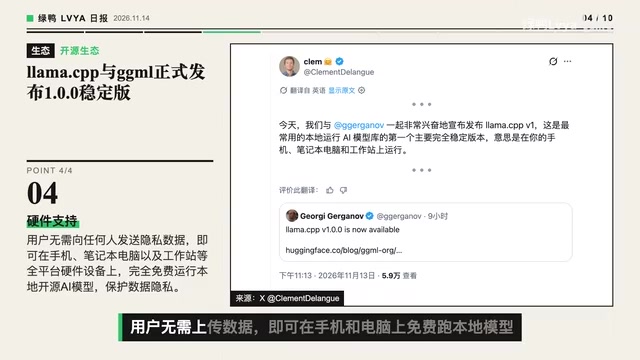
After 3.5 years of open-source iteration, the local inference library llama.cpp and the tensor library GGML have officially released version 1.0.0. The new version comprehensively cleans up deprecated interfaces and strengthens web interface protections, adds FP8 key-value cache and mixture-of-experts cache, and natively supports Kimi K3.1 Pro and Drama 3.
Users can run local models for free on phones and computers without uploading data. The 1.0.0 release marks local inference's transition from an experimental tool to production readiness, which is significant for privacy-sensitive applications and offline scenarios.
The relationship between llama.cpp and GGML is often confused: GGML is the underlying tensor computation library, responsible for defining data structures and executing matrix operations on backends such as CPU, Metal, and CUDA; llama.cpp is built on top of it, focusing on loading, quantization, and inference scheduling for large language models. The two iterated on 0.x versions for a long time with frequently changing interfaces, forcing many downstream projects to pin specific commits. Releasing 1.0.0 means the API is stabilizing, and downstream can manage dependencies by semantic versioning—this is the practical meaning of "from experimental tool to production ready."
FP8 key-value cache and mixture-of-experts cache are optimizations targeting VRAM usage. The key-value cache (KV Cache) stores already-computed keys and values in the attention mechanism to avoid recomputation when generating each new token, but its size grows linearly with context length. Storing it in FP8 can halve the cache with almost no loss in precision. Mixture-of-experts (MoE) models activate only some experts per inference, and caching the intermediate states of these experts reduces repeated loading, which is especially friendly to memory bandwidth on local devices.
Agent and Multimodal Models See Dense Updates
The agent platform Grogbot released a feature update, announcing that it can now join team meetings directly. Team members can ask it questions during meetings, assign stand-in tasks on the spot, or have it record decisions reached in discussion, extending one-on-one conversation to multi-person meetings for live Q&A and decision retention.
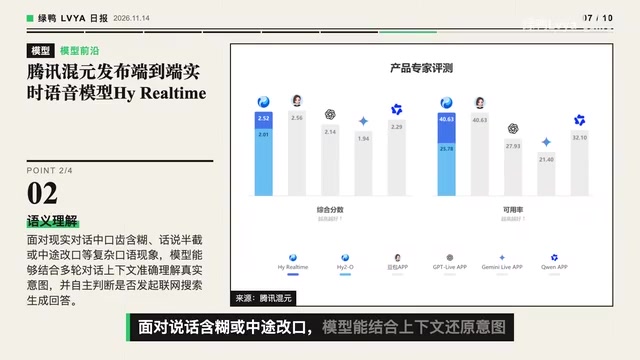
Tencent Hunyuan released the end-to-end real-time speech model Hi Real Time, adding autonomous tool calling and song-request singing capabilities. When faced with unclear speech or mid-sentence changes, the model can combine context to reconstruct intent and autonomously decide whether to initiate a search call; users can also specify genre or era when requesting songs. The new model is now live in Tencent Yuanbao and customer service, and will land on Tencent Cloud soon.
Meta recently released the personal agent extension MUSE on the Chrome Web Store, supporting a persistent browser sidebar for continuing conversations. Users can delegate tasks such as filling out forms, cross-site price comparison, and refund inquiries; key actions require user approval before execution, and the system keeps activity logs and supports revoking connector authorization at any time.
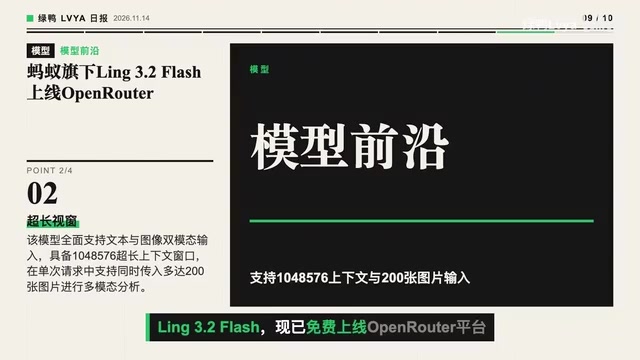
Ant Group's Inclusion AI launched the hybrid reasoning model Ling 3.2 Flash, now available for free on the OpenRouter platform. The model supports both image and text modalities, features an ultra-long context, supports up to 200 images per input, with a single output limit of 262144 tokens, enables deep-thinking reasoning by default, supports tool calling and structured output, and is priced at $0 per call.
The difference between an end-to-end real-time speech model and the traditional three-stage pipeline of "ASR → text LLM → TTS" is that each stage in the pipeline adds latency and accumulated error, and information such as tone, pauses, and mid-sentence changes in speech is lost when transcribed to text. The end-to-end approach models directly on speech representations, understanding both semantic and acoustic cues in a single forward pass—which is why it can handle "unclear speech or mid-sentence changes" and reconstruct intent using context. And precisely because the model retains the complete conversation state internally, it can autonomously decide whether to initiate tool calls and complete multi-step-decision tasks like song requests within the same session.
Nvidia Management Change Rumors Trigger Market Volatility
According to The Wall Street Journal, the main reason for Jensen Huang's departure from Nvidia's management points to a high-risk credit guarantee plan. Nvidia had reportedly discussed with OpenAI providing up to $250 billion in guarantees for a data center in Ohio; after the news broke, the stock fell 5%. Major cloud providers are now planning to adopt alternative chips to reduce dependence on Nvidia.
If true, this rumor would profoundly affect the AI compute supply chain landscape. Cloud providers' alternative chip plans combined with Nvidia's credit guarantee risk could accelerate the industry's migration from a single GPU supplier to diversified compute architectures.
Conclusion
From DeepSeek opening its full-suite API to Claude's global outage, from OpenAI's payments and robotics moves to the arrival of local inference 1.0, the AI infrastructure layer is undergoing dramatic restructuring. Developers have more choices than ever, but system resilience and multi-vendor strategies have also become more important than ever. Will you use DeepSeek's full-suite interfaces to replicate your own AI application?
Related articles

Gemini 4 Neon Leak: A Potential Strong Contender Against Opus 5.5
A Hacker News thread suggests Gemini 4 Neon looks like an Opus 5.5 competitor. This article unpacks the product positioning behind this community signal, shifts in the top-model competitive landscape, and what it means for developers' model selection strategy.

Claude Fable 5.2's Self-Authored Short Film 'Fable' Sparks Discussion
A short film 'Fable,' credited to Claude Fable 5.2 for script, visuals, and directing, appears on Hacker News. This article analyzes the significance of full-pipeline AI creation, community reactions, and what it means for content creators.

Anthropic IPO Pricing: A Signal of AI Giants Going Public
Anthropic's IPO pricing draws attention. This article analyzes its potential impact on AI industry valuation, commercialization paths, and the competitive landscape, and highlights public-market expectations and challenges for AI companies.