DeepSeek's Real Calculus Behind Open Source: Trading Weights for Ecosystem and Standards

DeepSeek's open source is a calculated exchange: expired weights for team, ecosystem, standards, and trust.
The article uses five pieces of evidence to analyze the business logic of DeepSeek's open-source strategy: it opens weights, code, papers, and training infrastructure but keeps the training data pipeline, making it open weights rather than full open-source AI. Founder Liang Wenfeng believes a closed-source moat is short-lived and the real moat is the team and culture. Extremely low training costs support extremely low pricing, making third-party self-hosting uneconomical, so open source won't hurt its API—but 100x profit would change that conclusion. Open source also lets cloud providers and chipmakers distribute for it; the more users, the more it resembles a standard. Open weights address the trust deficit in Western markets, and open-sourcing Ascend kernels turns compute constraints into ecosystem leverage. Financing terms preserve control, and open source doubles as a talent magnet. The conclusion: DeepSeek treats open source as a weapon to earn from the ecosystem and the future—math over ten years.
Handing the weights of its most powerful reasoning model to the world for free—what does DeepSeek get out of it? This Bilibili video lays out five pieces of evidence on one table to work out the math. The conclusion isn't romantic: open source isn't charity, but a carefully calculated exchange—trading weights that expire for a team, ecosystem, standards, and trust that don't.
What Was Open-Sourced, and What Was Kept
The first piece of evidence defines the boundary. DeepSeekAd opened up the weights, code, papers, and training infrastructure, with a license permitting commercial use, modification, redistribution, and even distillation. But the full pipeline for training data was not released. Strictly speaking, these are open weights, not open-source AI in the complete sense.
The trade-off is clear: what's opened is what can buy an ecosystem; what's kept is what can keep it alive. Handing out weights attracts developers and spawns downstream applications, while the data pipeline is the lifeline of model iteration—holding it is what gives it the first move for the next generation.
The difference between Open Weights and open-source AI: Open weights means the parameter files of a trained model can be downloaded, modified, and redistributed, but the training data, data-cleaning pipeline, and full details of the training code may not be public. Open-source AI in the complete sense (such as the OSI's Open Source AI definition) requires opening the training data and its processing flow, the training code, and the weights, so that others can reproduce the model. DeepSeek released the weights, inference code, papers, and part of the training infrastructure, but did not open the full pipeline of training data, so it is an open-weights model rather than fully reproducible open-source AI. This distinction directly affects whether downstream parties can independently audit model bias, reproduce training results, or improve data strategy from scratch.
Liang Wenfeng's Judgment: The Moat Is the Team, Not the Weights
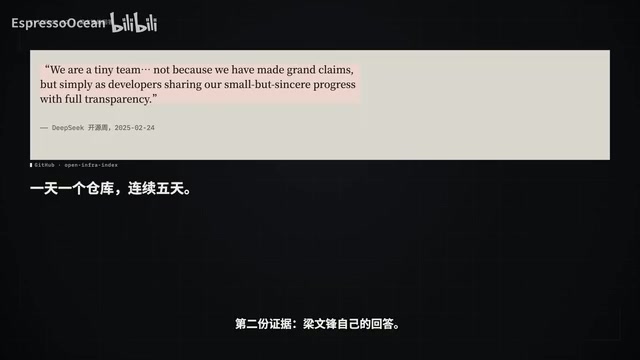
The second piece of evidence is the founder's own words. During 2025 Open Source Week, Liang Wenfeng released production-validated code in full, one piece per day. His logic: in the face of disruptive technology, a moat built through closed source is short-lived; the real moat is the team, the organization, and the culture. Open source is more a cultural act than a commercial one.
This passage deserves a close read. It elevates open source from a business strategy to a technological judgment: weights expire, teams don't. Having a strong technology ecosystem first matters far more than guarding a single model.
The Math: Why Open Source Didn't Kill Its API
The third piece of evidence is the cost structure. The full training of V3 used 2.788 million H800 GPU hours, about $5.57 million under the paper's assumptions; the RL stage of RE cost only about $294,000, but was built on a V3 base of about $6 million. In March 2025, V3-0324 changed the license to MIT, and the turning point arrived.

Only by pushing costs extremely low can prices be pushed extremely low. The video does the math: at current pricing, payback takes about 10 months, corresponding to roughly 6x profit. At this price point, third-party self-hosted deployment can't compete on cost, so open source won't hurt its API—anyone thinking of deploying it themselves will run the numbers and find it's better to just call the API. But if it wanted to earn 100x profit, open source would genuinely hurt it.
In other words, open source doesn't mean not making money; it means making only reasonable profit. In 2026, V4 reached 1.6T parameters, 49B activated, and a 1M context; V4.1 Flash is even cheaper and restores the deep modality, with pricing screws tightened into a reasonable range. This is a profit red line drawn on its own initiative.
GPU hours and training cost estimates: A GPU hour is a unit measuring compute consumption, i.e., one GPU running for one hour. The total cost of training a large model is usually estimated as "number of GPUs × runtime × unit price." The DeepSeek V3 report used 2.788 million H800 GPU hours, and at an assumption of about $2 per GPU hour, arrived at a training cost of about $5.57 million. This figure covers only the compute cost of a single training run, excluding R&D, data, labor, failed experiments, and cluster idle time, so the industry often treats it as a "lower bound" rather than the true total spend. Extremely low training costs allow its API pricing to be far below competitors while still maintaining reasonable gross margins.
Channels and Standards: Letting Cloud Providers Distribute for It
The fourth piece of evidence is channels. DeepSeek has no global sales team and no accumulated brand. Open source lets AWS, Azure, NVIDIA, Tencent, and Baidu distribute for it. The more people use the model, the more it looks like a standard. In 2026 it also open-sourced the Agent framework Harness, which got 95,000 stars in two days.
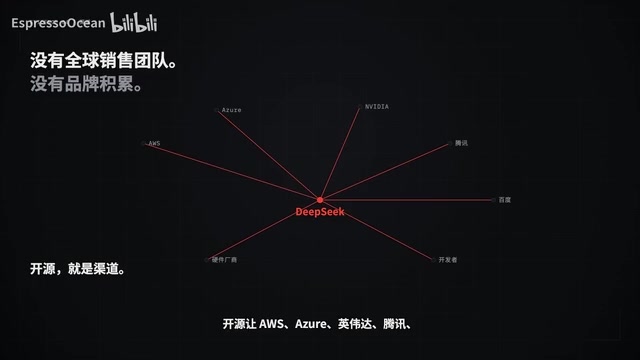
Open source isn't just a model; it's also an entry point. When a company has no sales force, making global cloud providers and chipmakers its distribution channels is the least effortful way to expand. The more users, the more stable the standard.
Trust Deficit and Compute Leverage
The fifth piece of evidence has two layers. The first is trust: Chinese AI companies face a trust deficit in Western markets, and open weights can be downloaded to one's own cloud and one's own data center, with data never leaving the country. Apps can be banned; weights cannot.
The second layer is compute. R2 failed training on Ascend, V4 was adapted to Ascend, and DeepSeek open-sourced the Ascend kernels. If you can't buy compute, turn the software ecosystem into leverage. This is a strategy forced by circumstances, and also a path to converting constraints into ecosystem influence.
The Ascend ecosystem and the CUDA alternative: Ascend is Huawei's AI chip series, paired with the CANN software stack and positioned as a domestic alternative to NVIDIA's CUDA ecosystem. Due to export controls, access to high-end NVIDIA GPUs is restricted, and Chinese AI companies need to migrate model training and inference to domestic compute such as Ascend. But migration isn't simply swapping hardware; it requires rewriting operators, adapting communication libraries, and tuning kernels. By open-sourcing Ascend kernels, DeepSeek effectively gives adaptation experience back to the ecosystem, lowering the migration barrier for other developers. This is both a forced compute self-rescue and a kind of ecosystem leverage: the more mature the software adaptation, the more usable Ascend becomes, the stronger the domestic compute ecosystem, and the more say DeepSeek gains in standard-setting as an early contributor.
Financing and Control: Open Source as a Talent Magnet
In 2026 DeepSeek raised financing for the first time: $7.4 billion, at a $50 billion valuation. But the terms preserved the founder's control—most external investors have no voting rights, with a five-year lock-up. One motive given in the video is to price employee options and retain core researchers.
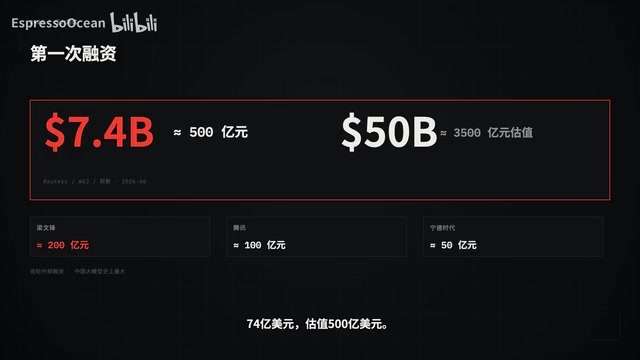
Open source plays a dual role here: it makes the company a talent magnet, and it makes talent more visible. The reputation researchers build in the open-source community is itself an incentive and a reference point for option pricing.
Open Source Hasn't Stopped, but Pressure Is Growing
V4 and V4.1 continue under MIT, Harness is also open-sourced, and open source hasn't stopped. But unresolved questions remain: will V5 continue under MIT? Will training data be opened? The video gives no answer, and that is precisely the next step most worth watching in this exchange.
Back to the original question. DeepSeek treats open source as a weapon, not charity; it's not that it doesn't want to make money, but that it chooses to make money from the ecosystem and from the future. Trading weights that expire for a team, ecosystem, standards, and trust that don't—this is math over ten years, not one.
Related articles

Codex App Complete Guide: From Installation to Hands-On Practice — AI Automatically Organizes Files and Builds Reports
Codex App complete guide: install from the app store, configure everyday work mode, and use real coffee shop data to practice file organization, Excel reports, and visual dashboards. Learn Plan Mode and the little pet feature — master Codex's AI automation workflow in one episode.

Getting Started with Langfuse: Building a Financial Analysis Agent and Evaluation Platform
A Langfuse tutorial: explore the core capabilities and boundaries of this open-source AI Engineer platform, and learn how to build an enterprise-grade log tracing, evaluation, and observability platform for a Harness-architecture financial analysis multi-agent system, covering prompt management, token cost analysis, and integration with frameworks like LangChain.

AI Agents Under Attack: Cursor Backdoor and the Binance Heist
This week in AI security: a Claude code backdoor in Cursor Marketplace, Binance's $6.3B laptop breach, VaporPanda's AI agent attacks on 200+ orgs, Gitbook and Chainalysis breaches, Polymarket's $2.7M loss, and Claude writing a root exploit in 53 minutes. Learn the latest AI agent attack trends and security recommendations.