DeepSeek Search Scraping Goes Free, GPT-6.2 Dual Models Released | AI Daily

OpenAI cuts and holds prices on two models, DeepSeek makes search free, Tencent open-sources a low-cost multimodal model; cost reduction and agent collaboration lead the day.
This piece rounds up several high-density AI developments of the day. OpenAI released GPT-6.2 series Astra and Sol, cutting the high-performance tier by about 20% while keeping the mid-tier price with capability upgrades for value. DeepSeek announced that search and web scraping are folded into token billing with no separate charge, though standalone Search and Fetch APIs remain per-call. Tencent open-sourced Hunyuan 4 Flash, FP8, and BASE weights, pushing API prices to an extremely low tier. On agents, Perplexity launched Multi-Agent and the Orchestrator API, Microsoft Copilot added Workspaces, and OpenAI launched ChatGPT for Sales. In voice transcription, Microsoft and ElevenLabs released products for general and medical scenarios respectively. The NVIDIA personnel rumor exists only as a secondhand account with no official announcement and should be treated with caution.
OpenAI released two new models at once, DeepSeek eliminated the cost barrier for search and web scraping, and NVIDIA saw an unconfirmed major personnel rumor. Information density was high today; below are the items with the greatest impact on developers and product teams.
OpenAI Releases Two Models: Astra Price Cut, Sol Stable
OpenAI released two models in the GPT-6.2 series: Astra and Sol. On pricing, Astra costs $8 per million input tokens and $40 per million output tokens, about 20% cheaper than the previous generation; Sol keeps the previous generation's pricing at $2 input and $10 output. Both models are available simultaneously in ChatGPT, Codex, and the API, each with a Pro version.
The pricing signals are fairly clear: the high-performance tier is actively cutting prices, while the mid-tier holds pricing steady and trades capability upgrades for cost-effectiveness. For teams doing model selection, Astra's lower cost means high-quality reasoning scenarios previously shelved due to budget can be re-evaluated; Sol continues to carry the bulk of everyday calls.
Token Billing and Per-Million-Token Pricing
LLM API costs are generally measured in tokens—the smallest segments the model splits text into when processing it. In English this roughly corresponds to words or word roots, while Chinese is often split by character or word. Vendors typically quote prices as "per million tokens": input price refers to the prompt sent into the model, output price refers to generated content, and the latter is generally 3–5x more expensive because decoding consumes more compute. Understanding this structure helps estimate real bills: the cost of a request is roughly input tokens × input unit price plus output tokens × output unit price. Long-context conversations, documents injected by RAG retrieval, and intermediate reasoning from repeated agent calls all significantly raise input-side usage, so Astra's 20% cut in a high-price tier often has a greater real impact on high-frequency reasoning scenarios than the headline number suggests.
Liang Shengyingming: DeepSeek Search and Scraping No Longer Billed
DeepSeekAd announced that starting November 18 at 12:00, search and web scraping will no longer be billed. Server-side search is billed only by tokens; the web tool and the two WebSearch tools will trigger this change; standalone Search and Fetch APIs remain charged per call.
This is an aggressive pricing move. Search augmentation is an unavoidable cost item for RAG-type applications; folding it into token billing turns "retrieval" from a separate line item into part of the model call, removing a variable from developers' cost calculations. For products relying on web search for real-time Q&A, the marginal cost structure will improve noticeably. The boundary to note: standalone APIs are not included in the free scope, so interface choice still affects the final bill.
Cost Structure of RAG and Web Search
RAG (Retrieval-Augmented Generation) means the model first retrieves relevant material from an external knowledge base or the web before answering, then inserts the retrieved results into the prompt and sends them to the model, mitigating stale knowledge and hallucination. Traditionally, retrieval and scraping are separately priced: one search request and one web scrape are each charged, settled separately from model token consumption. When search is folded into token billing, cost shifts from "per call" to "per volume," and developers only need to watch the size of prompts and generated content—the billing model becomes closer to a pure model call. This matters for real-time Q&A, sentiment monitoring, and price-comparison products, since such applications may issue tens of thousands of retrievals per day, and the old per-call fees often exceeded the model's own cost.
Tencent Open-Sources Three Versions Including Hunyuan 4 Flash
Tencent released the weights of three versions: Hunyuan 4 Flash, FP8, and BASE. The model has 2.20B total parameters, activates only 12B per token, and natively supports image understanding and long context. API pricing is $0.07 per million input tokens and $0.281 per million output tokens.
Small activated parameters combined with multi-version weight releases point to on-device and private deployment scenarios. This price point is quite low among open-source multimodal models, suitable as a baseline model for cost-sensitive applications that also need image understanding.
MoE Architecture, Total Parameters, and Activated Parameters
The description of Hunyuan 4 Flash—"2.20B total parameters, activates only 12B per token"—is a typical formulation of Mixture-of-Experts (MoE) architecture. An MoE model consists internally of multiple expert subnetworks and a routing network; during each forward pass the router selects only a few experts to participate, so total parameter count can be large while the parameters actually involved in computation per token (activated parameters) are far smaller. The benefit: memory footprint is counted by total parameters, but inference compute is counted by activated parameters, accommodating greater knowledge capacity at equal compute. Note that low activated parameters do not mean low deployment barriers—weight file size is still determined by total parameters. In the original text, "2.20B total parameters" and "12B activated" are numerically contradictory; normally total parameters exceed activated parameters, so the official model card should be authoritative.
NVIDIA Personnel Rumor: Treat with Caution
Jensen Huang posted on X acknowledging a serious mistake and saying he did not meet NVIDIA's standards for everyone. Another account claims the board unanimously accepted a resignation and does not plan to reinstate him.

No official NVIDIA announcement has been seen for this part; there is an information gap between the secondhand account and the original post, and it should not be circulated as established fact before official word emerges.
New Moves in Agents and Collaboration Layers
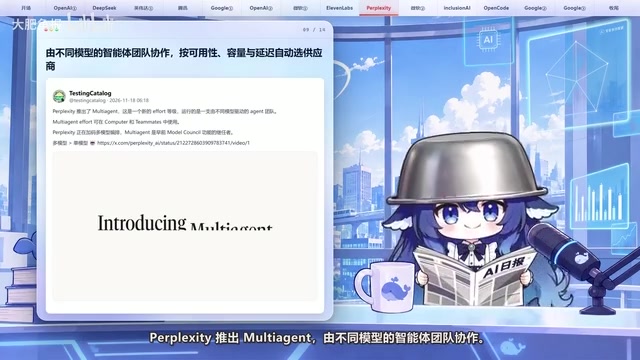
Perplexity launched Multi-Agent, in which teams of agents from different models collaborate on tasks, usable in Computer and Teammates, alongside the Orchestrator API—one key to call multiple models, automatically selecting vendors by availability, capacity, and latency.
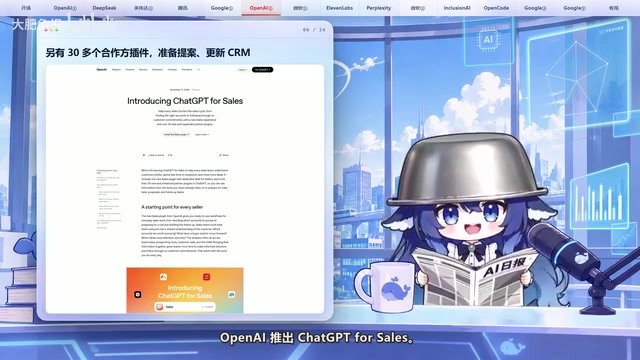
Microsoft Copilot added Workspaces teams and AI Agents, enabling shared-context collaboration, built on the earlier Projects and supporting invites. OpenAI launched ChatGPT for Sales, adding a Sales plugin plus 30+ partner plugins for researching prospects, preparing proposals, updating CRM, and closing deals.
Taken together, these point in the same direction: agents are moving from single-user tools toward team collaboration with permissions and shared context, and multi-model orchestration is being packaged into standardized APIs.
Voice, Transcription, and Real-Time Interaction
Microsoft released Transcribe Dragon and RealTime 1; the latter will power Copilot's voice mode, and reviewers say the experience approaches GPT Live but still needs testing. ElevenLabs launched Scribe VF Medical, purpose-built for real-time transcription of medical conversations, focusing on improving drug and procedure name accuracy, with support for up to 10,000 custom terms; in official tests medical term errors dropped by up to 48%.
Vertical-domain transcription is becoming its own track; engineering measures like custom glossaries solve real pain points better than simply scaling model parameters.
Full-Duplex and Real-Time Voice Interaction
Full-duplex means both parties can send and receive information simultaneously, rather than one speaking while the other waits to respond. In voice interaction, full-duplex means the model can keep listening while the user speaks and respond at the right moment, rather than waiting for silence detection to trigger—closer to the rhythm of human conversation. The hard parts are echo cancellation, interruption detection, and deciding "when to interject": the model must judge whether the user is pausing to think or has finished; interjecting too early interrupts the user, too late feels sluggish. ElevenLabs' custom glossary for medical scenarios addresses a different problem—specialized vocabulary lacks training samples in general acoustic models and is prone to transcription errors; hotword weighting can separately boost recognition accuracy for these terms, and such engineering measures are often more cost-effective than swapping in a larger model.
Other Notable Items
Gemini Tasks opened free to hundreds of millions of users in 6 countries—the US, Japan, South Korea, Canada, and Australia—powered by Gemini, able to call merchants to compare prices and check out with Google Pay, with advanced features launching first in the US. Google AI Studio supports directly purchasing custom domains, and US users can also download built Android apps to their devices.
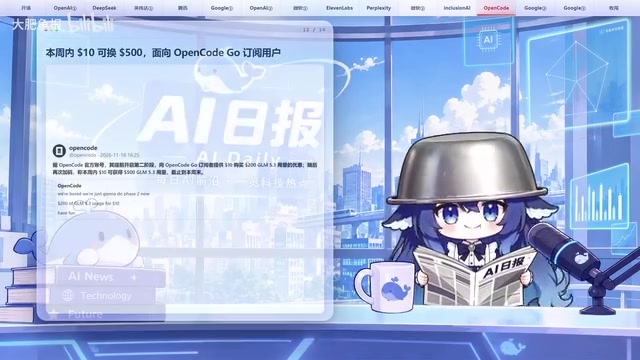
OpenCode's usage promotion got another boost: this week $10 buys $500 of GLM 5.3 usage, up from $10 for $200 in the same campaign earlier, for OpenCode Go subscribers.
Unconfirmed reports include: Gemini Neon has entered the cloud SKU catalog, with standard pricing exposed at $3 per million input tokens and $15 per million output tokens, and another claim that it has been added to the Anti-Gravity Client—neither officially confirmed. Inclusion Eye released D.O.V, claimed to be the first implementation of its reciprocal world model, supporting full-duplex real-time audio and video and judging when to interject.
Observations
Stringing today's items together, two main threads are clear. One is cost reduction: DeepSeek folds search into token billing, OpenAI cuts prices in the high-performance tier, and Tencent pushes multimodal model prices extremely low—cost constraints on developers' architectural choices are loosening. The other is form evolution: multi-agent collaboration, team context sharing, and multi-model orchestration APIs appearing simultaneously show the industry pushing "single Q&A" toward "continuous collaborative work units." When selecting models, look beyond benchmarks to whether these collaboration and billing structures fit your product path.
One-line Summary
OpenAI cuts and holds prices on two models, DeepSeek makes search free, Tencent open-sources a low-cost multimodal model; cost reduction and agent collaboration lead the day.
Paragraph Summary
This piece rounds up several high-density AI developments of the day. OpenAI released GPT-6.2 series Astra and Sol, cutting the high-performance tier by about 20% while keeping the mid-tier price with capability upgrades for value. DeepSeek announced that search and web scraping are folded into token billing with no separate charge, though standalone Search and Fetch APIs remain per-call. Tencent open-sourced Hunyuan 4 Flash, FP8, and BASE weights, pushing API prices to an extremely low tier. On agents, Perplexity launched Multi-Agent and the Orchestrator API, Microsoft Copilot added Workspaces, and OpenAI launched ChatGPT for Sales. In voice transcription, Microsoft and ElevenLabs released products for general and medical scenarios respectively. The NVIDIA personnel rumor exists only as a secondhand account with no official announcement and should be treated with caution.
Related articles

Jensen Huang Returns to Nvidia: The Power Game Behind an "Aggro Reset"
Nvidia's board reappointed Jensen Huang as CEO less than two weeks after his scandal-driven resignation. This analysis explores the board's decision-making, Trump's political intervention, media power failure, and market reaction behind the dramatic return.

Why Voice AI Can't Understand Kenyans' Everyday Conversations
Swahili speech recognition hits 3.24% error on read text, but everyday Kenyan speech mixes English, Sheng slang, and accents—leaving mainstream voice AI struggling.

Data Centers Build Their Own Natural Gas Plants: AI Compute's Breakout Around a Decade-Long Grid Wait
Grid interconnection approvals can take a decade, so xAI and others are building off-grid natural gas plants to power AI clusters. This article analyzes the drivers, costs, and impact of behind-the-meter generation on AI infrastructure.