DeepSeek-TUI: A Free Claude Code Alternative at 20x Lower Cost Tops GitHub Trending

DeepSeek-TUI: A free open-source terminal AI coding agent tops GitHub Trending
DeepSeek-TUI is a terminal AI coding agent written in Rust that functions like Claude Code but is completely free, gaining 2,400 stars in one day to top GitHub Trending. It offers file editing, shell commands, web search, MCP integration, and more — all in just 12MB of memory, with output costs 20x cheaper than Claude Code. While it still lags in error recovery and stability, its rapid iteration speed represents an important step toward democratizing AI coding tools.
This week's #1 spot on the GitHub Trending chart was claimed by a project called DeepSeek-TUI — a single binary written in Rust that wraps DeepSeek models into a Claude Code-like terminal AI coding agent. It's completely free, gained 2,400 stars in a single day, and has sparked widespread attention across the developer community.
What Is DeepSeek-TUI? A Free Terminal AI Coding Agent
DeepSeekAd-TUI is a terminal user interface (TUI) tool that, through a single Rust binary, gives developers a complete terminal agent loop. It supports file editing, shell command execution, web search, MCP server integration, and even sub-agent invocation — all running locally with no browser required.
The default backend models are DeepSeek R1 and the latest trillion-parameter model. Installation requires just one command (via npm), and once launched you'll see an interface with three modes: Normal, Plan, and YOLO. The status bar displays real-time token consumption and cost — a critical feature for cost-conscious developers.
Why Did It Top GitHub Trending? Three Core Advantages
The project's explosive popularity boils down to three reasons:
First, the experience mirrors Claude Code, but it's completely free. Give it a buggy file, and it will read, plan, edit, and display the code diff directly — virtually identical to Claude Code's workflow.

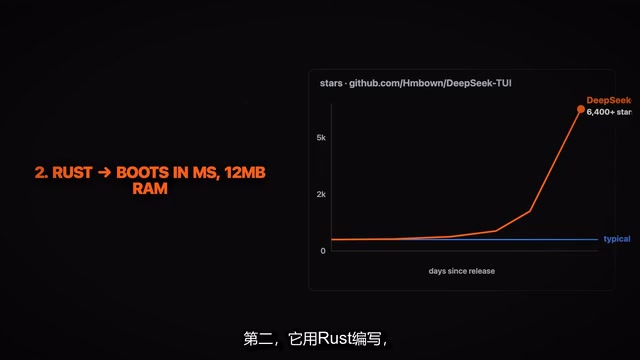
Second, it's extremely lightweight. Being written in Rust means startup takes just a few milliseconds, with only 12MB of memory usage when idle. Compared to Electron apps that easily consume hundreds of megabytes, this resource efficiency is impressive.
Third, the update frequency is remarkable. The maintainer seems to be on a permanent hackathon — from version 0.8 to 1.2 alone, they've shipped 68 releases and merged 20 Pull Requests. This iteration speed is quite rare in open-source projects.
DeepSeek-TUI's Comprehensive Feature Coverage
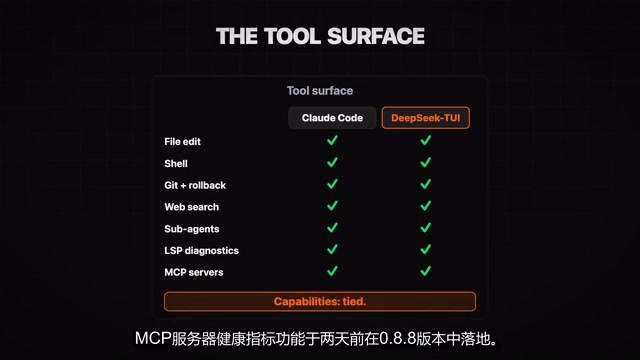
From a tooling perspective, DeepSeek-TUI's feature matrix is remarkably complete:
- File Operations: Read, write, edit with confirmation mechanisms
- Shell Commands: Deep terminal integration with rollback support
- Web Search: Built-in search capability
- Sub-agents: Concurrency limit control
- LSP Diagnostic Injection: Real-time compiler error capture
- MCP Server: Full Model Context Protocol support
- Health Metrics: Monitoring functionality added in version 0.88 just two days ago
DeepSeek vs Claude Code Cost Comparison: A 20x Price Gap
What truly set the internet ablaze is the cost comparison. Claude Sonnet 4.6 is priced at $3 per million input tokens and $15 per million output tokens; DeepSeek is priced at $0.14 per million input tokens and $0.28 per million output tokens.
Output costs are a full 20x cheaper. In practice, completing an editing task might cost just 3 cents — not 3 dollars, 3 cents. For developers who heavily use AI coding assistants daily, this price gap is enough to change decisions.
Can DeepSeek-TUI Really Replace Claude Code?
The answer is: Not entirely.
In coding benchmarks, DeepSeek and Claude Sonnet are within 1% of each other on SWE-bench, performing quite comparably. However, in general knowledge, Sonnet still leads with a score of 74 vs 63.

More critically, there are differences in the actual usage experience: Claude Code's agent performs better at error recovery, while DeepSeek-TUI is more prone to getting stuck in infinite loops. The capability is there, but the polish isn't quite there yet.
Who Should Try DeepSeek-TUI, and Who Should Stick with Claude Code?
Based on different use cases, here are the recommendations:
People who should try DeepSeek-TUI immediately:
- Those paying $200/month for Claude Code Max but primarily doing scaffolding, code refactoring, or writing scripts
- Developers who prefer self-hosting and prioritize privacy and data control
- Geeks who are obsessed with excellent terminal tools
People who should continue using Claude Code:
- Those deploying production agents where failures are unacceptable
- Those who need reliable error recovery and complex task handling
- Critical business scenarios with extremely high code quality requirements
Conclusion: An Important Step Toward Democratizing AI Coding Tools
The emergence of DeepSeek-TUI represents an important milestone in the democratization of AI coding tools. It proves that through the combination of open-source models + a lightweight client, you can replicate the core experience of top commercial products at extremely low cost. While there's still a gap in stability and error handling, given its remarkable iteration speed, these issues may be resolved very soon.
For most developers, it's worth at least 10 minutes to install and try it out — after all, the cost of experimentation might only be a few cents.
Related articles
 Tech Frontiers
A Rare Quiet Day in AI: Recursive Self-Improvement Stirs Beneath the Surface
A rare quiet day in AI sees multiple sources go silent simultaneously. Behind the calm, Recursive Self-Improvement (RSI) research continues. What this means for the industry.
 Tech Frontiers
Reve 2 vs. Ideogram 4: A Deep Dive into Layout Control in AI Image Generation
A deep comparison of Reve 2 and Ideogram 4's layout control capabilities, covering technical approaches, real-world use cases, and industry trends for designers and creators.
 Tech Frontiers
In the Weights: Check Your Influence Score in the AI World
In the Weights is an AI influence search engine that quantifies your presence in the AI world with a score. Explore how it evaluates practitioners and what it means for digital identity.