DeepSeek V3.2 Deep Dive: Three Major Breakthroughs in DSA Sparse Attention, Reinforcement Learning, and Agent Capabilities

DeepSeek V3.2 launches with three technical breakthroughs reaching GPT-5-level performance
DeepSeek released V3.2 and V3.2 Special—the former a balanced everyday model at GPT-5 level, the latter an extreme reasoning variant ranking world-first on multiple math competitions. Core breakthroughs include DSA sparse attention for dramatically faster long-context processing, scaling RL compute to 10% of pre-training for continuous reasoning improvements, and a large-scale Agent task synthesis pipeline across 1,800 environments enabling innovative "thinking while calling tools" capability.
DeepSeek recently surprised the AI community by releasing two new models—DeepSeek V3.2 and DeepSeek V3.2 Special. While the version numbers suggest a minor iteration, official benchmark data shows these models rival GPT-5 and compete directly with Gemini 3.0 Pro. This article provides a comprehensive breakdown of DeepSeek V3.2's core technical breakthroughs from three perspectives: official release information, paper technical details, and hands-on testing.
DeepSeek V3.2 vs. V3.2 Special: Positioning and Capability Differences
The two models released by DeepSeekAd have clearly differentiated positioning. DeepSeek V3.2 is a balanced, everyday-use model now fully available on the official website, app, and API. Its overall capability reaches GPT-5 level, only slightly below Gemini 3.0 Pro, while maintaining a clear advantage over other domestic open-source large models.
DeepSeek V3.2 Special is an extreme reasoning variant currently available only through the API, making it more suited for developers. This version achieves world-first rankings on multiple top-tier competition benchmarks, including AMC/AIME, the Harvard-MIT Mathematics Tournament, and the International Mathematical Olympiad—surpassing both GPT-5 and Gemini 3.0 Pro. Notably, the model was not specifically trained on these competition tasks, meaning its reasoning ability represents genuine generalization rather than overfitting.
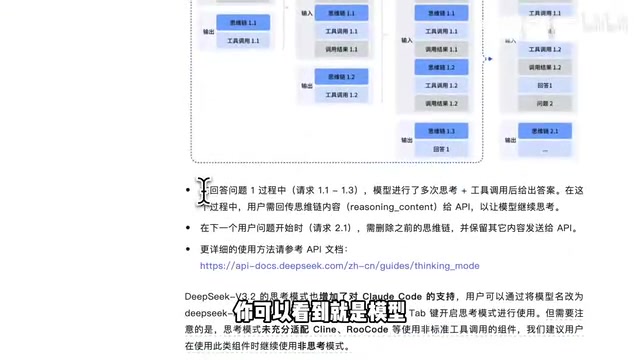
Both models continue DeepSeek's tradition of open-sourcing. Additionally, V3.2 features a notable new capability—thinking while calling tools—something never seen in any previous model. The model can interleave search, web scraping, and other tools within its chain-of-thought reasoning process, alternating between thinking and retrieval multiple times before delivering a final answer.
Technical Background: The Evolution of Agent and Tool-Use Paradigms Large model tool-use capability (Tool Use / Function Calling) was first systematically introduced by OpenAI in the 2023 GPT-4 API, allowing models to call external functions via structured JSON format. However, in early implementations, chain-of-thought reasoning and tool calling were strictly sequential: the model would complete a reasoning segment, decide whether to call a tool, wait for results, then continue reasoning. This pattern leads to rigid reasoning paths in complex tasks, preventing the model from dynamically adjusting its thinking direction based on intermediate tool results. DeepSeek V3.2's "thinking while calling tools" essentially achieves a native fusion of the ReAct (Reasoning + Acting) framework with deep chain-of-thought, making tool calls an intrinsic part of the reasoning process rather than a bolted-on post-processing step. This aligns closely with Anthropic's exploration of "extended thinking + tool use" in Claude, representing an important evolutionary direction for Agent architectures.
Three Core Technical Breakthroughs Explained
According to the DeepSeek V3.2 paper, this upgrade features three key technical innovations, achieving breakthroughs in attention mechanisms, reinforcement learning, and Agent capabilities respectively.
DSA Sparse Attention: Faster and More Accurate Long-Context Processing
Long-context processing has always been a performance bottleneck for large models. Traditional attention mechanisms require every token to interact with all other tokens in the context, resulting in quadratic computational complexity growth—like a party where every new arrival must shake hands with everyone already present; 100 people would require nearly 5,000 handshakes.
Technical Background: The O(n²) Dilemma of Attention Mechanisms Self-Attention in the Transformer architecture has been the core component of large language models since its introduction in 2017, but its O(n²) computational complexity remains the fundamental bottleneck constraining long-context processing. Specifically, for a sequence of length n, standard attention requires computing an n×n attention matrix. When the context window expands from 4K to 128K or longer, memory usage and computation time explode quadratically. The research community has proposed various sparsification approaches, including Longformer's sliding window attention, BigBird's random+local+global hybrid attention, and the FlashAttention series of IO-aware optimizations. DSA's innovation lies in introducing a dynamic importance-aware selection mechanism rather than static positional patterns, making sparsification more aligned with actual semantic needs and achieving a better balance between speed and accuracy.
DeepSeek's proposed DSA (DeepSeek Sparse Attention) mechanism adopts a strategy of "only shaking hands with important people." The model first performs a quick scan (called Lightning Attention in the paper) to identify the most critical tokens, then only performs deep interaction with these key tokens. This way, each token might only need to interact with 20 important tokens, drastically reducing total computation.
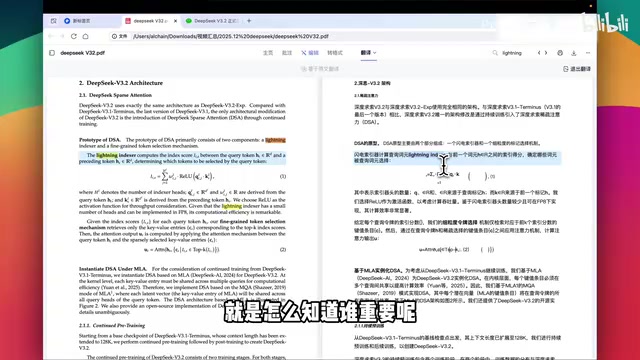
Training proceeds in two steps: Step one is "teaching the doorman to read people"—first run full attention to find the truly important tokens, then use these results to train a lightweight selector. Step two is "the doorman and the host work independently"—the selector and main model are trained separately to avoid mutual interference.
A counterintuitive finding: DSA sparse attention is not only faster but actually more accurate on certain tasks. The reason is that many tokens are essentially "distractors" irrelevant to the current reasoning; skipping them actually helps the model focus on useful information.
Scalable Reinforcement Learning Framework: Post-Training Compute Reaches 10% of Pre-Training
Another core competitive advantage of DeepSeek lies in large-scale reinforcement learning. They've scaled the reinforcement learning compute in the post-training phase to approximately 10% of pre-training, while most companies maintain this ratio at only 1%-5%.
Technical Background: The Evolution of RL in Large Model Post-Training The history of reinforcement learning for language model alignment dates back to OpenAI's 2022 proposal of RLHF (Reinforcement Learning from Human Feedback), whose core idea is training a reward model to simulate human preferences, then using PPO to optimize the language model. However, RLHF suffers from reward model instability and high training costs. DeepSeek previously pioneered large-scale adoption of GRPO (Group Relative Policy Optimization) in their R1 series, bypassing the need for a separate reward model by providing reward signals directly through rule verification (such as mathematical answer correctness). Scaling post-training RL compute to 10% of pre-training means running additional training on thousands of GPUs continuously for weeks, placing extreme demands on training stability, reward design, and infrastructure—which is the fundamental reason most labs cannot replicate this capability at the same scale.
DeepSeek observed an important pattern: continuously increasing reinforcement learning compute consistently improves model performance, and they haven't yet hit a ceiling. Their hypothesis is that reasoning capabilities can be further improved by increasing the compute budget. This ability to "bet heavily on RL while maintaining training stability" is a technical moat that many other companies struggle to replicate.
Large-Scale Agent Task Synthesis: 1,800 Environments × 85,000 Complex Instructions
To train the model's "thinking while using tools" capability, DeepSeek built a large-scale Agent task synthesis pipeline encompassing 1,800 environments and over 85,000 complex instructions.
The core design philosophy is "Hard to solve, but easy to verify"
Related articles
Deep Dive into AI Agent Skill Design: …
Deep Dive into AI Agent Skill Design: Engineering Practices from Anthropic and Perplexity
A deep dive into Skill design philosophy from Anthropic's Claude Code team and Perplexity's Agent team, covering the Tax Test, Gotchas Flywheel, progressive disclosure, and Eval-First practices for building high-quality AI Agent skill systems.
Deep Dive into OpenAI's Official GPT-5…
Deep Dive into OpenAI's Official GPT-5.6 Prompting Guide: The Shift from Manual to Automatic
A deep dive into OpenAI's official GPT-5.6 Sol prompting guide: conciseness-first, outcome-oriented design, autonomy boundaries, tool routing, and reasoning intensity tuning.
 Deep Dives
Deep Dive into How OpenClaw (Open-Source Crayfish) AI Agent Works
Deep analysis of OpenClaw AI Agent internals: System Prompt, tool calling, SubAgents, Skill system, memory, and Context Engineering explained.