DeepSeek V3.2 Released: Reasoning on Par with GPT-5, First to Integrate Deep Thinking into Tool Use

DeepSeek V3.2 open-sourced with GPT-5-level reasoning, first to integrate thinking into tool use.
DeepSeek V3.2 is officially open-sourced with reasoning capabilities reaching GPT-5 levels across multiple benchmarks, second only to Gemini 3.0 Pro. Its core breakthrough is being the first in the industry to deeply integrate thinking with tool use, fundamentally solving the problem of incorrect calculations in large models. The long-thinking version V3.2 Specialty won an IMO 2025 gold medal, and its agent capabilities reach the highest open-source level, marking the first time open-source models truly approach the closed-source ceiling.
DeepSeek V3.2 Released: The Strongest Reasoning Model Arrives in the Open-Source Community
DeepSeekAd V3.2 has been officially released and open-sourced, marking another major upgrade following V3. Across multiple benchmark tests, DeepSeek V3.2's reasoning capabilities are on par with GPT-5, second only to Gemini 3.0 Pro, placing it firmly in the global top tier. Even more noteworthy is that DeepSeek V3.2 is the first model in the industry to integrate deep thinking capabilities into tool use.
For developers and everyday users alike, a free, open-source, and top-performing large model is now within reach.
DeepSeek V3.2 Reasoning: Balancing Deep Thinking with Practical Efficiency
The core design philosophy of DeepSeek V3.2 is to balance reasoning capability with output length, making the model better suited for everyday use cases. Unlike some models that pursue maximum reasoning depth at the cost of verbose outputs, V3.2 maintains powerful reasoning while controlling output length, helping users access key information more efficiently.
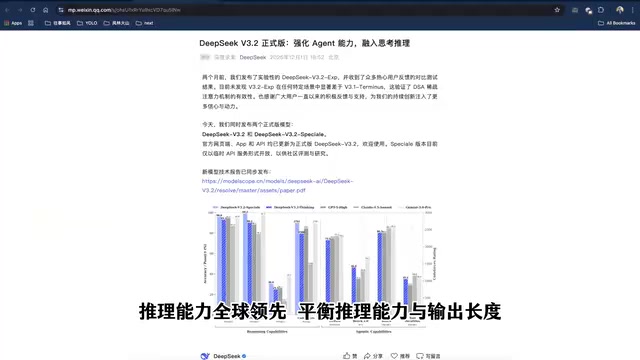
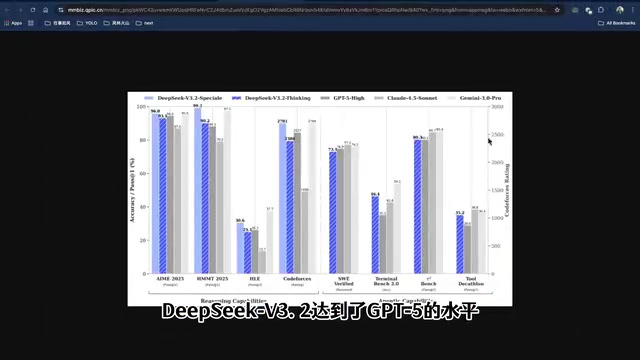
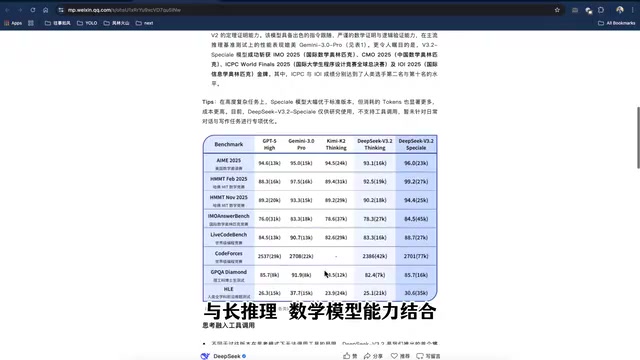
In reasoning benchmarks, DeepSeek V3.2's performance is remarkably impressive—reaching GPT-5 levels, second only to Google's Gemini 3.0 Pro. Benchmarks are standardized evaluation systems used in the AI field to measure model capabilities. Common reasoning benchmarks include MMLU (Massive Multitask Language Understanding), GPQA (Graduate-Level Question Answering), ARC-Challenge (Science Reasoning), MATH (Mathematical Problem Solving), and more. These tests cover multiple dimensions including logical reasoning, mathematical computation, code generation, and scientific knowledge, providing unified scoring standards that enable comparability between different models. DeepSeek V3.2's strong performance across multiple benchmarks demonstrates that its reasoning capabilities have robust generalization rather than being overfitted to specific tests.
As a fully open-source model, this achievement means the open-source community has, for the first time, truly approached the ceiling of closed-source models in reasoning capability. The DeepSeek series uses a Mixture of Experts (MoE) architecture—an efficient design that maintains a massive total parameter count while only activating a subset of parameters during each inference pass. Compared to traditional Dense models, MoE architecture can accommodate more knowledge and capabilities at the same computational cost. DeepSeek V3's predecessor used a 671B total parameter, 37B active parameter MoE design, offering significant advantages in both training efficiency and inference cost. This architectural choice enables DeepSeek to achieve comparable or even superior performance at far lower training costs than competitors, forming the technical foundation that sustains its open-source strategy.
DeepSeek V3.2 Specialty: Long-Thinking Version Wins IMO 2025 Gold Medal
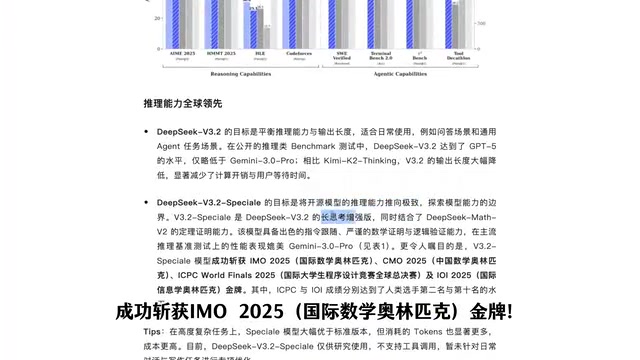
DeepSeek V3.2 also introduces a special version—DeepSeek V3.2 Specialty—a "long-thinking version" specifically optimized for long-chain reasoning. This version successfully won a gold medal at IMO 2025 (International Mathematical Olympiad), proving its top-tier capabilities in complex mathematical reasoning.
The International Mathematical Olympiad (IMO), founded in 1959, is the world's largest and most prestigious mathematics competition for high school students, with over 100 countries and regions participating annually. IMO problems typically span four major areas: algebra, geometry, number theory, and combinatorics, with each problem requiring rigorous mathematical proofs rather than simple numerical calculations. AI performance on the IMO has long been considered one of the ultimate benchmarks for mathematical reasoning ability. In 2024, Google DeepMind's AlphaProof and AlphaGeometry 2 first reached silver medal level on IMO-level problems, generating widespread attention. DeepSeek V3.2 Specialty's gold medal at IMO 2025 marks another leap in AI mathematical reasoning capability, demonstrating that long-chain reasoning (where the model performs extensive intermediate reasoning steps before outputting a final answer) is crucial for solving complex mathematical problems.
This also marks another critical step forward for AI in the domain of mathematical reasoning.
Core Breakthrough: Integrating Thinking into Tool Use, Solving the "Can't Calculate Correctly" Problem
If the improvement in reasoning capability represents quantitative change, then integrating thinking into tool use is DeepSeek V3.2's most revolutionary qualitative breakthrough.
Traditional large models frequently produce incorrect results when facing problems requiring precise calculations. The fundamental reason behind this lies in the core working principle of Large Language Models (LLMs)—autoregressive text generation based on the Transformer architecture. The model predicts the next most probable token one by one based on existing context, essentially performing sampling over a probability distribution rather than executing deterministic mathematical operations. When the model encounters a problem like "127×389=?", it isn't actually performing multiplication—it's "guessing" the answer based on patterns in training data. For simple calculations, the model might produce correct answers because it has seen enough similar cases in training data, but error rates increase significantly for complex or rare numerical calculations.
DeepSeek V3.2 fundamentally solves this pain point by deeply integrating deep thinking capabilities with tool use (such as calculators, code executors, etc.). Tool Use / Function Calling refers to the ability of large models to identify subtasks that require external tools during response generation, automatically generate structured function call requests, and continue reasoning after receiving tool results. Common external tools include calculators, code interpreters (such as Python sandboxes), search engines, database query interfaces, API services, and more.
OpenAI first introduced Function Calling in the GPT-3.5 era, but in early implementations, the model's "thinking process" and "tool calling" were relatively disconnected—the model would think first, then decide whether to call a tool, lacking deep interaction between the two. DeepSeek V3.2's innovation lies in deeply fusing Chain-of-Thought reasoning with tool calling, allowing the model to insert tool calls at any point in the reasoning chain and use tool results as input for subsequent reasoning, forming a closed loop of "think-call-verify-think again."
Specifically, during reasoning the model can autonomously determine when to call external tools for computation assistance or verification, seamlessly integrating tool results into the reasoning chain. This brings three significant advantages:
- Precise numerical computation: No longer relying on probabilistic guessing, obtaining accurate results through actual computation
- Tackling complex multi-step problems: Combining long reasoning capability with tool use to solve previously intractable complex tasks
- Improved result reliability: Verifying critical steps in the reasoning process through tools, effectively reducing hallucinations and errors
DeepSeek V3.2 is the first in the industry to integrate thinking into tool use, opening entirely new possibilities for practical applications of large models.
Agent Capabilities: Reaching the Highest Level Among Open-Source Models
In agent evaluations, DeepSeek V3.2 has reached the highest level among current open-source models.
AI Agents are AI systems capable of autonomously perceiving their environment, formulating plans, executing actions, and adjusting strategies based on feedback. Unlike traditional single-turn Q&A, agents need comprehensive capabilities including task decomposition, multi-step planning, tool selection and use, error recovery, and multi-turn interaction. Currently, commonly used agent evaluation benchmarks in the industry include SWE-bench (software engineering tasks), WebArena (web operation tasks), GAIA (general AI assistant evaluation), TAU-bench (tool use evaluation), and more. These evaluations simulate complex real-world task scenarios, requiring models not only to understand instructions but also to autonomously plan execution paths and handle various exceptions during the process.
DeepSeek V3.2 reaching the highest open-source level in agent evaluations means it has taken an important step in evolving from a "conversational assistant" to an "autonomous executor." Whether it's automated workflows, data analysis, or complex multi-step task processing, V3.2 can handle it all.
The DeepSeek official API has been updated simultaneously, and developers can integrate and use it immediately.
Impact of DeepSeek V3.2 on the AI Industry and Outlook
The release of DeepSeek V3.2 has profound implications for the entire AI industry:
Lowering the barrier to high-quality AI: An open-source model with reasoning capabilities on par with GPT-5 will greatly advance the open-source ecosystem. The AI large model space has long seen competition between open-source and closed-source camps. The closed-source camp is represented by OpenAI (GPT series), Google (Gemini series), and Anthropic (Claude series), operating through paid API access business models; the open-source camp is represented by Meta (Llama series), DeepSeek, Mistral, Alibaba (Qwen series), and others, making model weights publicly available for community use and secondary development. Open-source models offer advantages in transparency, customizability, and low-cost deployment, but typically lag behind top closed-source models of the same era in core capabilities. DeepSeek V3.2 is changing this landscape—small and medium enterprises and individual developers no longer need to rely on expensive closed-source APIs to access top-tier reasoning capabilities.
Pointing the direction for technical development: The innovation of integrating thinking into tool use provides an important reference for large model development—future AI must not only "think" but also "use tools," and the deep integration of both will unlock enormous potential.
Reshaping industry competition: When open-source models approach or match closed-source models in core capabilities, the competitive logic of the entire industry will undergo fundamental change. Closed-source models will need to find new moats in differentiation and ecosystem services.
The release of DeepSeek V3.2 once again proves that Chinese AI teams have achieved world-class competitiveness in the large model domain. With the model open-sourced and API available, we have every reason to expect more innovative applications built on V3.2 to emerge.
Key Takeaways
- DeepSeek V3.2 reaches GPT-5 level in reasoning benchmarks, second only to Gemini 3.0 Pro, becoming the strongest open-source large model
- The long-thinking version DeepSeek V3.2 Specialty wins a gold medal at IMO 2025
- First in the industry to integrate deep thinking into tool use, fundamentally solving the problem of incorrect calculations in large models
- Reaches the highest level among open-source models in agent evaluations, with the official API updated simultaneously
Related articles
 Tech Frontiers
A Rare Quiet Day in AI: Recursive Self-Improvement Stirs Beneath the Surface
A rare quiet day in AI sees multiple sources go silent simultaneously. Behind the calm, Recursive Self-Improvement (RSI) research continues. What this means for the industry.
 Tech Frontiers
Reve 2 vs. Ideogram 4: A Deep Dive into Layout Control in AI Image Generation
A deep comparison of Reve 2 and Ideogram 4's layout control capabilities, covering technical approaches, real-world use cases, and industry trends for designers and creators.
 Tech Frontiers
In the Weights: Check Your Influence Score in the AI World
In the Weights is an AI influence search engine that quantifies your presence in the AI world with a score. Explore how it evaluates practitioners and what it means for digital identity.