DeepSeek-V4.1-Flash-1017 Released: A Pareto Improvement in Both Performance and Cost

DeepSeek releases V4.1-Flash-1017, claiming Pareto improvements in performance, speed, and output conciseness.
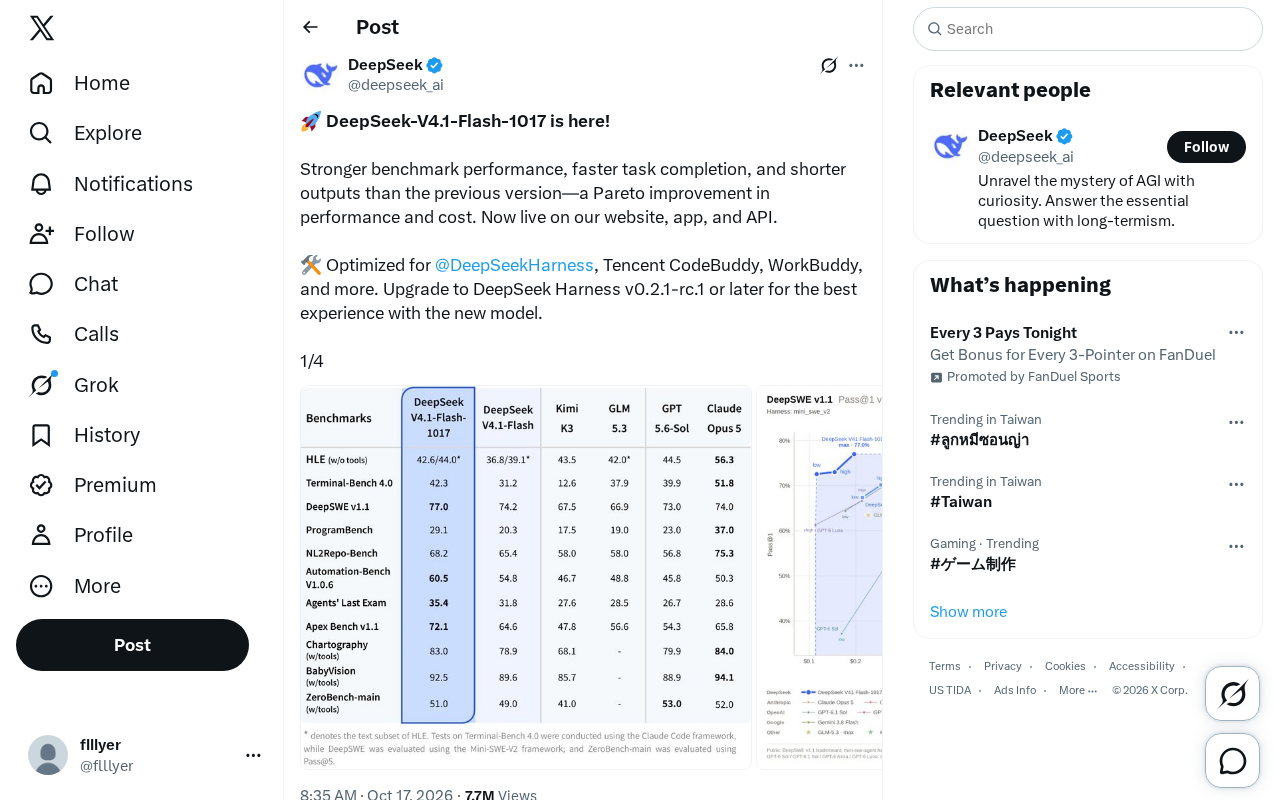
DeepSeek has released DeepSeek-V4.1-Flash-1017, described as a "Pareto improvement in performance and cost": stronger benchmarks, faster task completion, and shorter outputs, with no regression in any dimension. It is live on the official website, app, and API, and optimized for tools including DeepSeek Harness, Tencent CodeBuddy, and WorkBuddy; Harness needs upgrading to v0.2.1-rc.1 or above. Shorter outputs mean lower token consumption and faster responses, offering direct cost benefits for high-frequency API use. However, official details on benchmark scores, competitor comparisons, and cost reductions remain undisclosed, pending technical reports or third-party evaluations.
DeepSeek today officially released the DeepSeek-V4.1-Flash-1017 model through its official channels, positioning it as a "Pareto improvement in performance and cost"—simultaneously improving benchmark performance, task completion speed, and output conciseness. The model is now available on the official website, app, and API.
Core Upgrades: Faster, Stronger, Shorter
According to the official announcement, V4.1-Flash-1017 delivers three quantifiable improvements over the previous version: stronger benchmark scores, faster task completion, and shorter outputs. Together, these three improvements constitute what the company calls a "Pareto improvement"—an overall gain achieved without sacrificing any single metric.
The "shorter output" point deserves attention. At a time when large models generally pursue longer context windows and more detailed answers, DeepSeekAd is bucking the trend by emphasizing output conciseness. This likely reflects consideration of real-world usage scenarios: shorter outputs mean lower token consumption and faster response times, which translates directly into cost savings for API callers. The fact that the official announcement places "performance" and "cost" side by side corroborates this inference.
However, the official announcement did not disclose specific benchmark names, score comparisons, or the magnitude of cost reductions. These details will need to be filled in by subsequent technical reports or third-party evaluations.
The term token, which appears repeatedly in the text, is the basic unit of measurement for how large models process text, roughly corresponding to a word or word fragment; in Chinese contexts, one character or one common word typically approximates one token. API billing, context window limits, and generation speed are all based on tokens: input and output tokens are priced separately, with output typically costing more per unit, so "shorter output" directly reduces the bill for callers. At the same time, generating each token requires a forward computation, so the shorter the output, the shorter the end-to-end response time and the lower the perceived latency for users. This is also why, when optimizing costs, vendors compress output volume by reducing redundant phrasing and controlling reasoning length in addition to lowering per-token prices. When evaluating such improvements, one should pay attention to both the per-token price and the actual number of output tokens—only the product of the two constitutes the true cost of a single task.
Ecosystem Integration: From Harness to Tencent CodeBuddy
Another highlight of the new model is ecosystem integration. The company explicitly stated that V4.1-Flash-1017 has been optimized for tools including DeepSeekHarness, Tencent CodeBuddy, and WorkBuddyAd. This means the model is not being released in isolation but is deeply tied to coding assistance and task orchestration tools.
For developers using DeepSeek Harness, the company provided clear upgrade guidance: users must upgrade to v0.2.1-rc.1 or higher to get the best experience with the new model. This synchronized "model + toolchain" upgrade pattern reflects DeepSeek's efforts to strengthen the closed loop of its developer ecosystem—model capability improvements can only be fully unlocked through supporting tools.
The appearance of Tencent CodeBuddy is also worth noting. As Tencent's coding assistant product, its optimization and adaptation for DeepSeek's new model suggests that the two parties may have deeper technical collaboration in code generation scenarios.
DeepSeek Harness is the model runtime and evaluation toolchain that DeepSeek provides to developers, typically used for unified management of model calls, orchestration of task workflows, running benchmarks, and debugging prompts and tool calls. It can be understood as the middleware layer connecting model APIs to application scenarios. Such toolchains are highly sensitive to model version compatibility: if a new model adjusts output formats, tool-calling protocols, or reasoning behavior, an older version of Harness may fail to fully leverage its capabilities or may even encounter parsing failures. This is precisely why the company requires upgrading to v0.2.1-rc.1 or higher. Here, "rc" stands for release candidate, meaning the version may still be subject to further adjustments; before upgrading in production environments, it is advisable to fully validate in a test environment and lock dependency versions to avoid the uncertainty introduced by automatic upgrades.
What a Pareto Improvement Means
Against the backdrop of accelerating large-model iteration cycles, "Pareto improvement" is a weighty claim. It means the new version has not regressed on any of the three dimensions—performance, speed, and output length—and has made significant progress on at least one.
For developers, the most direct value lies in the change in cost structure: shorter outputs combined with faster task completion reduce the actual cost per task. For applications that call the API at high frequency, the cumulative effect of such improvements cannot be ignored.
For ordinary users, the new model is already available on the official website and app, requiring no additional action to experience it. Shorter outputs may also change the reading experience—higher information density and less redundant phrasing.
Pareto improvement originates from the concept of Pareto optimality in welfare economics: if a change makes at least one person better off while making no one worse off, it is a Pareto improvement. In the context of large-model iteration, the term is borrowed to describe situations where multiple objectives do not degrade simultaneously—at least one of performance, speed, and output length improves while the others do not decline. The common contrasting situation is a "trade-off": improvements in model capability are often accompanied by higher inference costs or longer outputs, requiring users to weigh different metrics. Therefore, when a vendor claims a Pareto improvement, it is essentially asserting that it has broken through this trade-off curve and pushed multi-objective optimization to a better frontier. It should be noted that this claim is usually based on evaluation dimensions selected by the vendor; whether it holds still depends on the choice of benchmarks and measurement methods, and readers should judge in light of third-party testing.
Details to Watch
At present, the official announcement is relatively brief, lacking specific benchmark data, horizontal comparisons with competitors, and quantified explanations of cost reductions. These gaps will need to be filled by technical reports or community testing.
In addition, the "1017" in the name V4.1-Flash-1017 may correspond to a specific version snapshot; the company has not yet explained its relationship to the mainline V4.1 series or the subsequent update cadence. For production environments that depend on stable versions, it is advisable to validate in a test environment before upgrading the Harness toolchain.
Overall, this is a pragmatic iteration: rather than pursuing an arms race in parameter scale or context length, it focuses on speed and cost in actual use. At a time when model capabilities are gradually converging, this kind of engineering-level optimization may be more practically valuable than paper scores.
One-line Summary
DeepSeek releases V4.1-Flash-1017, highlighting Pareto improvements in performance, speed, and output conciseness.
Paragraph Summary
DeepSeek has released the DeepSeek-V4.1-Flash-1017 model, which the company calls a "Pareto improvement in performance and cost": stronger benchmark scores, faster task completion, and shorter outputs, with no regression in any of the three. The model is now available on the official website, app, and API, and has been optimized for tools including DeepSeek Harness, Tencent CodeBuddy, and WorkBuddy; Harness must be upgraded to v0.2.1-rc.1 or above. The article notes that "shorter output" means lower token consumption and faster responses, which has direct cost implications for scenarios that call the API at high frequency, and reflects DeepSeek's approach of avoiding the arms race in parameters and context and focusing on engineering practicality. However, the company has not disclosed specific benchmark scores, competitor comparisons, or the magnitude of cost reductions, nor has it explained the meaning of "1017" in the version name or its relationship to the mainline V4.1; these details await verification through technical reports or third-party evaluations.
Related articles

AI Is Not a Replacement: Human-AI Collaboration Through the Lens of Factory Root Cause Analysis
Starting from factory root cause analysis, this article explains how AI accelerates evidence chain construction rather than replacing human experts, exploring the pragmatic implementation logic and business value of 'AI supporting people rather than replacing them.'

AI Agent Decision Auditing: Building an Evidence Chain in Regulated Workflows
Starting from a Reddit discussion, this article analyzes three core issues in AI agent decision auditing within regulated workflows: what fields audit records should contain, how to handle feedback latency for erroneous decisions, and how to continuously calibrate LLM judge consistency with human judgment.

Apple Opens Multiseat Subscription Purchasing: App Subscriptions Can Now Be Sold in Bulk to Businesses and Schools
Apple opens multiseat purchasing for auto-renewable subscriptions: businesses and schools can bulk-buy via Apple Business and Apple School Manager, adding or removing seats anytime. Enabled by default in App Store Connect—developers should verify settings; group purchasing sandbox testing opens October 2026.