DeepSeek V4.1 Flash 1017 Released: Top in 4 of 11 Benchmarks

DeepSeek V4.1 Flash 1017 released, first in 4 of 11 benchmarks, highlighting long-horizon Agent capabilities.
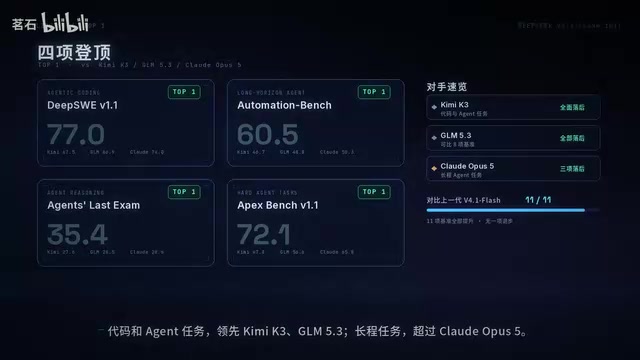
DeepSeek V4.1 Flash 1017 has been released. The company claims it achieves first place in 4 out of 11 benchmark tests and comprehensively surpasses the previous generation model across all 11 metrics. Comparison targets point to Kimi K3, GLM 5.3, and overseas Cloud Opus 5. The release party claims leadership over the first two in code and Agent tasks, and surpassing Cloud Opus 5 in long-horizon tasks. Capability descriptions center on three directions: longer persona chains, more stable tool calling, and stronger multimodality, with multimodality information being the most limited. The product positioning is summarized as "reaching the finish line in one sentence." The article reminds that the above data are all from the release party's own statements with no third-party reproduction, and recommends small-scale comparative tests before formal adoption.
DeepSeek V4.1 Flash 1017 Released: Top in 4 of 11 Benchmarks
The release video for DeepSeekAd V4.1 Flash 1017 opens with a near-joking line: "If writing code were just wishful thinking, keyboards would be obsolete." Behind this slogan is a clear product signal — the model is evolving from "assisting with code writing" toward a delivery form of "reaching the finish line in one sentence."

Core Data: 11 Benchmarks, 4 First-Place Finishes
According to data published by the release party, DeepSeek V4.1 Flash 1017 achieves first place in 4 out of 11 benchmark tests and comprehensively surpasses the previous generation model across all 11 metrics. This is a broad improvement rather than a single-point breakthrough.
The comparison targets directly point to the most fiercely competitive names currently: Kimi K3, GLM 5.3, and overseas Cloud Opus 5. The release party claims it leads the first two in code and Agent tasks, and surpasses Cloud Opus 5 in long-horizon tasks.
It should be noted that these data come from the release party's own statements, and there are currently no third-party independent reproduction results. The selection of benchmarks, prompt design, and scoring criteria can significantly affect rankings, so readers should maintain caution when citing these numbers.
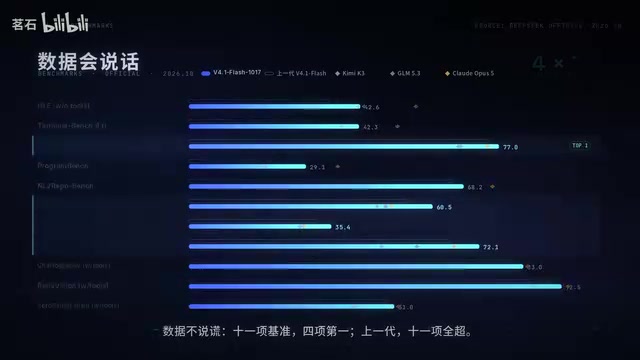
Benchmarks are a common means of evaluating model capabilities, with typical examples including HumanEval and SWE-bench for code generation, MMLU for comprehensive knowledge, and GSM8K and MATH for mathematical reasoning. Different benchmarks examine vastly different capability dimensions, and summarizing scores from multiple benchmarks into "first in 4 of 11" is a compressed expression that obscures the strength distribution among individual items. Additionally, benchmark scores are highly dependent on prompt templates, the number of few-shot examples, whether tools are allowed, and parameter settings such as sampling temperature. Common industry practice is to report different metrics such as pass@1 and pass@k simultaneously. Therefore, horizontal comparison of leaderboard results from different vendors is only meaningful when evaluation protocols are consistent, which is why third-party independent evaluations (such as LMSYS Chatbot Arena and private test sets built by various institutions) are valued.
Three Capability Directions: Long Chains, Tool Calling, Multimodality
More noteworthy than rankings is the specificity of capability descriptions. The release content mentions three directions: longer persona chains, more stable tool calling, and stronger multimodality.
"Longer persona chains" points to context retention capability in long-horizon tasks. The typical failure mode in Agent scenarios is forgetting early constraints or losing intermediate state when a task progresses to the middle-to-late stages. How long the chain can be extended directly determines whether the model can independently complete multi-step engineering tasks.
"More stable tool calling" is key to Agent deployment. The stability of tool calling is not just about success rate, but also parameter format correctness, retry logic after failure, and tolerance for ambiguous instructions. The release party uses "stable" rather than "strong" to describe it, which is somewhat more informative than claiming capability ceilings.
Multimodality is listed as the third pillar, but the release content does not provide specific benchmarks or scenario descriptions, so information is relatively limited.
Tool calling (Tool Use / Function Calling) refers to the model outputting structured call requests during reasoning, which are executed by an external runtime and the results returned to the model to continue reasoning. Its technical foundation is that the model, after specialized training, can generate function names and parameters according to JSON Schema. Common industry specifications include OpenAI's function calling format and MCP (Model Context Protocol). Evaluating tool calling requires looking not only at "whether the right tool was called," but also at whether parameter types and enum values are correct, whether dependency order is reasonable when chaining multiple tools, and whether the model can correct and retry based on error information after a failed call. In Agent scenarios, a single task often involves dozens of tool calls, and a single-call accuracy of 95% decays significantly after multi-step chaining — which is precisely why "stable" is closer to production needs than "strong."
What the Comparison with Cloud Opus 5 Means
Using Cloud Opus 5 as a reference for long-horizon tasks is a targeted choice. Long-horizon task capability is typically related to the model's planning ability, state management, and error recovery mechanisms, and is also the main source of experience differences among current Agent products.
If the claim that "long-horizon tasks surpass Cloud Opus 5" holds in actual use, then it would have direct value in scenarios such as automated coding agents, multi-step data analysis, and complex workflow orchestration. However, the verification cycle for these scenarios is long, and a single benchmark score cannot fully represent performance in real production environments.

Long-horizon tasks refer to tasks that require dozens or even hundreds of operations and span a long context to complete, such as locating and fixing a cross-module defect in a large codebase, or completing a multi-stage data cleaning and analysis process. The core difficulty of such tasks lies in state management: the model must continuously maintain completed steps, unmet constraints, and intermediate artifacts in context, and as the conversation grows longer, early information is diluted or even pushed out of the context window. Common mitigation methods include context compression, external memory (writing intermediate results to files or databases), subtask decomposition, and explicit planning (plan-and-execute). Long-horizon capability is therefore strongly correlated with error recovery mechanisms — the model needs to be able to recognize that it made an error at some step and backtrack, rather than pushing forward along an erroneous path.
Product Implications of "Reaching the Finish Line in One Sentence"
A recurring image in the release messaging is "reaching the finish line in one sentence." It describes a shift in interaction paradigm: users give the goal, and the model is responsible for decomposition, execution, and delivery, with the intermediate process transparent to the user.
This places comprehensive demands on the model — it must not only write code, but also plan, call tools, and self-correct when errors occur. Judging from the three capability directions emphasized by the release party, V4.1 Flash 1017 is positioned precisely to advance in this direction.
However, the actual gap between "one sentence" and "reaching the finish line" depends on the model's robustness in edge cases. The smooth flows in demo videos and the repeated debugging in real projects are often two different things.
A Rational View of the "Top-Ranking" Narrative
Competition among domestic models on benchmark leaderboards has reached a fever pitch, and expressions like "top-ranked" and "strongest" have become almost standard in release rhythms. For developers and enterprise users, what is more valuable for reference is actual measured performance in specific scenarios: whether it is stably usable on your codebase, in your toolchain, and under your task complexity.
The data provided by DeepSeek V4.1 Flash 1017 offers a starting point worth verifying, but between benchmark first place and actual usability, there remains a large amount of engineering detail. It is recommended to conduct a small-scale comparative test with your own typical tasks before formal adoption.
In model selection practice, the industry typically distinguishes between two types of evidence: "public benchmarks" and "private evaluation sets." Public benchmarks facilitate horizontal comparison but carry the risk of benchmark contamination — that is, test questions may already have appeared in pretraining corpora, leading to inflated scores. Private evaluation sets are built from an enterprise's own real tasks and better reflect deployment effectiveness. An actionable approach is: extract 50 to 200 typical tasks from your own business logs, fix the prompts and scoring criteria, conduct blind comparative testing between the new and old models, and simultaneously record success rate, average time consumption, and per-task cost. The cost of this small-scale A/B test is far lower than a full switchover, yet it can effectively reduce the risk of being misled by leaderboard narratives.
One-line Summary
DeepSeek V4.1 Flash 1017 released, first in 4 of 11 benchmarks, highlighting long-horizon Agent capabilities.
Paragraph Summary
DeepSeek V4.1 Flash 1017 has been released. The company claims it achieves first place in 4 out of 11 benchmark tests and comprehensively surpasses the previous generation model across all 11 metrics. Comparison targets point to Kimi K3, GLM 5.3, and overseas Cloud Opus 5. The release party claims leadership over the first two in code and Agent tasks, and surpassing Cloud Opus 5 in long-horizon tasks. Capability descriptions center on three directions: longer persona chains, more stable tool calling, and stronger multimodality, with multimodality information being the most limited. The product positioning is summarized as "reaching the finish line in one sentence," an Agent interaction paradigm where users give goals and the model handles decomposition, execution, and delivery. The article reminds that the above data are all from the release party's own statements with no third-party reproduction, benchmark rankings are affected by test selection and scoring criteria, and it recommends conducting small-scale comparative tests with one's own typical tasks before formal adoption.
Related articles

Gemini 4 Argon Hands-On: AI Builds Board Games, Constructs Temples, and Trains Robots Autonomously
Gemini 4 Argon hands-on roundup: AI autonomously builds a desk racetrack and temple in Blender, writes a ray tracing engine, trains a humanoid robot to sink 7 shots, plus API pricing and developer access.

The Magic Octagonal Coin: Why Only 9% of People Can Predict Its Flip?
Only 9% of people can correctly predict the Magic Octagon coin flip. This article explains its spatial rotation mechanism, common cognitive pitfalls, and a new hypothesis based on Relevance Theory, exploring the limits of human spatial reasoning.

Sam Altman: AI Is Entering the Era of Scientific Discovery — Math Breakthroughs Will Replicate in Biology and Energy
Sam Altman says AI is entering the era of scientific discovery — math breakthroughs will replicate in biology, materials science, and energy to help develop new drugs and energy sources.