DeepSeek V4.1 Flash "Minor Update" Hands-On: Across-the-Board Benchmark Gains Reshape the Reasoning Market on Value

DeepSeek V4.1 Flash, though a minor update, gains 11 points on terminal benchmarks in five weeks, offers standout value, and cuts thinking tokens by a third.
DeepSeek's V4.1 Flash 1017 is officially a minor update, yet Terminal Bench 4.0 rose from 31% to 42% in five weeks—an 11-point jump—with broad gains elsewhere. At ~20 cents per task and output pricing one-sixteenth of GPT 5.6 Sol, it tops the value curve. RL training for complete projects boosts planning and tool use. Thinking tokens drop about a third, cutting real costs further. A search API (75 cents per 1,000 requests) and open weights on Hugging Face round it out.
DeepSeek has released V4.1 Flash 1017, the latest version of its Flash series, and officially bills it as "a minor update." But a look at its own published benchmark table shows almost every metric moving upward—by margins that make the phrase "minor update" seem rather modest.
This piece is based on a hands-on breakdown from a YouTube channel and official demos, focusing on three things: how much the benchmarks rose, where the pricing lands, and what changed in the model's training methodology.
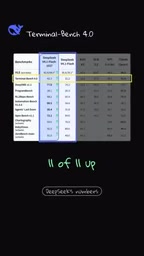
Benchmark Performance: Terminal Task Capability Jumps 11 Points in Five Weeks
The most interesting result is on Terminal Bench 4.0. According to data cited by the video's author, this metric rose from 31% to 42% in just five weeks—an 11-percentage-point gain. For an iterative release of the same model size, that pace is unusual; typically these "small versions" deliver single-digit percentage-point improvements.
The author calls the slope "a bit crazy," and that's no exaggeration. Terminal-style tasks test a model's planning and error-correction abilities in multi-step command-line environments, and gains in these abilities tend to depend on improved training-data quality and reinforcement-learning strategies rather than simply piling on parameters. An 11-point leap shows the training side was genuinely serious.
Other benchmarks show a consistent direction: nearly every test item in the official table is up. This "broad gains rather than a single breakthrough" pattern usually means the training pipeline as a whole was optimized, rather than targeted tuning for one specific benchmark.
Terminal Bench is a benchmark specifically designed to evaluate language models on multi-step tasks in terminal environments. It simulates real command-line workflows, requiring the model to plan and execute a series of shell commands based on natural-language instructions—file operations, software installation, system configuration, and so on. The test focuses not only on whether the final result is correct but also on the model's ability to diagnose and recover from errors. Scoring is typically based on task completion, step efficiency, and command accuracy. Because terminal tasks involve long-horizon planning, tool use, and real-time error correction, Terminal Bench is regarded as an important yardstick for a model's practical engineering ability, and it particularly reflects the verifiable skill level a model develops under reinforcement learning.
The Intersection of Price and Performance: About 20 Cents per Task
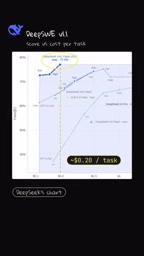
The most informative part of the video is the price-performance scatter plot. DeepSeekAd V4.1 Flash sits in the highest-value region of the chart, at roughly 20 cents per task. The author calls this value boundary the "burrito frontier"—the gist being that the work you can get done for the price of one burrito basically sits right on that boundary.
The cross-comparison is more noteworthy: this result is already close to OpenAI's GPT 5.6 Sol. To be clear, GPT 5.6 Sol is not OpenAI's current flagship, so this isn't a same-generation showdown. But the key factor is the order of magnitude in speed—the Flash model's output price is roughly one-sixteenth of its counterpart's. In cost-sensitive scenarios, that gap is enough to change technology choices.
A caveat: the value ranking on the scatter plot depends on the composition of the specific task set. The video does not disclose the full evaluation task distribution, so the 20-cent figure should be understood as an average under a specific benchmark, not a guaranteed price for general workloads.
GPT 5.6 Sol is a model version from OpenAI optimized for complex reasoning and multi-step tasks, a specific iteration within the GPT-5 series. The Sol version typically emphasizes enhancements in scientific computing, logical reasoning, and long-context understanding, but it is not OpenAI's latest flagship (such as other variants of GPT-5.6 or higher versions). Its pricing sits in the high-end range, with output token costs significantly higher than lightweight models. In value comparisons, Sol often serves as a performance reference point, but note that its positioning is not aimed at purely cost-sensitive scenarios; therefore, direct price comparisons should be evaluated alongside task complexity and latency requirements.
Training Approach: Using Reinforcement Learning to Build Complete Projects
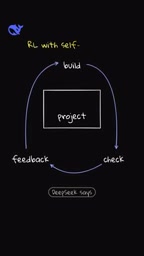
DeepSeek says this version uses reinforcement learning to train its ability to build complete projects, and it has published several demos. Judging from the demos, the model is asked to complete a runnable project end-to-end rather than answer isolated questions. This training paradigm places high demands on reward design—it needs to judge whether a project actually runs and whether its structure is sound, not just whether the text looks plausible.
This also explains the jump in terminal benchmarks: building complete projects and multi-step terminal operations share the same class of abilities—long-horizon planning, tool use, and error recovery. Reinforcement learning has a natural advantage on such verifiable tasks, because success or failure can be judged programmatically.
The performance gains of a same-size model come largely from scaling this kind of verifiable reward, not from changes to model architecture. The video's author also explicitly says it's "still the same model, the same size"—what changed is the degree of optimization.
Reinforcement Learning (RL) in large language model training usually refers to methods that optimize model behavior through reward signals. Unlike supervised learning, RL does not rely on human-labeled "correct" outputs; instead, it lets the model try actions in an environment and receive rewards based on results. In code generation and project-building scenarios, rewards can be designed as programmatic verification: for example, whether the project compiles successfully, whether tests pass, and whether the structure meets specifications. Such verifiable rewards allow RL to scale improvements in a model's long-horizon planning and error-recovery abilities. DeepSeek's emphasis on using RL to train complete project building leverages exactly this paradigm, letting the model self-optimize on end-to-end tasks rather than merely imitating text patterns.
Hands-On Experience: Thinking Tokens Cut by About One-Third
In his own tests, the author observed that this version's thinking token count dropped by about one-third and that outputs were more concise. The official line is that responses will be more streamlined, using fewer tokens.
The cost impact of this change is no less significant than the unit price itself. A reasoning model's bill is made up of input, output, and thinking tokens together; compressing the thinking portion by a third means actual usage costs fall more noticeably than the sticker price. For high-frequency calling scenarios, this is an easily overlooked but quite substantial improvement.
The trade-off is a possible compromise: fewer thinking tokens mean efficiency on simple tasks, but on complex reasoning tasks they may compress the exploration space. The video does not provide comparison data on complex tasks, so users need to verify this on their own workloads.
Thinking tokens refer to the tokens corresponding to the internal intermediate reasoning steps a reasoning model generates before producing its final answer. These tokens are not shown directly to users, but they count toward API usage and affect costs. For example, the model may first break down the problem, list options, verify conditions, and then output a conclusion. The number of thinking tokens reflects how "deliberate" the model is: more tokens often mean fuller exploration, but also higher latency and cost. Compressing thinking tokens can improve efficiency and lower actual usage costs, but it may sacrifice reasoning depth on complex tasks. Therefore, when evaluating such optimizations, one must weigh efficiency on simple tasks against accuracy on complex tasks.
Supporting Moves: Search API and Open Weights
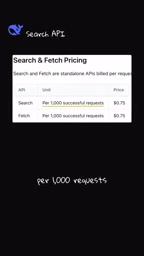
DeepSeek has also launched its own search API, priced at 75 cents per 1,000 requests. That price is in an aggressive range for the retrieval API market and, combined with the model's own low price, forms a complete low-cost inference stack: cheap retrieval, cheap generation, and thinking tokens saved too.
On the weights side, the model is now open on Hugging Face. For teams that need private deployment or fine-tuning, this removes vendor lock-in concerns and lets the community independently reproduce benchmark results—the data in the video currently comes mainly from official tables and the author's personal tests, and large-scale independent third-party evaluations have not yet appeared. That's a gap worth keeping in mind when judging this version's true level.
Is This Really a "Minor Update"?
From a model architecture standpoint, yes. Same size, same architecture, no generational change.
From an engineering-results standpoint, not really. In five weeks, terminal benchmarks rose 11 points, thinking tokens were cut by a third, the value curve was pushed to the top of the chart, and it was accompanied by a search API and open weights—the practical impact of this combination is closer to a substantial capability upgrade than a patch-style minor version.
For developers, what's worth paying attention to is not the version number but two verifiable questions: can the ~20-cent-per-task cost be reproduced on your own task set, and does accuracy on complex tasks show a visible decline after the reduction in thinking tokens? Only hands-on testing can answer these two questions.
One-line Summary
DeepSeek V4.1 Flash is billed as a minor update, but terminal benchmarks rose 11 points in five weeks, value stands out, and thinking tokens are cut by a third.
Paragraph Summary
DeepSeek's V4.1 Flash 1017 is officially called a minor update, but its benchmark table shows Terminal Bench 4.0 rising from 31% to 42% in five weeks—an 11-point gain—with other metrics also up across the board. Cost per task is about 20 cents, output pricing is just one-sixteenth of GPT 5.6 Sol, and value sits at the top of the curve. Training uses reinforcement learning to build complete projects, improving long-horizon planning and tool use. Hands-on testing shows thinking tokens cut by about a third with more concise output, so actual usage costs fall more than the sticker price. A search API at 75 cents per thousand requests launched alongside it, and weights are open on Hugging Face. Although the model architecture is unchanged, the capability upgrade from engineering optimization is significant and worth developers testing for themselves.
Related articles

OpenAI Partners with Shield: How the Astra Agent Revolutionizes IT Troubleshooting
OpenAI and Shield launch the Astra agent, which autonomously logs into computers and legacy systems to fix IT issues in real time, 35-40% faster than traditional models, with humans involved only when judgment is needed.

iPhone Duo Battery Life Tested: One Charge a Day Is Unavoidable, and the Large Screen Is the Culprit
iPhone Duo battery test: heavy use needs at least one charge a day, and about 30% remains after 6.5 hours of screen-on time. How often the large screen is unfolded is key; a MagSafe battery pack helps, and long-term degradation is also worth watching.

Kimi K3.1 Pro Open-Sourced: 2.8 Trillion Parameters Close In on Opus
Moonshot releases the open-source MoE model Kimi K3.1 Pro, with 2.8T total parameters and 104B activated, trailing Opus 5.5 by under 1 point on Terminal Bench 4.0.