DeepSeek V4.1 Flash Ultrafast Lands on AI Gateway: 1,000 Tokens/Second Ultra-Fast Inference
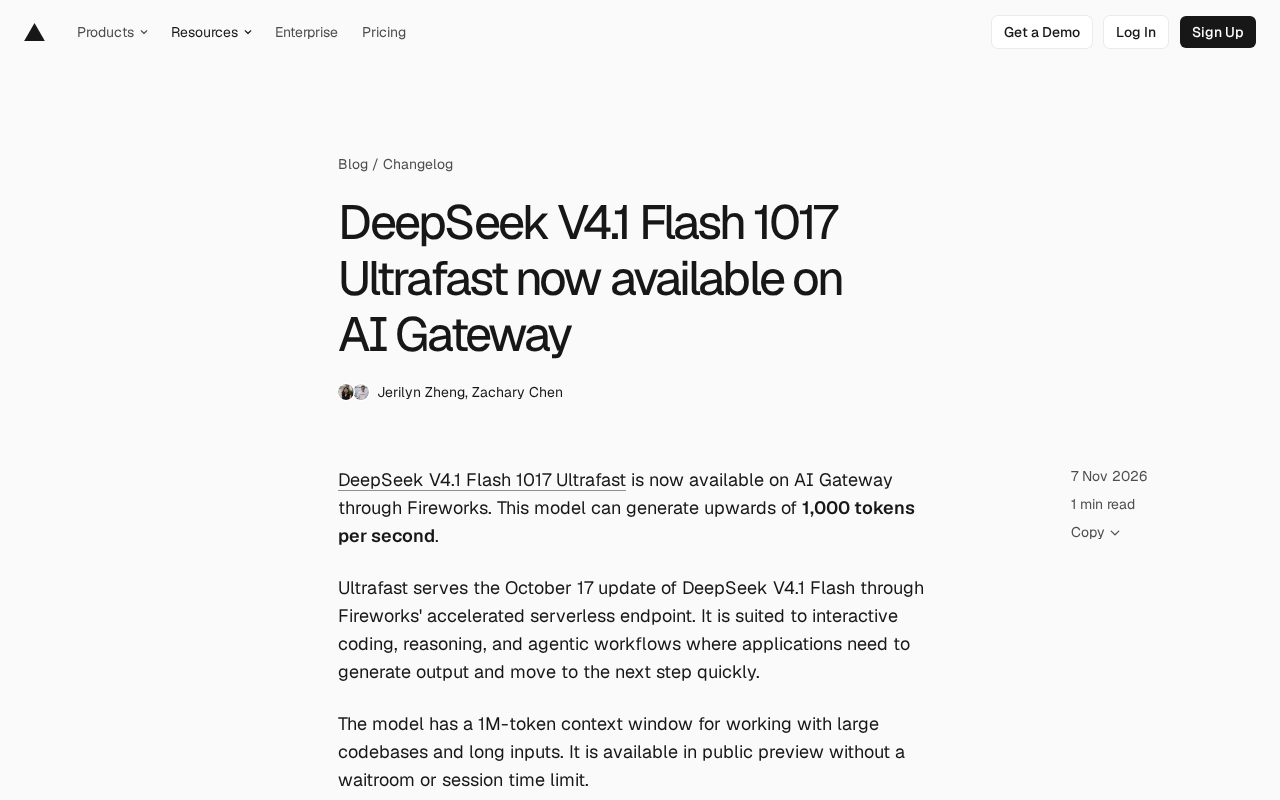
AI Gateway launches Fireworks-accelerated DeepSeek V4.1 Flash ultra-fast version, generating 1,000+ tokens per second.
AI Gateway adds the DeepSeek V4.1 Flash 1017 Ultrafast model, optimized via Fireworks' accelerated serverless endpoint, with 1,000+ tokens/sec generation and a 1M token context window, ideal for large codebases and long inputs. In public preview with no waitlist or session limits, it's callable via deepseek/deepseek-v4.1-flash-1017-ultrafast with AI SDK streaming examples and support for Claude Code and Cursor via Vercel CLI. Ultra-fast inference notably reduces end-to-end latency in interactive coding and multi-step agentic workflows; AI Gateway offers usage tracking, retry/failover, zero data retention, and budget management at providers' original pricing with no markup.
AI Gateway has recently added the DeepSeek V4.1 Flash 1017 Ultrafast model, served through Fireworks' accelerated serverless endpoint with generation speeds exceeding 1,000 tokens per second. This speed matters significantly in interactive coding, reasoning, and agentic workflows—applications need to produce content quickly and move to the next step, and ultra-fast inference meets exactly that need.
Core Capabilities of Ultra-Fast Inference
DeepSeekAd V4.1 Flash 1017 Ultrafast is not a brand-new base model, but an accelerated version of the DeepSeek V4.1 Flash updated on October 17. It achieves high throughput through Fireworks' accelerated infrastructure, and is officially described as "capable of generating over 1,000 tokens per second." For scenarios requiring continuous interaction, this speed means shorter wait times and a smoother experience.
The model itself features a 1 million token context window, capable of handling large codebases and long inputs. This is a key advantage for tasks such as code completion, project-level refactoring, and long document analysis. The model is currently in public preview, with no waitlist and no session time limits—developers can call it directly.
Serverless Endpoint is an on-demand, auto-scaling inference deployment method: developers don't need to pre-reserve GPU instances; the platform automatically allocates compute resources when requests arrive and releases them when idle. Fireworks' accelerated serverless endpoint layers inference optimizations on top of this (such as continuous batching, speculative decoding, KV cache reuse, etc.), thereby reducing per-request latency without sacrificing throughput. Compared to dedicated endpoints, serverless mode is better suited for scenarios with highly variable traffic that are insensitive to cold starts but require high concurrency; the trade-off is that peak hours may be affected by platform capacity scheduling, so the "no waitlist" promise typically refers to current preview-stage capacity headroom rather than a permanent SLA.
Context Window refers to the total number of tokens a model can read simultaneously in a single call, including both the input prompt and the generated output. 1 million tokens is roughly equivalent to hundreds of thousands of lines of code or several long documents, allowing the model to "see" the key files of an entire code repository within a single request, rather than relying on repeated retrieval and concatenation. It's worth noting that context window size is not entirely equivalent to effective utilization: extremely long inputs significantly increase prefill time and memory usage, and in very long contexts the model's recall of mid-section information may degrade (the "lost in the middle" phenomenon). Therefore, in engineering practice, retrieval and chunking strategies are usually still employed, treating window capacity as an upper bound rather than filling it by default.
How to Integrate and Use
Using the model in AI Gateway is very simple—just set the model name to deepseek/deepseek-v4.1-flash-1017-ultrafast. The official documentation provides an AI SDK example demonstrating how to stream text generation:
import { streamText } from 'ai';

const result = streamText({
  model: 'deepseek/deepseek-v4.1-flash-1017-ultrafast',
  prompt: 'Write a TypeScript helper that retries a failed request with backoff.',
});

for await (const text of result.textStream) {
  process.stdout.write(text);
}
For coding agent tools like Claude Code, Codex, and Cursor, you can complete configuration by installing the latest version of Vercel CLI and running npx vercel ai-gateway setup, then selecting the model in the agent. The official documentation also provides a model playground for developers to quickly try it out.
AI SDK is an open-source TypeScript library introduced by Vercel that provides a unified calling interface for different model providers. The streamText in the example is a streaming generation API: it returns an async iterable textStream, and each time the model produces a segment of tokens it is immediately pushed, so the frontend or terminal can render as it receives rather than waiting for the entire text to be generated. This streaming mode is precisely the prerequisite for ultra-fast inference to deliver value—time to first token (TTFT) determines when users see feedback, while tokens per second determines how quickly the text fills in. Passing the model name as a string switches the backend, meaning business code barely needs to change when switching providers—this is also the core selling point of a unified calling layer.
The Platform Value of AI Gateway
AI Gateway itself is a unified model calling layer that provides usage and cost tracking, retry and failover configuration, performance optimization, and other features, aiming to achieve higher uptime than any single provider. It also includes custom reporting, zero data retention support, API key budget management, routing rules, and more.
On pricing, AI Gateway reflects providers' original pricing, charges no inference platform fees, and does not mark up Bring Your Own Key (BYOK) requests. This means developers can get additional reliability and management features at the same cost as calling providers directly.
Bring Your Own Key (BYOK) refers to developers using their own API keys obtained from model providers, with requests forwarded through the gateway. In this case, the gateway only handles routing, observability, and reliability—it does not resell inference compute, so it typically adds no markup; in contrast, the platform-paid model involves the gateway purchasing uniformly and then billing by usage. Zero Data Retention means that request and response content is not persistently stored by the provider or gateway after inference completes, with only necessary usage metadata retained—suitable for scenarios involving sensitive code or compliance requirements. Together, these two constitute the two clauses most commonly examined when enterprises adopt a unified gateway: the former affects cost structure, and the latter affects data boundaries.
Use Cases and Significance
The value of ultra-fast inference is particularly prominent in agentic workflows. When multiple models need to be called in sequence with repeated reasoning, the latency of each generation is amplified. A speed of 1,000 tokens per second can significantly shorten end-to-end response times, allowing agents to complete task loops faster.
In interactive coding scenarios, developers can see code generation results almost immediately after entering a prompt—this instant feedback is very helpful for maintaining a flow state. Combined with the 1 million token context, the model can understand the entire project structure rather than being limited to the current file.
The addition of DeepSeek V4.1 Flash 1017 Ultrafast further enriches AI Gateway's model selection and provides a noteworthy option for developers pursuing low latency. As model speeds continue to improve, the boundaries of what's possible with real-time AI applications are constantly expanding.
One-line Summary
AI Gateway launches Fireworks-accelerated DeepSeek V4.1 Flash ultra-fast version, generating over a thousand tokens per second.
Paragraph Summary
AI Gateway adds the DeepSeek V4.1 Flash 1017 Ultrafast model, based on the October 17 Flash version optimized through Fireworks' accelerated serverless endpoint, with generation speeds exceeding 1,000 tokens per second and a 1 million token context window, suitable for large codebases and long input processing. The model is in public preview with no waitlist or session duration limits; developers can call it via the model name deepseek/deepseek-v4.1-flash-1017-ultrafast, and the official documentation provides AI SDK streaming examples, with support for coding agents like Claude Code and Cursor via Vercel CLI. The article argues that ultra-fast inference delivers significant value in interactive coding and multi-step agentic workflows by shortening end-to-end latency; AI Gateway provides usage tracking, retry and failover, zero data retention, budget management, and other capabilities, all billed at providers' original pricing with no markup.
Related articles
 Tech Frontiers
Edge AI on Microcontrollers: When Is It Actually Worth Deploying?
Drawing on Reddit discussions and Arm case studies, this article analyzes the real-world use cases for edge AI on microcontrollers: when each device needs independent inference, when a gateway or cloud is more reasonable, and the costs and boundaries of specialized hardware.
 Tech Frontiers
Pushing the Limits of Extreme Sudoku on a 16GB GPU: Insights from Depth and Flow Matching
A researcher trained a 16.54M-parameter model on a 16GB GPU to solve extreme Sudoku, finding effective depth breaks the 60% plateau and flow matching with improved sampling pushes accuracy past 99% with ~50× lower layer-evaluation budget.
 Tech Frontiers
AI Agent Approval Workflows: Why Human Confirmations Always Get Mindlessly Clicked
Why do AI agent approval workflows always get mindlessly clicked? A Reddit discussion shows that separating rules from keys, low-frequency high-risk approvals, and GitHub Environments-style gates are the keys to effective approvals.