DeepSeek V4.1 Flash vs GPT-6 Astra: Four Real-World Build Tests — Who Wins?

DeepSeek V4.1 Flash is 6× cheaper but 3× slower than GPT-6 Astra across four real-world build tests.
A Bilibili creator ran identical prompts through DeepSeek V4.1 Flash and GPT-6 Astra via OpenRouter across four tasks — an RTS game, 3D animated website, barbershop booking app, and Blender truck animation — evaluating quality, functionality, cost, build time, and iteration ability. Astra produced more polished first-pass results in ~5.5 hours for ~$118 total; DeepSeek iterated its way to comparable quality in ~15 hours for just ~$20, roughly 6× cheaper. DeepSeek won the booking app and Blender categories on value; Astra led on detail and speed. The choice comes down to budget vs. turnaround time.
A Bilibili creator used identical prompts to have DeepSeek V4.1 Flash and GPT-6 Astra each complete four build tasks: a Vampire-era-style real-time strategy game, a 3D scroll-animation website, a barbershop booking app, and a Blender truck modeling animation. All tests were run through the OpenRouter paid API, enabling precise tracking of costs, token usage, and build times. This is a rare apples-to-apples, cross-model, cross-task comparison — and the results are surprising.
Methodology and Evaluation Dimensions
The evaluator examined five core dimensions: output quality, functionality (did it do what was asked), total build cost, build time, and each model's ability to accept feedback and iterate. Using paid APIs meant every call was logged, making it possible to see behavioral differences between the two models.
One consistent observation stood out: Astra tended to produce a better, more usable version on the first try with less debugging needed, while DeepSeekAd continuously self-checked and iterated — which improved final quality but dramatically extended build time.
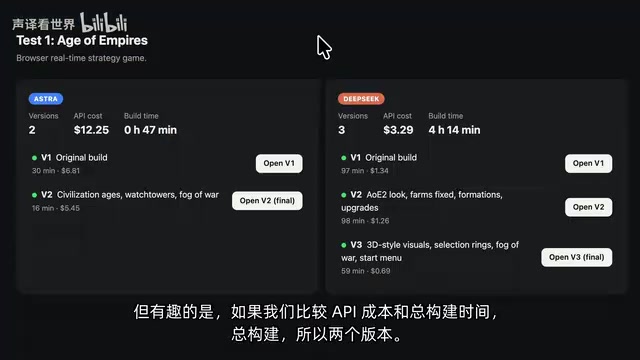
Game Build: Astra Wins on Visuals, DeepSeek Wins on Cost
The first task was to recreate an Age of Empires-style real-time strategy game. DeepSeek's initial version had obvious weaknesses: farms couldn't be tended, villagers didn't use tools, watchtowers couldn't be built, and there was no evolution system. After three rounds of iteration, the evaluator finally got features like advancing to the Castle Age, functional farms, watchtowers, and militia formations (line, square, flanking, staggered) working correctly. Defeat logic was functional — destroy the town center and the game ends.
Astra's performance was more impressive. It delivered polished UI, well-designed menus, and clickable interactions on the first attempt, along with a war-fog system straight out of the original Age of Empires: only the local area is visible, and the map is gradually revealed as the player advances. The evaluator specifically praised the attack-range ring display on watchtowers and enemy AI that intelligently positions itself just outside attack range.
The cost and time comparison is striking: Astra completed two versions in just 47 minutes for $12.25; DeepSeek's three versions took 4 hours and 14 minutes but only cost $3.30. Astra was dramatically faster, but DeepSeek was nearly 4× cheaper. The evaluator's verdict: Astra wins on UI and experience; both are competent on logic and gameplay, but DeepSeek's 4-hour wait time was its biggest pain point.
3D Animated Website: A Close-Call Draw
The second task was to build a watch showcase website with scroll-scrub animation, where the core challenge was slicing a Higgs Field–generated video into frames and embedding it so scrolling felt smooth.
DeepSeek's initial version had messy layout and choppy frame transitions (scrolling once would jump from frame 198 to 264). Multiple feedback rounds were needed before smooth transitions were achieved. The evaluator admitted that transition effect was "hard for DeepSeek to nail," but the final version landed around a 6–7 out of 10. Astra couldn't generate the video animation at first because Higgs Field MCP wasn't configured, but once added, the visual quality was excellent — particularly the consistency of hover-triggered image swaps showing the watch on different wrists.
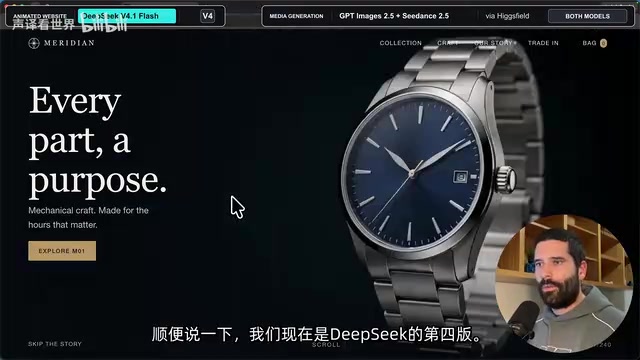
The cost gap was significant: Astra's total API cost was $48.63 over 2 hours and 10 minutes (much of that waiting on image and video generation); DeepSeek was just $7.74 over 7.5 hours. That's roughly 6× cheaper for DeepSeek, but over 3× longer.
The evaluator offered a practically useful take: for a personal project, choose DeepSeek (cheaper); for a professional agency, lean toward Astra, since its speed lets you roll the higher API cost into your quote, deliver faster, and move on to the next project. Final verdict: a draw.
Scroll-scrub animation is an interaction technique that binds scroll position to animation frame playback — scroll down, the animation advances; scroll up, it reverses. The typical implementation slices a video into a frame-by-frame image sequence, then uses JavaScript to listen for scroll events and swap frames proportionally, creating the immersive sense that the user is manually controlling playback speed. The hard part is uniform frame distribution and jump logic — if two adjacent scroll positions trigger a large frame gap (e.g., jumping from frame 198 to 264), the eye perceives a noticeable stutter, breaking the smoothness. That's exactly why DeepSeek's first version was criticized for messy layout and choppy scrolling. MCP (Model Context Protocol) is an open protocol from Anthropic that lets AI models call external tools and services through a standardized interface. Higgs Field MCP is one such connector, enabling models to directly drive image and video generation services — which explains why Astra couldn't complete the video animation portion before it was configured.
Booking App: A Clear Win for DeepSeek
The third task was to build a booking system for a barbershop with a backend (SQLite database), including customer appointment booking, staff login with an admin dashboard, viewing and canceling appointments, blocking staff unavailability, and preventing double-booking.
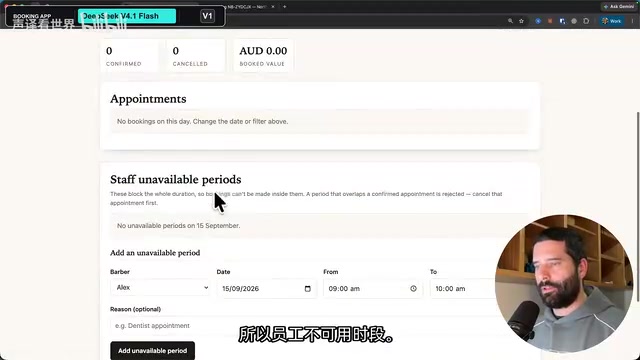
Both models delivered quite complete functionality: customers could successfully book and receive a private management link, duplicate time slots were automatically removed, staff could see confirmation status and execute cancellations from the dashboard, and cancellations synced to the frontend in real time. Astra's UI was somewhat more polished (with icons and a tagline), but functional differences were minimal.
The key difference was again cost: Astra cost $17.88 and took 41 minutes; DeepSeek cost just $2.33 in about 1 hour. Building this app with DeepSeek was seven to eight times cheaper. The evaluator's verdict was blunt: "This isn't even a question" — both apps ran well, looked similar, and took comparable time, but DeepSeek was dramatically cheaper. DeepSeek wins.
Blender Truck Modeling: Detail vs. Intended Use
The final task was the most technically demanding: modeling an off-road truck driving over rough terrain in Blender, with the camera orbiting and diving under the chassis to show suspension, drivetrain, and other undercarriage components.
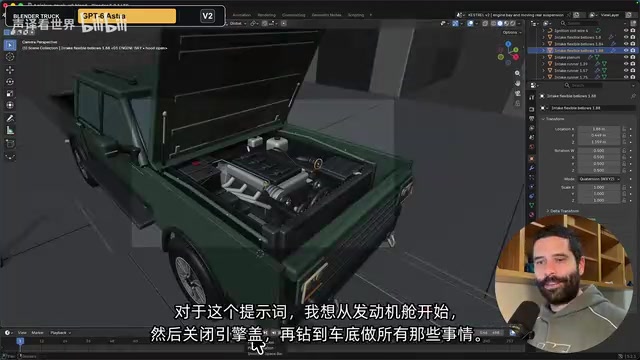
DeepSeek managed to model dynamic suspension that moved up and down with bumps, and the evaluator was impressed that the model was willing to attempt modeling the truck's major undercarriage components. But Astra delivered a level of detail on the first try that far exceeded DeepSeek's — tire contact patches, drivetrain, and suspension component articulation were all clearly visible. After a follow-up prompt, Astra even modeled the engine bay: battery, fluid reservoirs, a hood prop rod, and latch hardware, with remarkable detail.
The evaluator went further, using the Higgs Field connector and Seedance 2.5 to convert the Blender animations into photorealistic scene videos. Interestingly, DeepSeek's Australian outback bouncing scene (with a Toyota truck, driving lights, and antenna) came across as more realistic and contextually fitting — perfect as B-roll for an e-commerce ad. Astra's model had higher detail, but the photorealistic scene felt somewhat "toy-like" by comparison.
On cost, DeepSeek again dominated: $4.66 vs $39.64, roughly 9–10× cheaper, with only about 30 minutes more time. The evaluator's nuanced conclusion: if you're an automotive engineer who needs precise modeling, choose Astra (more detail); if you're generating visuals for an ad or B-roll, DeepSeek is good enough and far cheaper — DeepSeek wins.
Overall Comparison: The Trade-off Between Value and Speed
Looking at the four tasks combined, the overall differences between the two models come into sharp focus:
- Astra total: $118, 58.6M tokens, 511 API requests, 5.5 hours of build time
- DeepSeek total: ~$20, 306.5M tokens, 110 API requests, 14 hours 52 minutes of build time
DeepSeek's API spend was roughly 6× cheaper, but it consumed 5× the tokens, made far more iterations, and took 3× as long to build. Both models' Higgs Field connector credit usage was roughly comparable, confirming that both can fluidly call MCP tools and external skills.
The core trade-off is clear: DeepSeek V4.1 Flash is extremely affordable but extremely time-consuming, building quality through repeated iteration; GPT-6 Astra works out of the box with a high first-pass success rate and fast delivery, but costs several times more. For individual developers and budget-sensitive scenarios, DeepSeek is the smarter choice; for commercial teams that need fast delivery and can pass costs to clients, Astra's speed advantage holds more value.
(Note: All model names, pricing, and feature descriptions in this article are based on testing records from a single Bilibili video source and are provided for reference.)
Understanding the token consumption gap (DeepSeek using 5× more tokens) comes down to differences in reasoning mechanism. DeepSeek V4.1 Flash uses a chain-of-thought self-checking strategy: before outputting final code, it generates extensive internal reasoning steps, repeatedly verifying logic, catching errors, and replanning — and all of that reasoning content itself produces tokens. GPT-6 Astra tends to output usable results on the first pass, reducing the number of back-and-forth iterations (110 vs. 510 API requests). For cost-conscious users, total token volume — not request count — is the primary driver of API bills. Even though DeepSeek's per-request unit price is extremely low, the cumulative token consumption from multiple iterations still far exceeds the cost of Astra's single high-quality output. OpenRouter, as a unified API gateway, supports calling multiple model providers through a single interface and automatically logs token counts and costs for every call — the technical foundation that made precise cost quantification possible in this comparison.
Related articles

OpenAI Partners with Shield: How the Astra Agent Revolutionizes IT Troubleshooting
OpenAI and Shield launch the Astra agent, which autonomously logs into computers and legacy systems to fix IT issues in real time, 35-40% faster than traditional models, with humans involved only when judgment is needed.

iPhone Duo Battery Life Tested: One Charge a Day Is Unavoidable, and the Large Screen Is the Culprit
iPhone Duo battery test: heavy use needs at least one charge a day, and about 30% remains after 6.5 hours of screen-on time. How often the large screen is unfolded is key; a MagSafe battery pack helps, and long-term degradation is also worth watching.

Kimi K3.1 Pro Open-Sourced: 2.8 Trillion Parameters Close In on Opus
Moonshot releases the open-source MoE model Kimi K3.1 Pro, with 2.8T total parameters and 104B activated, trailing Opus 5.5 by under 1 point on Terminal Bench 4.0.