DeepSeek-V4-Pro API at 75% Off: Full Breakdown of Million-Token Context & Mainstream Tool Integrations
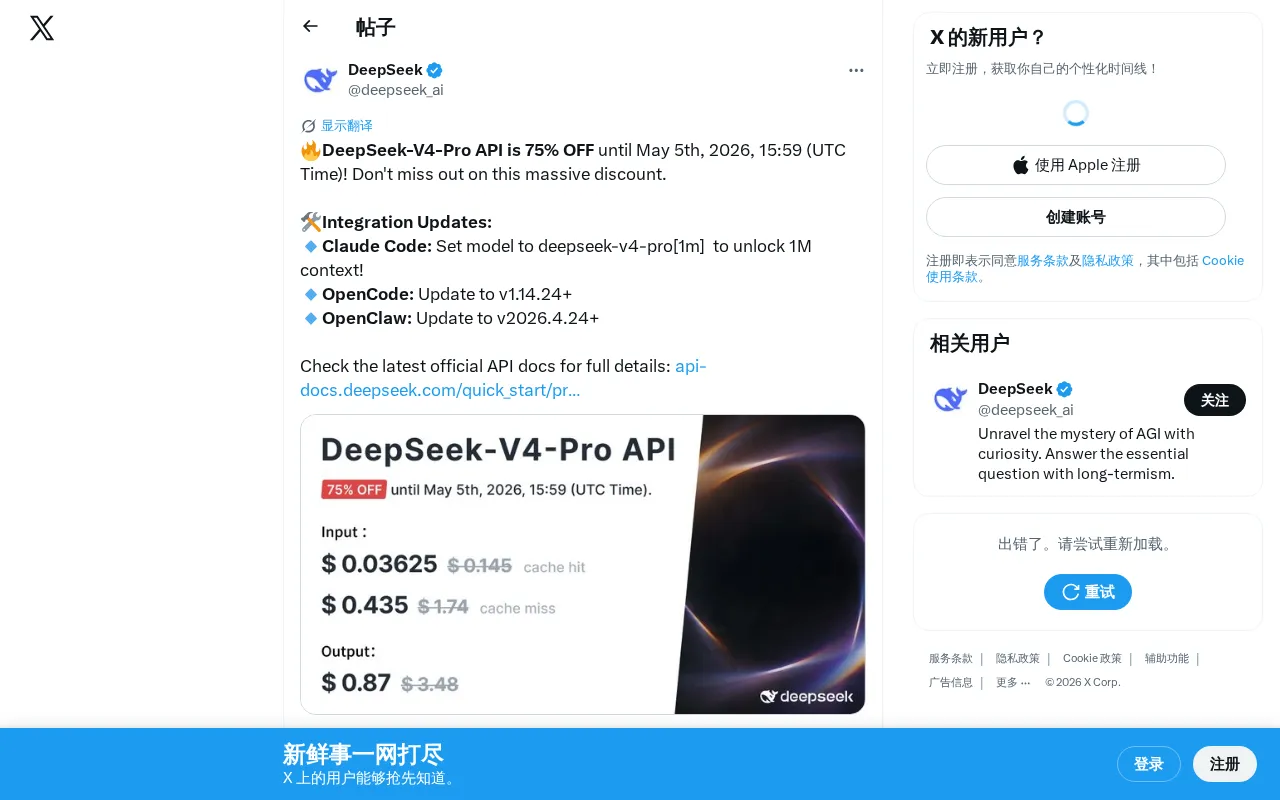
DeepSeek-V4-Pro API launches a year-long 75% off promotion with million-token context support.
DeepSeek announced its V4-Pro API is available at 75% of the original price through May 5, 2026 — a roughly year-long promotion. The model supports a 1-million-token ultra-long context window and leverages MoE architecture to balance high performance with low cost. It's already integrated with mainstream dev tools like Claude Code and OpenCode. The move reflects intensifying LLM API competition and an accelerating commoditization trend, as DeepSeek uses aggressive pricing to capture market share.
DeepSeek-V4-Pro API at 75% Off: Unprecedented Discount, Lasting a Full Year
DeepSeekAd recently announced that the DeepSeek-V4-Pro API is available at 75% of its original price from now through May 5, 2026 — an unprecedented promotional campaign spanning roughly one year, offering developers and enterprise users an exceptionally cost-effective way to access a top-tier large language model.
This isn't just a simple price adjustment — it reflects the increasingly fierce competition in the LLM API market. DeepSeek's strategy of deep, extended discounts to capture market share carries strategic implications that every AI practitioner should pay attention to.
Million-Token Context Window: DeepSeek-V4-Pro's Core Technical Highlight
The most notable technical highlight of this update is that DeepSeek-V4-Pro supports a 1 million (1M) token ultra-long context window.
Understanding Tokens and Context Windows
To fully appreciate what this specification means, it helps to understand the concepts of tokens and context windows. A token is the basic unit that large language models use to process text — it's not simply equivalent to a single character or word. In English, one token corresponds to roughly 4 characters or 0.75 words; in Chinese, a single character is typically encoded as 1–2 tokens. A model's context window refers to the maximum number of tokens it can "see" and process simultaneously during a single inference pass. A 1-million-token context window is roughly equivalent to 750,000 English words or 500,000–700,000 Chinese characters — approximately the length of 10–15 average books.
Implementing ultra-long context windows poses enormous engineering challenges: in traditional Transformer architectures, the computational complexity of the attention mechanism scales quadratically with sequence length, meaning that doubling the context length quadruples the compute required. The industry typically employs techniques such as sparse attention, linear attention, and sliding window attention to reduce computational overhead, combined with engineering approaches like KV Cache compression and distributed inference to support million-scale context deployment in practice.
In real-world applications, a million-token context enables:
- Full-book document analysis: Input hundreds of thousands of words in a single pass for comprehension and summarization — no need for chunking
- Global understanding of large codebases: In software engineering scenarios, the model can "see" far more code files simultaneously and provide more accurate modification suggestions
- Coherent complex multi-turn conversations: Maintain context consistency throughout extended interactions without "forgetting" earlier information
Million-token context windows have become a standard capability for top-tier LLMs. DeepSeek-V4-Pro matches international frontrunners like Gemini and Claude on this metric while offering lower prices — a standout value proposition.
DeepSeek's MoE Architecture: The Technical Foundation for High Performance at Low Cost
DeepSeek's ability to deliver top-tier performance at highly competitive prices is inseparable from its underlying architecture. Since V2, DeepSeek has consistently adopted the Mixture of Experts (MoE) architecture. The core idea behind MoE is that while the model has a massive total parameter count, only a small subset of "expert" networks are activated when processing each token, dramatically reducing actual compute requirements. For example, an MoE model with hundreds of billions of total parameters might activate only tens of billions per inference pass, making inference costs far lower than a dense model of equivalent total size. This architectural design allows DeepSeek to strike a superior balance between model capability and inference efficiency, providing the cost structure that supports its aggressive pricing strategy. By contrast, dense-architecture models at comparable capability levels typically require significantly more inference compute, which is directly reflected in API pricing.
Ecosystem Integration Updates: Seamless Access via Claude Code, OpenCode, and More
Alongside the pricing announcement, DeepSeek revealed several major ecosystem integration updates that significantly lower the barrier to entry for developers.
Claude Code Integration with DeepSeek-V4-Pro
Developers can set the model to deepseek-v4-pro[1m] in Claude Code to unlock the million-token context capability. In other words, DeepSeek-V4-Pro can be used directly as Claude Code's backend model — developers can enjoy DeepSeek's capabilities and price advantages without switching toolchains.
Claude Code is a command-line AI coding assistant developed by Anthropic, designed specifically for software development scenarios. It helps developers write, debug, and refactor code directly in the terminal. A key design feature is its support for calling third-party models through OpenAI API-compatible interfaces, enabling developers to switch underlying models without changing their workflow. In the current LLM ecosystem, OpenAI's API format has become the de facto industry standard — nearly all model providers offer compatible interfaces, which greatly reduces the cost of migrating between different models. This "same frontend tools, swappable backend models" pattern is becoming the dominant paradigm in AI development toolchains.
OpenCode and OpenClaw Version Requirements
- OpenCode: Update to v1.14.24 or later
- OpenClawAd: Update to v2026.4.24 or later
OpenCode is an open-source terminal AI coding assistant positioned similarly to Claude Code, but fully open-source and supporting multiple model backends. It represents an important trend in current AI-assisted programming tools: open-source and model-agnostic development. Developers can freely choose underlying models based on their needs and budgets without being locked into any single vendor's ecosystem. OpenClaw is another developer-facing AI tool that similarly supports flexible model switching.
The synchronized version updates and compatibility with DeepSeek-V4-Pro reflect DeepSeek's active investment in Developer Relations — ensuring mainstream development tools support their models from day one is a critical strategy for winning developer mindshare. The AI coding tool market is currently in a period of rapid expansion, with products like GitHub Copilot, Cursor, Windsurf, Claude Code, and Cline each serving different niches, while backend model interchangeability is becoming a shared characteristic across all of them.
These version updates ensure full compatibility between development tools and the DeepSeek-V4-Pro API. Developers are encouraged to upgrade promptly for the best experience.
The LLM API Price War Intensifies: Industry Impact Analysis
From an industry perspective, DeepSeek's 75%-off discount is nothing short of a "price disruptor" move. This strategy is likely to trigger several chain reactions:
For developers, this is an excellent window of opportunity. Accessing a top-tier LLM API at significantly reduced cost can meaningfully lower AI infrastructure spending for both personal projects and enterprise applications.
For competitors, DeepSeek's aggressive pricing will further squeeze the profit margins of other API providers. From DeepSeek-V3 to V4-Pro, DeepSeek has consistently pursued a strategy of "performance on par with the best, pricing far below the best" — and its user base has been expanding rapidly.
For the industry as a whole, the commoditization of LLM APIs is accelerating. Commoditization is a classic economics concept referring to the process by which originally differentiated products become standardized and homogenized, ultimately competing primarily on price. In the LLM API space, this trend is becoming increasingly apparent: the performance gaps between flagship models from OpenAI, Anthropic, Google, DeepSeek, and others are narrowing on mainstream benchmarks, making it increasingly difficult for users to distinguish providers based on model capability alone.
When model capability itself is no longer a decisive differentiator, competition shifts to price, latency, reliability, ecosystem toolchains, and developer experience. This closely mirrors the trajectory of the cloud computing industry — the core compute services of AWS, Azure, and GCP have converged functionally, ultimately leading to a competitive landscape centered on pricing and ecosystem lock-in. DeepSeek's year-long deep discount strategy is fundamentally about leveraging price advantages during this commoditization window to rapidly expand its user base and build scale effects and ecosystem stickiness.
Developer Getting-Started Guide: How to Capitalize on DeepSeek-V4-Pro
For developers interested in trying it out, here are concrete action steps:
- Get an API Key: Visit DeepSeek's official API documentation, register an account, and access the latest integration guide
- Choose an integration method: Select the right path based on your tech stack — Claude Code, OpenCode, or direct API calls
- Explore high-value use cases: Take full advantage of the million-token context window for long document processing, large codebase analysis, complex knowledge Q&A, and similar scenarios
- Scale gradually: With a discount period spanning a full year, you can start with small-scale experiments, validate results, and progressively expand usage
As LLM API prices continue their downward trend, DeepSeek-V4-Pro's promotion offers developers an extremely attractive option. Whether you're an independent developer or part of an enterprise engineering team, now is an ideal time to evaluate and integrate the DeepSeek API.
Key Takeaways
- DeepSeek-V4-Pro API is offered at a 75% discount (only 75% of the original price), running through May 5, 2026
- V4-Pro supports a 1-million-token ultra-long context window, capable of processing full book-length documents
- Integrated with mainstream development tools including Claude Code, OpenCode, and OpenClaw for seamless developer access
- The underlying MoE architecture provides the cost structure that supports aggressive pricing, balancing high performance with low cost
- The aggressive pricing strategy reflects intensifying competition and a clear commoditization trend in the LLM API market
- The year-long discount period gives developers and enterprises ample time to evaluate and migrate
Related articles
 Tech Frontiers
A Rare Quiet Day in AI: Recursive Self-Improvement Stirs Beneath the Surface
A rare quiet day in AI sees multiple sources go silent simultaneously. Behind the calm, Recursive Self-Improvement (RSI) research continues. What this means for the industry.
 Tech Frontiers
Reve 2 vs. Ideogram 4: A Deep Dive into Layout Control in AI Image Generation
A deep comparison of Reve 2 and Ideogram 4's layout control capabilities, covering technical approaches, real-world use cases, and industry trends for designers and creators.
 Tech Frontiers
In the Weights: Check Your Influence Score in the AI World
In the Weights is an AI influence search engine that quantifies your presence in the AI world with a score. Explore how it evaluates practitioners and what it means for digital identity.