DeepSeek Web Version Goes Open Source: Real-World Deployment on Cloudflare

Built a static frontend from the official open-source Chat Demo and deployed it to Cloudflare, with inference still routed through DeepSeek's API and visitors paying their own API costs.
The article describes a lightweight practice by a Bilibili creator: instead of rewriting the frontend, they directly used DeepSeek's officially open-sourced Chat Demo on GitHub, built it locally, and deployed it to Cloudflare static hosting to obtain a shareable chat interface. This path delegates interface distribution to a global edge network and leaves model inference to the official API, eliminating server operations and self-hosted inference costs. The article specifically clarifies that "open-source web version" does not mean free model quota—each visitor must enter their own API Key and bear the costs, making it more suitable for demo sites, internal tools, or community sharing rather than a free public chat service.
After DeepSeek officially open-sourced its Chat Demo, many developers have been trying to move it into their own environments. Bilibili creator "A-Ling's Code Experiments" took a lightweight approach: instead of rewriting the frontend, they used the official open-source code directly, built it locally, and deployed it to Cloudflare, resulting in a working chat interface. The value of this path lies in offloading the static frontend to a global edge network, leaving model inference to the official API—eliminating server operations while keeping an entry point that can be shared publicly.
Open-Source Code and Deployment Path
According to the creator, the project didn't reinvent the wheel—it directly adopted the Chat Demo project open-sourced by DeepSeekAd under the "DeepSeek AI" organization on GitHub. The flow is roughly: build the static frontend locally, then deploy it to Cloudflare's hosting service.
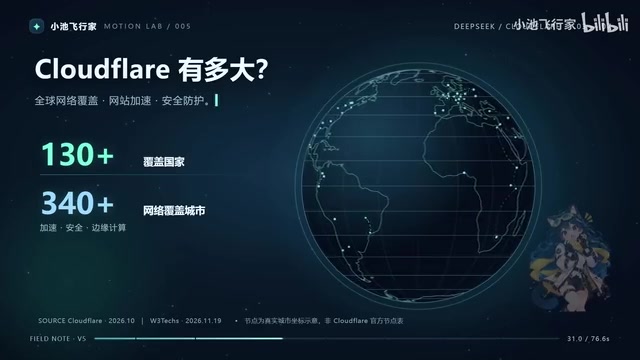
Cloudflare itself is a global internet infrastructure platform that provides website acceleration, attack protection, and the ability to run code close to users. Screenshot information shows that by October 2026, its network covers over 130 countries and 340+ cities; W3Tex statistics show that roughly 30% of websites use Cloudflare as a reverse proxy. These figures come from the original material and are used to illustrate the platform's distribution scale.
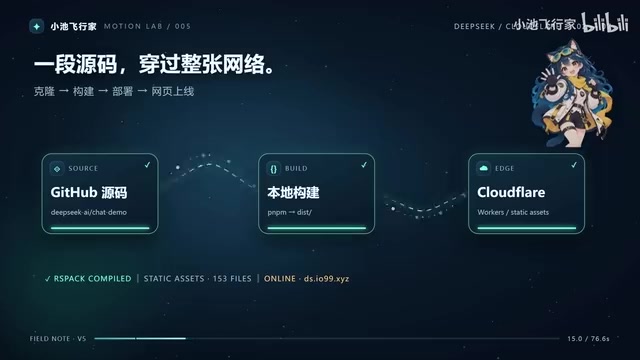
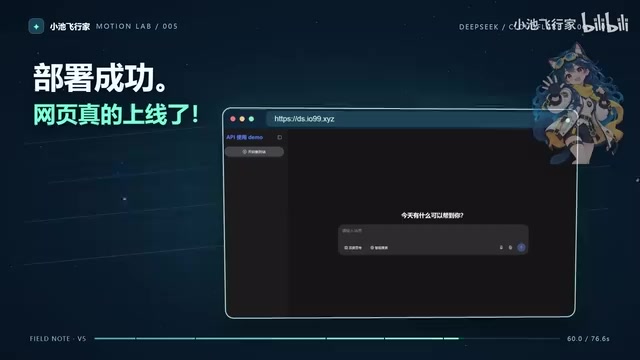
This deployment approach has one key characteristic: it's a static frontend, so there's no need to maintain a server. The web pages are hosted on Cloudflare, while model inference is still handled by DeepSeek's API. For individual developers, this means eliminating backend operations and scaling anxiety, while also avoiding the cost barrier of self-hosted inference services.
Static frontend hosting refers to uploading resources such as HTML, CSS, and JavaScript—which contain no server-side business logic—to a hosting platform, which handles distribution and availability. Visitors' browsers load these resources directly and execute them locally. This contrasts with dynamic deployment, which requires a server to run code and manage sessions and databases. Static hosting typically features zero operations, automatic scaling, and billing by request or traffic, making it suitable for interface layers and lightweight tool applications. However, a static frontend cannot hide secrets on its own, nor can it replace backend authentication. Therefore, any functionality involving API calls and quota consumption requires an architectural decision about who holds the key and who bears the cost.
Key Prerequisite: API Costs Are Borne by Visitors
The most easily misunderstood aspect of this experiment is that "the DeepSeek web version is open source" does not equal "free DeepSeek model quota." The creator explicitly reminds viewers in the video: each visitor must enter their own API Key, and costs are borne individually.

Looking at this from an architectural perspective makes it clearer: Cloudflare hosts the interface and static resources, while the actual costs come from model inference calls. Therefore, the deployer doesn't need to pay for strangers' conversations, but visitors must bring their own keys to use it. This model suits demo sites, internal tools, or community sharing—not free public chat services.
API Key is a credential used for identity verification and billing when calling large model APIs, typically existing as a string. The holder can use it to initiate inference requests and incur costs based on usage. Entering an API Key into a pure static frontend means the key exists in the browser environment and may be viewed by visitors or obtained through developer tools, or leaked if page scripts are tampered with. Therefore, a safer approach for such demo sites is to restrict access to trusted users, set usage limits, rotate keys regularly, or introduce a very lightweight server-side proxy to hide the key. Understanding this is essential to accurately judge the security and cost boundaries of the "visitor pays" model.
The Significance of This Experiment
From an engineering perspective, this attempt isn't technically sophisticated, but the direction has reference value. Open-source frontend plus edge hosting significantly lowers the barrier to "building a usable AI chat entry point"; delegating inference to the official API avoids model deployment and compute investment. According to the address provided by the creator, the project can be accessed at ds.io99.xyz—a small engineering experiment.
For readers who want to replicate this, the path is relatively clear: find the Chat Demo repository under the DeepSeek AI organization, build locally, deploy to Cloudflare, and keep the API Key input field on the page. What needs to be thought through in advance is cost attribution and key security—not focusing on "free."
Frequently Asked Questions
Is this an official DeepSeek service? No. The frontend comes from official open-source code, but deployment and the access address are handled by an individual developer, and inference calls go through the official API.
Does using it cost money? Yes—visitors bring their own API Key and bear the costs themselves.
Do I need to maintain my own server? No—the static frontend is hosted on Cloudflare.
Related articles

Nothing CMF Buds 2A Drops to $17.89 on Black Friday: A New Low for ANC Earbuds
Nothing CMF Buds 2A wireless earbuds Black Friday deal: just $17.89 on Amazon, about $11 off retail and a record low. ANC earbuds at an entry-level price.

When AI Creation Gets Accused of "Spitting": Hacker News Heats Up Over the Glaude Controversy
A Hacker News post, "Spitting in the Face of Glaude," sparks debate on AI creation transparency and attribution ethics. This analysis examines the blurred creator identity behind the controversy and offers practical advice for AI content production.

Akai Embraces Custom Firmware: MPC Sample 1.4 Lets Users AI-Program Their Sampler
Akai embraces the modding community with MPC Sample 1.4 firmware, supporting vibe-coded custom firmware and effects. We analyze the impact of this open strategy on music hardware and AI-assisted programming.