Degree or Skills? Career Dilemmas and Breakthroughs for Career Changers

Degree or skills? A practical breakdown for career changers navigating academic gaps and third-tier college stigma.
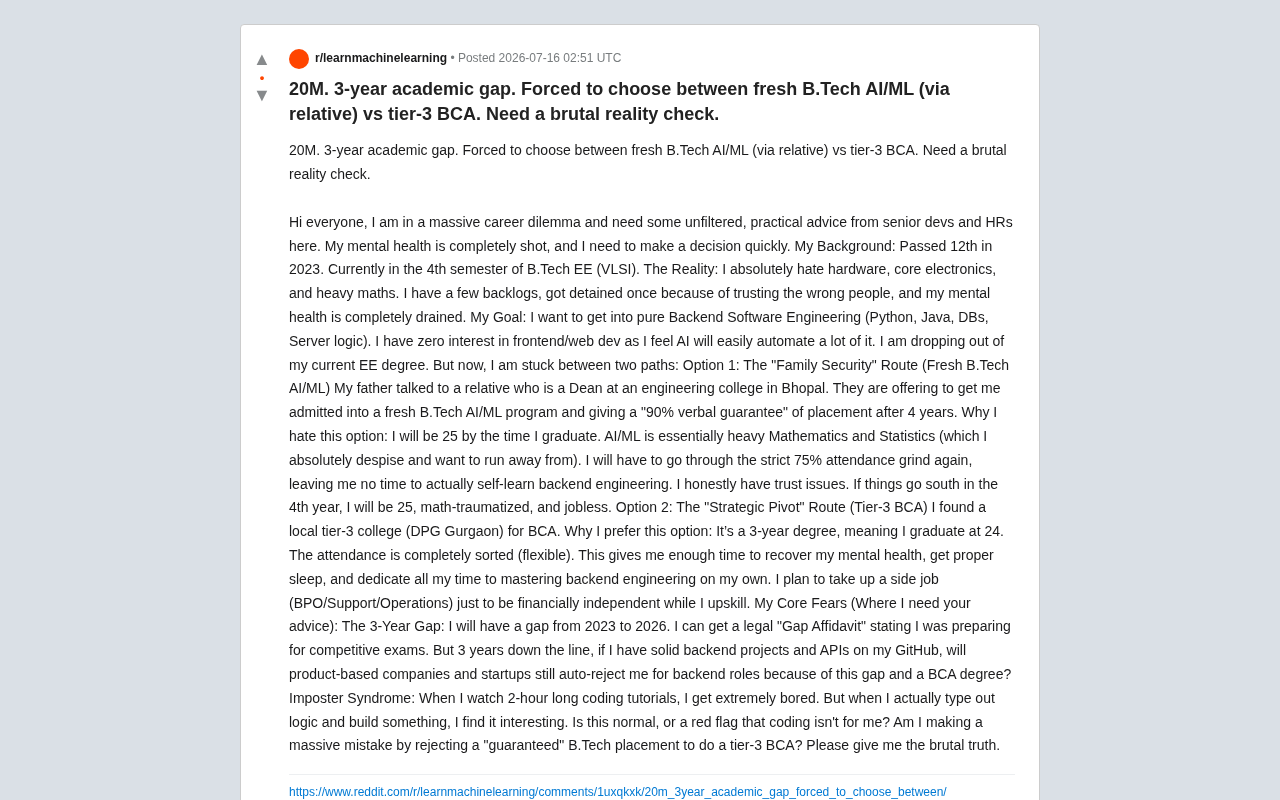
A 20-year-old Indian VLSI student who hates hardware faces a choice: a B.Tech AI/ML with a "90% verbal job guarantee" or a third-tier BCA with room to self-study backend development. This article dissects the real value of verbal guarantees, the psychology of learning styles, AI's uneven impact on tech roles, and why BCA plus a strong GitHub portfolio may be the smarter bet for career changers.
A Real Career Crossroads
Recently, a 20-year-old Indian student posted a plea for help on Reddit that sparked extensive discussion among developers and HR professionals. His situation is fairly representative: currently in the fourth semester of an Electronics Engineering (VLSI) program, he openly admits he "hates hardware, core electronics, and heavy math," while carrying the weight of failed courses, being held back a year, and a three-year academic gap. His goal is clear — to become a pure backend software engineer (Python, Java, databases, server logic).
It's worth noting that VLSI (Very Large Scale Integration) is the branch of electrical engineering closest to hardware, involving chip design, transistor layout, timing analysis, and highly mathematical content. It differs fundamentally from backend software engineering in terms of cognitive approach. Backend engineers focus on server logic, API design, database optimization, and system architecture — the two fields share almost no skill overlap. This explains why he experiences such a jarring professional disconnect. This isn't simply "not liking" something; it's a clash between two entirely different thinking paradigms.
He now faces a dilemma, and what lies beneath this choice reflects the core question that tech job seekers worldwide must confront: In an era of rapid AI adoption, should you pursue a "safe" degree, or bet on transferable, practical skills?
The Battle Between Two Paths
Option One: The Family Safety Play — A New B.Tech in AI/ML
His father, through a relative who serves as the dean of an engineering college in Bhopal, secured him admission to a brand-new AI/ML undergraduate program, complete with a "90% verbal employment guarantee."
But he's deeply resistant, for very practical reasons:
- Completing a four-year degree means he won't graduate until he's 25;
- AI/ML is fundamentally math-heavy and statistics-intensive — exactly the domain he's trying to escape;
- A strict 75% attendance requirement would eat up all the time he'd need to self-study backend engineering;
- The "verbal guarantee" has no legal force — if something goes wrong in year four, he'll be "25, beaten down by math, and unemployed."
On the credibility of "verbal guarantees," it helps to understand the Indian engineering education landscape: "employment guarantees" are a common enrollment pitch at private engineering colleges. Their statistics typically include any kind of offer from campus recruiting, ranging from extremely low-paying entry-level positions to sales roles unrelated to the field of study. Data from India's All India Council for Technical Education (AICTE) shows there are approximately 3,500 engineering colleges nationwide, with around 60% of graduates facing employment difficulties. The gap in employment outcomes between top institutions and bottom-tier ones is enormous. Verbal commitments are virtually unenforceable legally, and consumer court cases over the years show very few students successfully recovering damages.
Option Two: The Strategic Pivot — A BCA at a Third-Tier College
The other path is a BCA (Bachelor of Computer Applications) at a third-tier college in Gurgaon — a three-year degree. He leans toward this option:
- Three years means graduating at 24, one year earlier;
- Flexible attendance requirements would let him restore his mental health and focus energy on self-studying backend engineering;
- He plans to simultaneously work part-time in BPO/customer service/operations roles to achieve financial independence while upskilling.
The BCA is a three-year computer applications bachelor's degree unique to India, covering programming fundamentals, databases, networking, and software engineering, with significantly lower math requirements than B.Tech. Historically in India's IT job market, BCA was considered a substitute for B.Tech, but in recent years, as outsourcing firms (like TCS and Infosys) have raised degree requirements, BCA graduates have become less competitive at large outsourcing companies. At startups and product-oriented companies, however, the impact of degree differences is relatively limited, with portfolios and actual ability carrying more weight.
Three Core Fears — Questions Everyone Shares
The three "soul-searching questions" he raised are actually the shared anxieties of countless non-traditional candidates and job seekers with employment gaps.
Fear One: Will a Three-Year Gap + Third-Tier Degree Lead to Automatic Rejection?
He worries that even with solid backend projects and APIs on GitHub, product companies or startups will still reject him outright because of his academic background and employment gap.
The reality: it depends on the type of company you're targeting. For large outsourcing companies or some traditional enterprises that emphasize "degree screening," a third-tier BCA plus a three-year gap is indeed a liability — you may get filtered out at the resume stage. But for startups and product-driven teams, the hiring logic tends to be "can you solve problems?" A candidate who can show a real deployed backend service, clean API design, and sound database modeling is far more convincing than a diploma. Employment gaps can be reasonably explained with "studying + self-learning projects" — the key is filling the narrative gap with actual work.
Fear Two: Bored by Long Tutorials, But Engaged When Actually Coding — Is That a Red Flag?
He says watching two hours of coding tutorials is extremely draining, but when he actually sits down to write logic and build things, he finds it interesting.
This isn't just normal — it's actually a good sign. Passive watching and active building are two entirely different cognitive modes. From a cognitive science perspective, passively watching videos activates the declarative memory system, while programming ability relies on procedural memory, which can only be internalized through repeated practice. Research shows that active retrieval (such as building your own projects) produces more than twice the learning effectiveness of passive review — a phenomenon known as the "Testing Effect." The real red flag is "Tutorial Hell" — endlessly watching tutorials without ever building anything. The state he describes is the opposite: an aversion to passive input and a love of active creation — precisely the psychological profile that suits a tech career changer.
Fear Three: Is Giving Up the "Guaranteed Employment" Degree for a Third-Tier BCA a Huge Mistake?
This is the central question of the entire post. There's no absolute answer, but it can be broken down into several rational dimensions.
A Clear-Eyed Reality Check
The Real Value of a "Verbal Guarantee"
A "90% verbal employment guarantee" has almost no credibility as a career planning tool. College employment rates are often calculated using various statistical definitions, and no one can predict what the market will look like several years from now. Staking your entire future on a promise with no written commitment is inherently high-risk.
Time Cost and Mental Health
In purely time-based terms, the three-year BCA lets him graduate a year earlier and frees up significant discretionary time. For someone whose "mental health is already depleted," being able to recover sleep and control your own pace is itself the greatest productivity boost. Grinding through four years of intensive math coursework while in a state of burnout is likely to result in failure on both fronts.
Skill Alignment: Backend vs. AI/ML
He explicitly states he loves backend logic and hates math and statistics — yet B.Tech AI/ML is precisely a math-intensive program. Forcing yourself into a field you hate means you'll struggle to be competitive even after graduating. While backend engineering does require some algorithmic foundations, its reliance on advanced mathematics is far lower than machine learning. From an interest-and-ability-fit perspective, BCA + self-studying backend aligns much better with his actual situation.
On the Judgment That "AI Will Automate Certain Directions"
His reason for avoiding frontend work is that "AI will easily automate a lot of frontend tasks." This assessment has some merit, but deserves careful consideration. The proliferation of AI coding tools like GitHub Copilot and Cursor has indeed changed the structure of software development work, but the impact isn't evenly distributed: boilerplate code generation for frontend UI is now highly automated, but backend system design, distributed architecture decisions, database performance tuning, and security compliance still rely heavily on human judgment. A 2024 McKinsey report noted that the tasks most affected by AI are repetitive, rule-based coding tasks, while the value of systems-level thinking and cross-domain business logic integration is actually increasing. No direction is "AI-proof" — the real moat is system design capability, business understanding, and the judgment to solve complex problems, not any specific tech stack.
Actionable Advice for Others Facing Similar Dilemmas
All things considered, if this student can maintain strict self-discipline, then BCA + systematic self-study of backend development + consistent GitHub project output is a path better suited to his interests, mental state, and time constraints. But the prerequisite for this path is extremely strong self-motivation — a third-tier college won't give you any external structure, and if you slack off, three years can be wasted just the same.
For everyone facing a similar career-change dilemma, a few principles are worth keeping in mind:
- A degree is your entry ticket; your work is your competitive edge. Within your available options, use real projects to offset academic shortcomings.
- Be wary of "guarantee" pitches. Promises without written commitments should never be the pivot point for life decisions.
- Interest alignment determines long-term endurance. Forcing yourself into a field you hate won't yield long-term achievement, no matter how much short-term suffering you endure.
- Mental health is a foundational asset. Any "hard work" done in a state of burnout is inefficient.
The final choice is in his hands, but this discussion reminds us: in the tech industry, there is never just one path — the key is finding the one you can keep walking.
Key Takeaways
Related articles

Alibaba Launches Happy Shrimp: AI-Powered One-Click Complete Song Generation
Alibaba launches Happy Shrimp, an AI music generation tool that creates complete songs with lyrics, melody, arrangement, and vocals from natural language descriptions. In-depth analysis of its core features, differentiation from competitors like Suno, and industry impact.
GPT Sol Ultra vs Grok 4.6: Real-World Task Completion Benchmark in Reasoning Mode
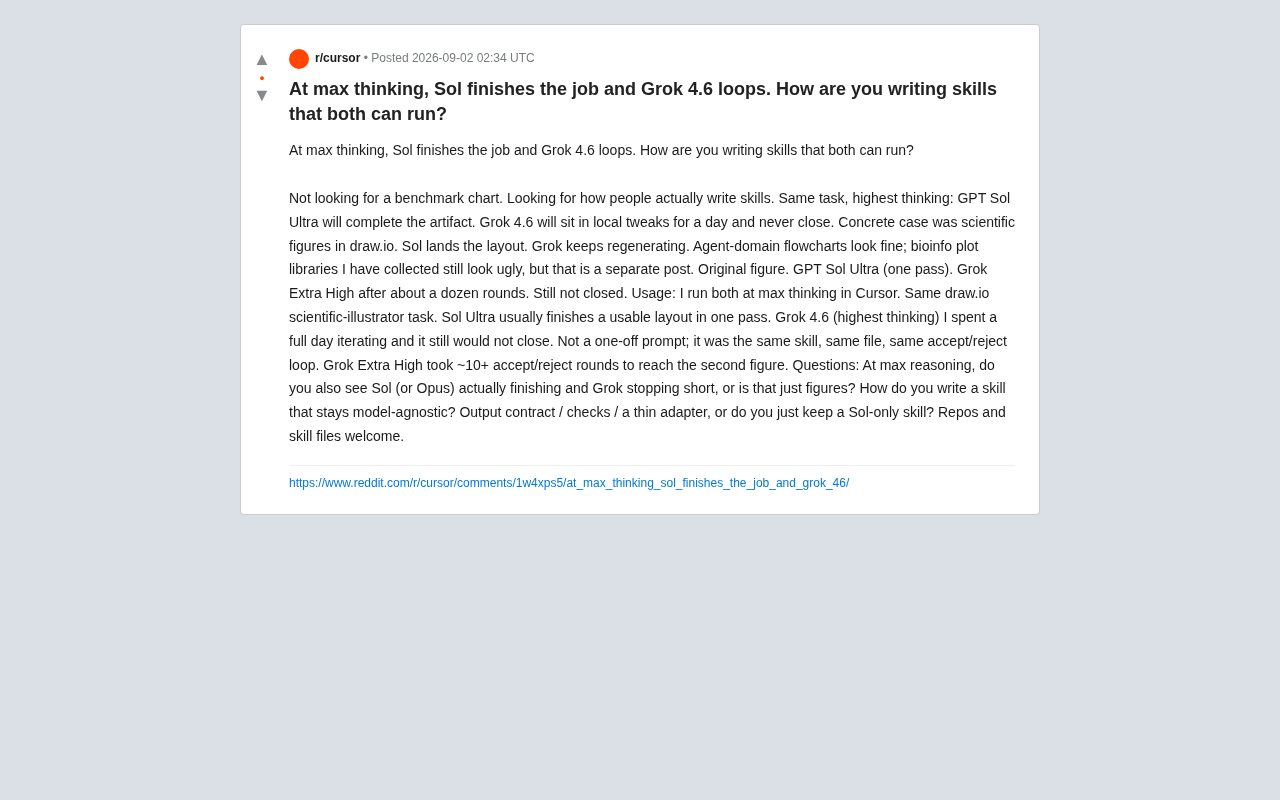
Developer benchmark reveals GPT Sol Ultra completes draw.io scientific diagrams in one iteration while Grok 4.6 fails to converge despite maximum reasoning mode, exposing that reasoning depth ≠ task delivery capability.
OpenAI Authorship Dispute: The Battle Over Academic Boundaries in the AI Era
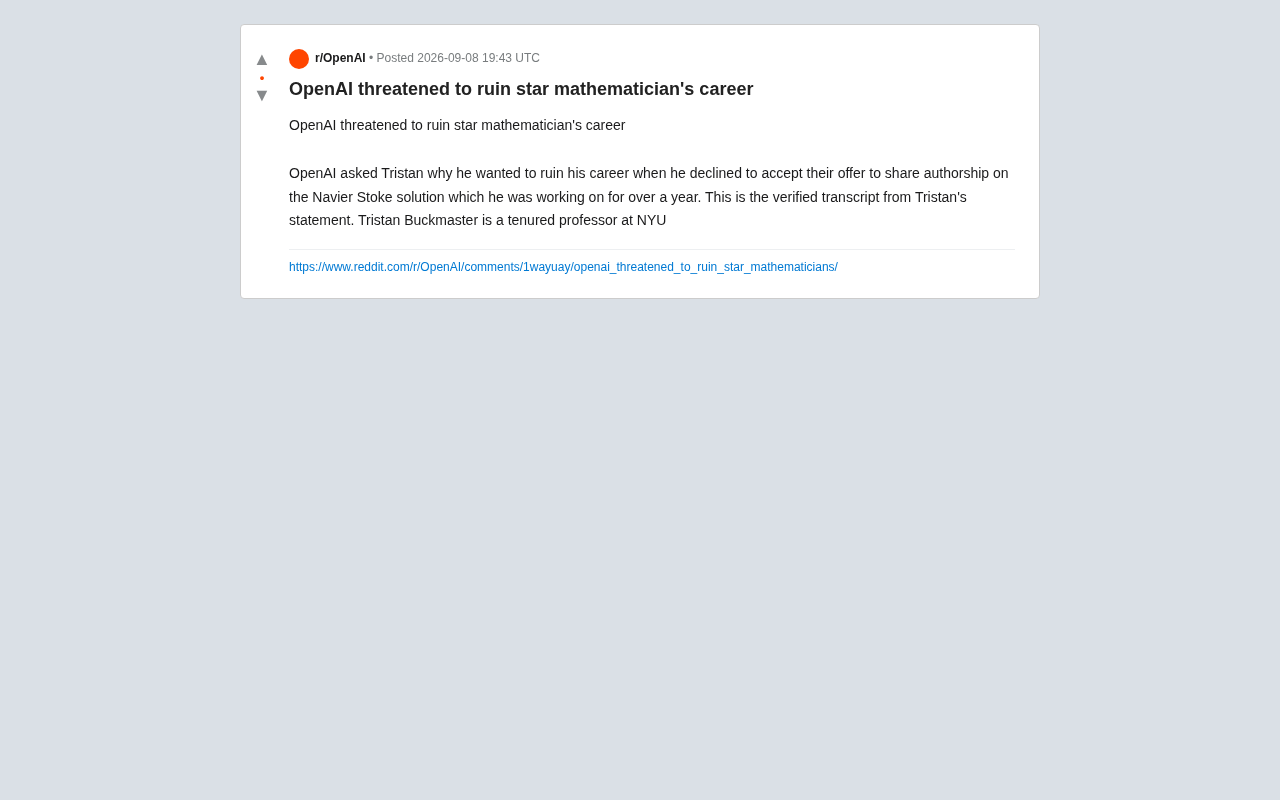
OpenAI disputes authorship with mathematician Tristan Buckmaster over Navier-Stokes research, raising ethical questions about AI involvement in science.