Democrats Want to Win the Midterms by Cracking Down on AI—Will It Work?

Democrats want to use AI regulation to regain Congress, but a crackdown carries backfire risks.
As U.S. midterm elections approach, Democrats see AI regulation as a policy card to regain control of Congress. If they flip at least one chamber, they will regain committee leadership, accelerating AI legislation. The AI issue can bypass partisan gridlock and connect to voter pain points. But cracking down on AI faces industry backlash, credibility issues, and high coordination costs. A comprehensive federal AI law is unlikely short-term; fragmented progress is more likely. For the AI industry, the direct changes are more hearings and rising compliance discussions.
Title
Democrats Want to Win the Midterms by Cracking Down on AI—Will It Work?
Meta Description
Democrats hope to regain control of Congress by cracking down on AI, making AI regulation a midterm election issue. This article analyzes the electoral calculus, potential risks, and real impact on the AI industry.
Article Content
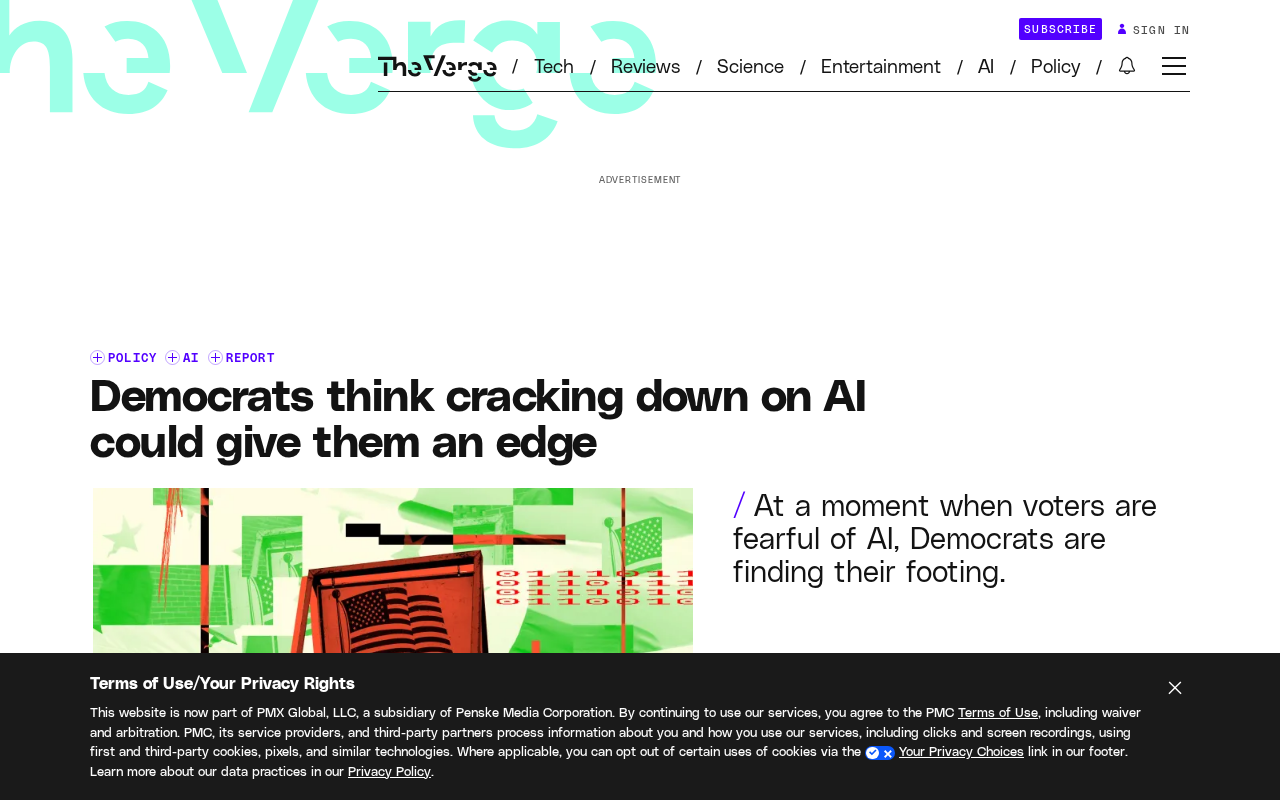
As the U.S. midterm elections approach, AI regulation is becoming a policy card Democrats are trying to play to regain control of Congress. A Politico report notes that if Democrats flip at least one chamber in November, committee leadership will return to their hands, and how to handle AI—the "newest and thorniest" political issue—will be a question they must answer.
Why Democrats Are Targeting AI Regulation
According to Politico, polls predict Democrats are likely to flip at least one congressional chamber in the midterms, meaning committee gavels will return to Democratic hands. Once they control the agenda-setting power, AI legislation shifts from "open for discussion" to "ready to advance."
For Democrats, AI is a rare issue: it's new enough that voters haven't formed entrenched partisan biases; it's hot enough to command high media attention; and it's specific enough to connect to voter-perceived pain points like jobs, copyright, election disinformation, and algorithmic discrimination. Stack these characteristics together, and AI regulation naturally becomes ready-made material for an election narrative.
But material doesn't equal victory. The subtext of the report is that Democrats don't have a unified answer on "how to regulate," while Republicans are relatively united in their deregulatory stance. This asymmetry is both an opportunity and a risk.
Committee leadership is a core mechanism of how the U.S. Congress operates. The House and Senate have multiple committees (such as the Judiciary Committee, Energy and Commerce Committee, Finance Committee, etc.), with committee chairs held by members of the majority party, who have the power to decide whether to send bills to markup, schedule hearings, subpoena witnesses, and lead budget appropriations. While the minority party can participate, it cannot set the agenda. Therefore, whichever party controls the chamber majority holds committee chair positions, determining which issues can enter the legislative fast track. For an issue like AI regulation that spans multiple committee jurisdictions, committee leadership means Democrats can simultaneously launch hearings and draft bills in relevant committees, significantly accelerating the agenda.
The Electoral Calculus of Cracking Down on AI
Democrats' tough-on-AI stance has a clear electoral calculation behind it.
First, AI anxiety is spreading. From white-collar workers worried about job displacement, to parents concerned about children encountering deepfake content, to creators worried about their work being "freeloaded" by models—these emotions can all be converted into demands for regulation. Proposing a strong regulatory framework sends a signal to these groups: we're on it.
Second, the AI issue can bypass traditional partisan gridlock. Compared to highly polarized issues like immigration and abortion, AI regulation can easily garner cross-partisan support at an abstract level—"reining in Big Tech" has appeal on both sides. Democrats can use the AI issue to shape an image of "responsible governance."
Third, committee leadership is real leverage. Once Democrats take a chamber, hearings, bill texts, and budget riders can all become tools of pressure, and they will partially control the pace of AI regulation.
Deepfake refers to highly realistic fake audio and video content synthesized using generative AI technology. In recent years, deepfakes have been used to create false speeches by politicians and fabricate election information, drawing lawmakers' attention. Congress has proposed multiple bills targeting election deepfakes, requiring platforms to label or remove such content and setting criminal liability for producers and disseminators. This issue, due to its intuitive visual impact and direct threat to election integrity, has become one of the less partisan-contested entry points in AI regulation and is one of the priority scenarios for Democrats' fragmented legislation push.
Risk: Crackdown Could Backfire
The electoral dividends of cracking down on AI are not without costs.
The most direct risk is industry backlash. AI is one of the few fields in the U.S. where both capital and talent are accelerating their influx. An overly stringent regulatory framework can easily be labeled as "killing innovation," and this label is equally damaging in swing districts.
Second is the credibility problem at the implementation level. Congress's recent legislative record on tech issues has not been impressive, and voters are immune to promises that are "said but not done." If Democrats treat AI regulation merely as a campaign slogan without an actionable legislative path, the issue's热度 will quickly fade.
There's also a structural challenge: AI regulation spans multiple committee jurisdictions—copyright, privacy, national security, labor—making coordination costs extremely high. Even if Democrats control one chamber, the pace of progress may not keep up with the election cycle.
"Killing innovation" is a classic framing in U.S. tech policy debates. Industry and some bipartisan lawmakers often use this argument to oppose strong regulation, arguing that excessive restrictions hinder R&D, capital investment, and talent inflow, weakening America's edge in global AI competition. This label is particularly effective in swing districts because the AI industry creates jobs and tax revenue in many states. If Democrats propose stringent compliance requirements (such as mandatory model audits and training data disclosure), opponents can easily cast them as "anti-tech jobs," backfiring in elections. Therefore, how to balance regulation and innovation is a political arithmetic Democrats must confront.
Real Impact on the AI Industry
From an industry perspective, the most direct change from Democrats regaining partial control of Congress is not in the bills themselves, but in the agenda and discourse power.
There will be more hearings, and AI company executives will be subpoenaed to testify more frequently; regulatory agencies may receive more support for staffing and budgets; discussions around model transparency, training data sources, and risk assessment will shift from industry self-regulation to legislative language. For teams building AI applications and open-source tools, compliance costs need to be incorporated into product planning in advance, especially for areas involving copyrighted data and content generation.
But the probability of a comprehensive federal AI law in the short term remains low. The more likely path is fragmented progress: first placing pieces in specific scenarios (such as election deepfakes, child protection, government use of AI), then gradually expanding.
Conclusion
Democrats treating AI regulation as an election issue is logically sound but questionable in effect. The novelty of the AI issue can bring attention, but novelty also fades quickly; a tough stance can rally some voters but may also activate industry opposition. What really determines the success of this card is not how loud the slogans are, but whether they can produce legislative text acceptable to both sides after the election. For those following AI policy, the hearing schedules and draft bills in the coming months are more worth watching than campaign speeches.
One-line Summary
Democrats want to use AI regulation to regain Congress, but a crackdown carries backfire risks.
Paragraph Summary
As U.S. midterm elections approach, Democrats see AI regulation as a policy card to regain control of Congress. If they flip at least one chamber, Democrats will regain committee leadership, accelerating the AI legislative agenda. The AI issue, due to its novelty and strong cross-partisan abstract consensus, can bypass traditional gridlock and connect to voter pain points like jobs, copyright, and election disinformation. However, cracking down on AI faces risks including industry backlash, insufficient implementation credibility, and high committee coordination costs. A comprehensive federal AI law is unlikely in the short term; fragmented progress is more likely. For the AI industry, the most direct changes are more hearings and rising compliance discussions.
Related articles

OpenAI Partners with Shield: How the Astra Agent Revolutionizes IT Troubleshooting
OpenAI and Shield launch the Astra agent, which autonomously logs into computers and legacy systems to fix IT issues in real time, 35-40% faster than traditional models, with humans involved only when judgment is needed.

iPhone Duo Battery Life Tested: One Charge a Day Is Unavoidable, and the Large Screen Is the Culprit
iPhone Duo battery test: heavy use needs at least one charge a day, and about 30% remains after 6.5 hours of screen-on time. How often the large screen is unfolded is key; a MagSafe battery pack helps, and long-term degradation is also worth watching.

Kimi K3.1 Pro Open-Sourced: 2.8 Trillion Parameters Close In on Opus
Moonshot releases the open-source MoE model Kimi K3.1 Pro, with 2.8T total parameters and 104B activated, trailing Opus 5.5 by under 1 point on Terminal Bench 4.0.