Denmark's Oral Defense Requirement to Combat AI Cheating: Lessons for Educational Assessment Reform

Denmark combats AI cheating by requiring oral defenses of written work, shifting assessment from outputs to understanding.
Denmark is addressing AI-driven academic dishonesty by requiring students to orally defend their written assignments, leveraging its long-standing oral examination tradition. This approach bypasses unreliable AI detection tools and shifts assessment focus from final outputs to genuine understanding. While implementation costs and equity concerns remain, the strategy offers a pragmatic model for global education systems grappling with generative AI's impact on academic integrity.
When AI Meets the Academic Integrity Crisis
With the widespread adoption of generative AI tools like ChatGPT, global education systems are facing an unprecedented integrity crisis. Students can input a few prompts and generate a well-structured, logically coherent essay or assignment in seconds. Traditional written assessment methods are becoming increasingly inadequate for judging students' true capabilities amid this technological wave.
ChatGPT is built on the GPT series of Large Language Models (LLMs), utilizing the Transformer architecture and Reinforcement Learning from Human Feedback (RLHF) for training. Its text generation capability stems from statistical pattern learning across massive corpora, producing grammatically correct, logically coherent, and stylistically varied text. Since its release in November 2022, ChatGPT surpassed 100 million users within two months, becoming the fastest-growing consumer application in history. Meanwhile, competitors like Claude, Gemini, and ERNIE Bot quickly followed suit, making AI writing tools more accessible than ever before. These models can not only generate general-purpose text but also produce professionally nuanced writing in specific academic domains (such as law, medicine, and computer science), further blurring the line between human-original and machine-generated content.
Facing this challenge, Denmark has offered an inspiring answer: requiring students to conduct oral defenses of their written assignments. This initiative sparked lively discussion on Hacker News, garnering 93 upvotes and 45 comments, reflecting the tech community's keen interest in educational transformation in the AI era.
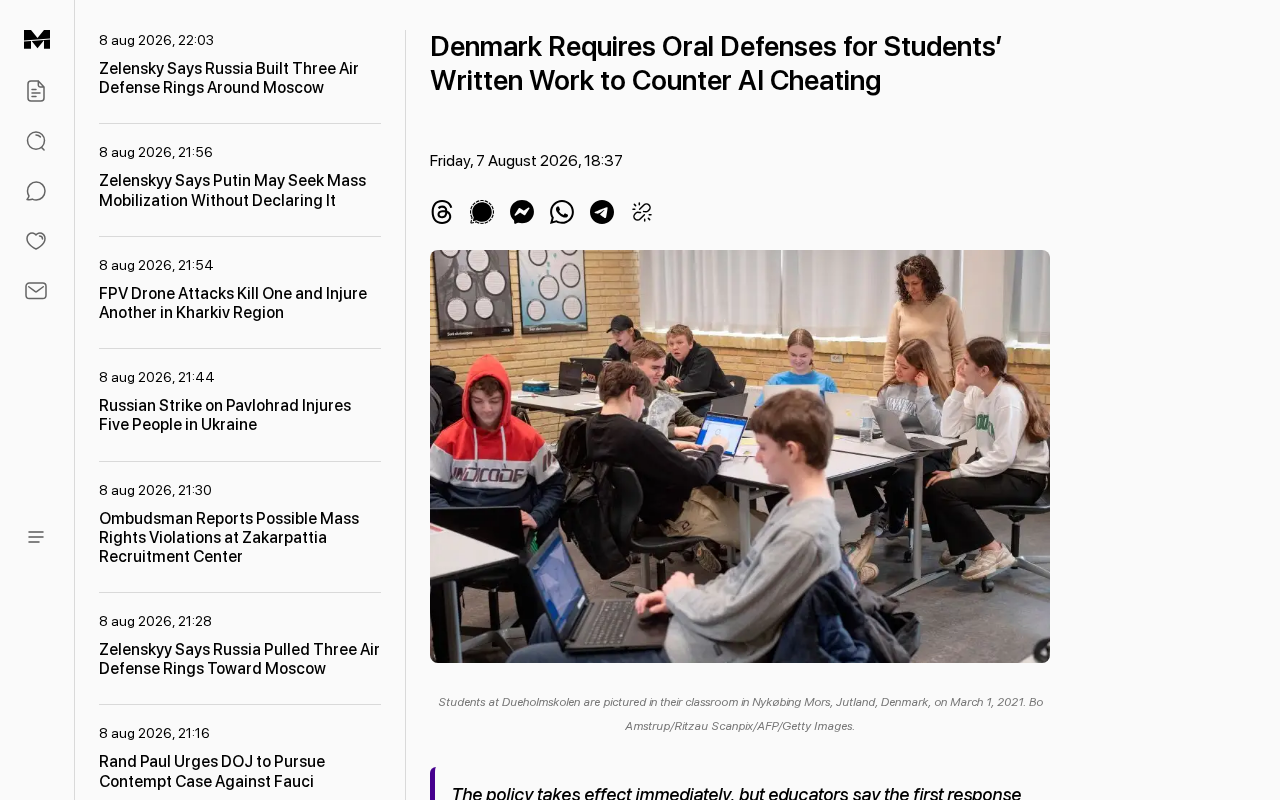
Denmark's Solution: Returning to Oral Examination
The Core Logic of Oral Defenses
Denmark's educational system response isn't complicated, but it strikes at the heart of the issue: if a paper is truly the student's own work, they should be able to clearly explain the viewpoints, argumentation process, and conclusions within it. Conversely, if the work was ghostwritten by AI, students will often reveal gaps when facing in-depth questioning.
The value of oral defenses lies in the fact that they no longer assess the final text output itself, but rather the depth of understanding and thought process behind it. This is precisely the aspect that current AI tools find hardest to replace for students—even if AI can produce beautiful prose, it cannot help students truly internalize knowledge.
Why Denmark Chose the Oral Defense Path
A notable detail: oral defenses are not a brand-new Danish invention. In fact, the oral examination tradition has a long history in European higher education systems, with doctoral thesis defenses being a prime example. Denmark's move is more akin to extending and scaling down this mature mechanism to broader student written assignment evaluation in response to new challenges posed by AI.
Oral examinations (Viva Voce, Latin for "with living voice") have centuries of history in European academic tradition. Degree conferral in medieval European universities relied almost entirely on oral defenses, where students had to answer questions extemporaneously and engage in academic debate before faculty committees. This tradition has been particularly well-preserved in Germany (Mündliche Prüfung), France (Soutenance de thèse), and Nordic countries. Denmark's education system itself already incorporates substantial oral examination components, particularly in upper secondary school (Gymnasium) graduation exams and university course assessments, where oral and written examinations carry equal weight—a distinctive feature of its educational culture. Therefore, extending oral defenses to written assignment evaluation represents an institutional extension for Denmark's education system, rather than an entirely new institutional creation.
Compared to investing heavily in developing AI detection tools (whose accuracy and reliability have been consistently questioned), oral defenses represent a more pragmatic and sustainable solution. They don't depend on any technological arms race but instead return to the essence of education—verifying whether students have truly mastered the knowledge.
Why AI Detection Tools Struggle to Solve the Cheating Problem
Why not simply use technological means to detect AI-generated content? This was a focal point in community discussions.
The reality is that current AI detection tools on the market have serious flaws. On one hand, as large language models rapidly iterate, generated text increasingly resembles human writing style, making detection progressively more difficult. On the other hand, these tools have persistently high false positive rates, potentially mislabeling students' original work as AI-generated, creating wrongful accusations. OpenAI's own previously launched AI text detector was taken offline due to insufficient accuracy.
From a technical standpoint, current mainstream AI text detection tools (such as GPTZero, Turnitin's AI detection module, Originality.ai, etc.) primarily rely on two technical approaches: first, analyzing text perplexity and burstiness—measuring text predictability, since AI-generated text typically exhibits lower perplexity and more uniform burstiness distribution; second, training specialized classifiers to distinguish between human and AI writing. However, both methods face fundamental challenges. OpenAI's AI Classifier, released in January 2023, correctly identified AI text only 26% of the time in testing, while 9% of human text was incorrectly flagged as AI-generated, ultimately being retired in July of that year due to "low accuracy." More critically, simple paraphrasing, translation switching, or using different prompting strategies can easily circumvent most detectors, trapping technological detection in an endless cat-and-mouse game.
In this context, building trust on unreliable detection algorithms is tantamount to building castles on sand. Denmark's oral defense approach cleverly sidesteps this technological trap, shifting the assessment anchor from "whether content was AI-generated" to "whether the student truly understands."
Deeper Transformation of Educational Assessment in the AI Era
A Paradigm Shift from Outcome-Oriented to Process-Oriented
Denmark's approach reveals a broader trend: in the AI era, educational assessment must shift from being outcome-oriented to process-oriented. When AI can easily produce high-quality final products, purely outcome-based assessment methods lose their discriminating power.
This shift has deep theoretical roots in education. Bloom's Taxonomy divides cognitive abilities into six levels: remembering, understanding, applying, analyzing, evaluating, and creating. Traditional written assignments often primarily test lower-level abilities, and AI happens to excel at producing content at these levels. Oral defenses can effectively assess higher-order cognitive abilities—whether students can demonstrate analytical reasoning under questioning, whether they can transfer knowledge to new contexts, and whether they can critically evaluate different perspectives. Additionally, Vygotsky's "Zone of Proximal Development" theory also supports this interactive assessment approach: through teacher-student dialogue, educators can precisely locate students' actual cognitive levels, rather than merely seeing a final output that may have been polished by AI.
Future education may need to focus more on students' thinking processes, critical analysis capabilities, and knowledge application skills—precisely the core competencies that AI cannot perform on behalf of humans and that humans truly need to develop.
Potential Controversies and Implementation Costs of Oral Defenses
Of course, this solution is not without costs. Oral defenses require significant faculty and time investment. For large institutions with many students, conducting individual oral examinations presents an enormous organizational challenge. Furthermore, students with weaker oral communication skills or anxiety may be disadvantaged by this assessment format, raising concerns about assessment equity.
Consider a large comprehensive university with 30,000 undergraduates: if every major written assignment in every course includes a 15-20 minute oral defense, the required faculty hours would grow exponentially. For a single 300-student lecture course, the oral examination component alone would require 75-100 hours of faculty time, not including rubric development, examiner coordination, and grade appeal administration. Some discussants suggest adopting a stratified sampling strategy—conducting oral defenses only for suspicious assignments or randomly selected students to reduce systematic burden. Other scholars propose that a hybrid model combining peer review with oral presentations might find a compromise between scale and depth.
How to balance academic integrity with assessment efficiency and fairness will be an ongoing challenge that Denmark and other countries following suit will need to continue exploring.
Implications for Global Educators
Denmark's practice provides a valuable reference for the global education community. It sends an important signal: when facing the impact of AI, it's better to proactively restructure assessment systems than to passively defend against it.
For educators in China, this case is equally worthy of reflection. The proliferation of generative AI is an irreversible trend—blocking is less effective than channeling. Perhaps the real solution lies not in prohibiting students from using AI, but in designing assessment methods that genuinely reflect student capabilities—whether through oral defenses, live demonstrations, or project-based comprehensive evaluations.
Ultimately, the goal of education has never been to produce polished assignments, but to cultivate people who can think and innovate. In an era when AI can ghostwrite everything, this original purpose becomes even more precious. Through a return to traditional oral defenses, Denmark has taught us a vivid lesson.
Related articles

Sim-to-Real Gap in Quadruped Robots: Causes and Solutions for Bridging the Simulation-Reality Divide
Explore the Sim-to-Real Gap in quadruped robots: causes like physics mismatch, sensor noise, and actuator dynamics, plus solutions including domain randomization and system identification.

The AI Spending Divide: 1% of Companies Are Going All In While Most Are Still Spending 'Lunch Money'
Ramp AI Index data shows the top 1% of companies treat AI as essential operating expense while median firms spend 'lunch money.' Analysis of the divide, causes, and actionable takeaways.

llama.cpp GUI Launcher for Linux: Hands-On Review of Two Installation Methods
Hands-on review of the llama.cpp GUI Launcher for Linux, comparing manual compilation vs. Snap installation, covering startup commands, known bugs, and differences from Ollama and LM Studio.