Density Ratio Estimation via Stein Displacement Fields: A Convex Optimization Framework for Unifying Distribution Transport

This research unifies density ratio and displacement field estimation via Stein operators, solving both simultaneously through one convex optimization problem.
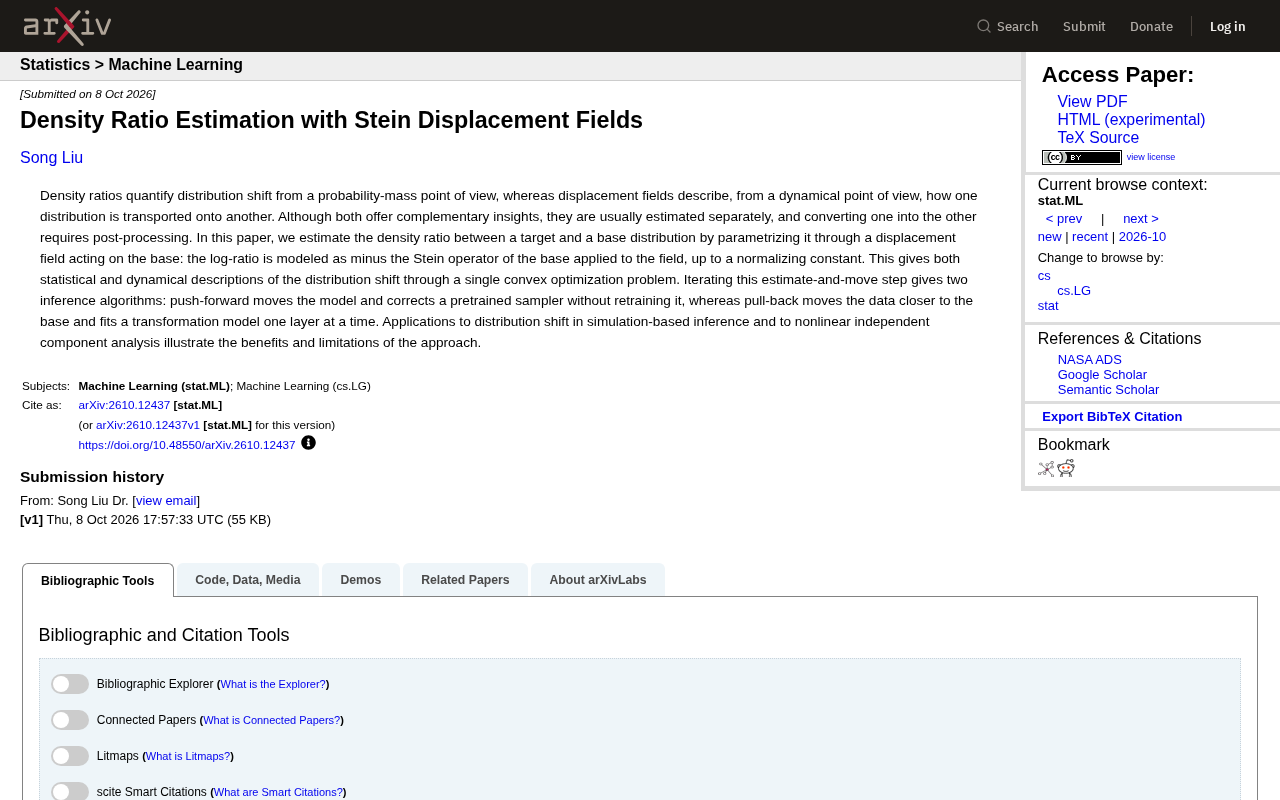
This paper presents a framework unifying density ratio and displacement field estimation by parameterizing the log density ratio as the negative Stein operator applied to a displacement field plus a normalization constant. This convex optimization yields self-consistent statistical and dynamical descriptions of distribution shift. Two iterative algorithms—push-forward (correcting pre-trained samplers without retraining) and pull-back (layer-wise transformation fitting)—are validated on simulation-based inference and nonlinear ICA.
Density Ratio and Displacement Field: Two Languages, Two Sides of One Problem
In machine learning and statistical inference, quantifying the difference between two distributions is always a core problem. The density ratio describes distribution shift from the perspective of probability mass—it tells us by what factor the target distribution's probability density exceeds the base distribution's at a given location. The displacement field, on the other hand, takes a dynamical perspective, describing how to "transport" the base distribution to the target distribution—it is a set of velocity vectors that indicate which direction each sample point should move.
These two languages each have mature estimation methods, but they have long been treated separately. Going from a density ratio to a displacement field, or vice versa, typically requires additional post-processing steps. The consequence of this separation is that we can often only obtain one of the two descriptions—either the statistical or the dynamical description of distribution shift—but not both simultaneously.
According to the research paper, the authors propose an estimation framework that unifies the two: parameterizing the density ratio with a displacement field acting on the base distribution, so that the statistical and dynamical descriptions are obtained simultaneously through a single convex optimization problem.
Core Method: Bridging Two Perspectives with the Stein Operator
The key insight of this work lies in an elegant mathematical construction. The authors model the log density ratio between the target and base distributions as the negative of the base distribution's Stein operator applied to the displacement field, plus a normalization constant.
The Stein operator plays a crucial role here. It is a differential operator acting on functions, widely used in Stein's Method to construct valid statistics without explicitly computing normalization constants. Applying the Stein operator to a displacement field is equivalent to building a bridge between the dynamical description and the probability density—the displacement field determines how samples move, and the Stein operator "translates" this movement process into changes in the density ratio.
This parameterization brings an important practical advantage: the entire estimation problem reduces to a convex optimization problem. Convexity means there is no concern about local optima, and the solution process is stable and reproducible. More importantly, since the density ratio and the displacement field are estimated simultaneously within the same optimization framework, they are inherently self-consistent, requiring no additional conversion or correction steps.
The Stein identity is the key mathematical foundation for understanding the entire parameterization. For any function (\phi) that decays sufficiently fast on the boundary (or satisfies appropriate regularity conditions), when the probability density (p(x)) is sufficiently smooth on (\mathbb{R}^d), we have (\mathbb{E}_{p(x)}[\nabla_x \log p(x) \cdot \phi(x) + \nabla_x \cdot \phi(x)] = 0). Here (\nabla_x \log p(x)) is called the score function, and it is the core component of the Stein operator. The importance of the Stein identity lies in the fact that it constructs an expectation expression that does not depend on the normalization constant—even when the normalization constant (Z) of (p(x)) is unknown, (\nabla_x \log p(x) = \nabla_x \log \tilde{p}(x)) ((\tilde{p}) being the unnormalized density) can still be computed. This property makes Stein's Method extremely valuable in scenarios requiring inference over unnormalized distributions (such as Bayesian posteriors and energy models), and it is also the fundamental reason why this paper can simultaneously estimate the density ratio and displacement field without explicitly computing normalization constants.
Stein Variational Gradient Descent (SVGD) is one of the most well-known applications of the Stein operator in inference, and the displacement field parameterization in this paper has deep connections to SVGD. SVGD starts with a set of particles from an initial distribution and iteratively moves them along a velocity field derived from the Stein operator, eventually making the particle distribution approximate the target distribution. The update direction is precisely the gradient of the Kernelized Stein Discrepancy (KSD), and this direction is essentially a displacement field. The work in this paper can be viewed as a generalization of SVGD: in SVGD, the relationship between the displacement field and the density ratio is implicitly fixed, whereas this paper explicitly parameterizes both within the same convex optimization objective, enabling joint estimation of the density ratio and displacement field—thereby retaining the dynamical update mechanism while also gaining the ability to statistically describe distribution shift.
Two Inference Algorithms: Push-forward and Pull-back
Based on the above estimation framework, the authors further propose two iterative inference algorithms, corresponding to the two directions of distribution transport.
Push-forward works by moving the model. Specifically, it iteratively estimates the density ratio and moves samples along the displacement field to correct a pre-trained sampler without retraining it. This is very practical for generative models that have already consumed substantial computational resources during training—you can improve the match between their output distribution and the target distribution without touching the original model parameters.
Pull-back takes the opposite direction: it pulls the data toward the base distribution and then fits a transformation model layer by layer. This approach naturally suits building hierarchical transformation models, where each layer only needs to learn a relatively simple displacement, and stacking them together achieves complex distribution mappings. This "one layer at a time" strategy shares similarities with the idea of Normalizing Flows, but the underlying mechanism differs—here it is achieved via Stein displacement fields.
Both algorithms share the same convex optimization subproblem as their core step, differing only in whether the model or the data is moved during iteration.
Normalizing Flows are a classical framework for exact density estimation through invertible transformations. Given a base distribution (p_0(z)) and a series of invertible mappings (f_1, f_2, \ldots, f_K), the target density is computed via the change-of-variables formula (p_K(x) = p_0(f^{-1}(x)) \prod_{k=1}^{K} |\det \nabla f_k^{-1}(x)|). The advantage of normalizing flows is that they can compute log-likelihood exactly, but the cost is that each transformation layer must satisfy two constraints: invertibility and a tractable Jacobian determinant, which severely limits model expressiveness in practice. The pull-back algorithm in this paper is similar in that it also employs a layer-by-layer stacking strategy, but it does not require transformations to be invertible, nor does it require a closed-form Jacobian determinant—each layer only needs to learn a Stein displacement field, and complex mappings are achieved through displacement composition. This difference makes the pull-back algorithm more flexible in transformation form than traditional normalizing flows.
Applications and Experimental Validation
The paper demonstrates the method's practical performance in two specific scenarios.
The first scenario is the distribution shift problem in Simulation-based Inference. In such problems, we typically have a black-box simulator that can generate simulated data, but there is a discrepancy between the distribution produced by the simulator and the distribution of real observed data. This method can correct a pre-trained sampler via the push-forward algorithm, making its output closer to the true data distribution.
The second scenario is Nonlinear Independent Component Analysis (Nonlinear ICA). This is a classical blind source separation problem: recovering statistically independent source signals from observed data under an unknown nonlinear mixing function. The paper uses the pull-back algorithm to build transformation models layer by layer in an attempt to solve this problem.
The authors honestly discuss the benefits and limitations of the method in the paper. The stability and unification brought by the convex optimization framework are clear advantages, but the method's effectiveness also depends on the choice of base distribution and the specific form of the Stein operator, and it may face challenges in scenarios with large distribution shifts.
Simulation-based Inference (SBI) is a class of methods for statistical inference when the likelihood function cannot be computed analytically. In many scientific fields (such as astrophysics, neuroscience, and epidemiology), researchers can build forward simulators—given parameters (\theta), generate observed data (x)—but cannot write down the likelihood function (p(x|\theta)). Traditional Approximate Bayesian Computation (ABC) achieves inference by comparing summary statistics of simulated and observed data, but it is extremely inefficient in high-dimensional parameter spaces. In recent years, neural network-based SBI methods have improved efficiency by learning the parameter posterior (p(\theta|x)) or the likelihood function, but the core challenge remains: there is often a systematic bias (distribution shift) between the distribution produced by the simulator and the true data distribution. This bias may arise from model simplification, numerical errors, or unmodeled systematic effects. The method in this paper corrects a pre-trained sampler via the push-forward algorithm to reduce this shift, providing a theoretically guaranteed approach to model calibration in SBI without retraining.
Why This Direction Is Worth Attention
The value of unifying density ratio estimation and displacement field estimation within a single convex optimization framework lies not only in its mathematical elegance. From an engineering practice perspective, it means we can simultaneously obtain the "what" (density ratio) and the "how" (displacement field) of distribution shift in a single computation, without having to convert back and forth between two independent estimation pipelines.
This approach forms an interesting resonance with some current trends in the generative model field. Diffusion models achieve distribution transport through gradual denoising, normalizing flows achieve exact density estimation through invertible transformations, and the Stein displacement field method offers a path between the two—combining the intuitiveness of dynamics with the computational guarantees of convex optimization. For application scenarios that require simultaneously understanding the nature of distribution shift and taking action based on it—such as domain adaptation, distribution shift correction in causal inference, and simulation calibration in scientific computing—this unified perspective may bring new approaches to problem-solving.
Readers interested in the specific implementation details and complete experimental results of the paper can consult the original paper for more technical information.
One-line Summary
The study proposes using Stein displacement fields to uniformly parameterize density ratios and displacement fields, simultaneously obtaining both statistical and dynamical descriptions of distribution shift through a single convex optimization problem.
Paragraph Summary
This paper proposes a theoretical framework that unifies density ratio estimation and displacement field estimation. The key insight is to parameterize the log density ratio between the target and base distributions as the negative of the base distribution's Stein operator applied to the displacement field, plus a normalization constant. This construction incorporates both the statistical description (density ratio) and the dynamical description (displacement field) into a single convex optimization problem, enabling simultaneous estimation that is inherently self-consistent without additional post-processing. Based on this framework, the authors propose two iterative inference algorithms: Push-forward, which corrects a pre-trained sampler by moving the model without retraining, and Pull-back, which fits a transformation model layer by layer by moving the data. The method is experimentally validated in two scenarios: distribution shift correction in simulation-based inference and nonlinear independent component analysis. Convex optimization guarantees solution stability and uniqueness, but the method's effectiveness depends on the choice of base distribution and the specific form of the Stein operator, and it may face challenges when distribution shifts are large.
Related articles

macOS Is No Longer UNIX: Apple Didn't Renew Certification, But the Technology Is Unchanged
Apple did not renew macOS's UNIX certification, and the Open Group has removed Apple's entry. This article analyzes the technical reality behind the expiration, Apple's possible intentions, and the practical impact on developers.

Building Stateful Multi-Agent Systems with Azure Cosmos DB
Based on the official Azure Cosmos DB tutorial, this article explains how to use the Agent Memory Toolkit to add shared persistent memory to a multi-agent travel planner, covering short-term, long-term, episodic, and semantic memory plus cross-session state continuity.

Production AI Agent Operations: A Three-Step Framework for Observing, Evaluating, and Optimizing
Azure Cosmos DB team proposes a three-step framework for production AI Agent operations: observe trace tracking, evaluate with LLM as a judge and regression testing, optimize cost across RU, retrieval, memory, and LLM layers.