Deplo: A Minimalist Deployment Solution Without Docker or SSH
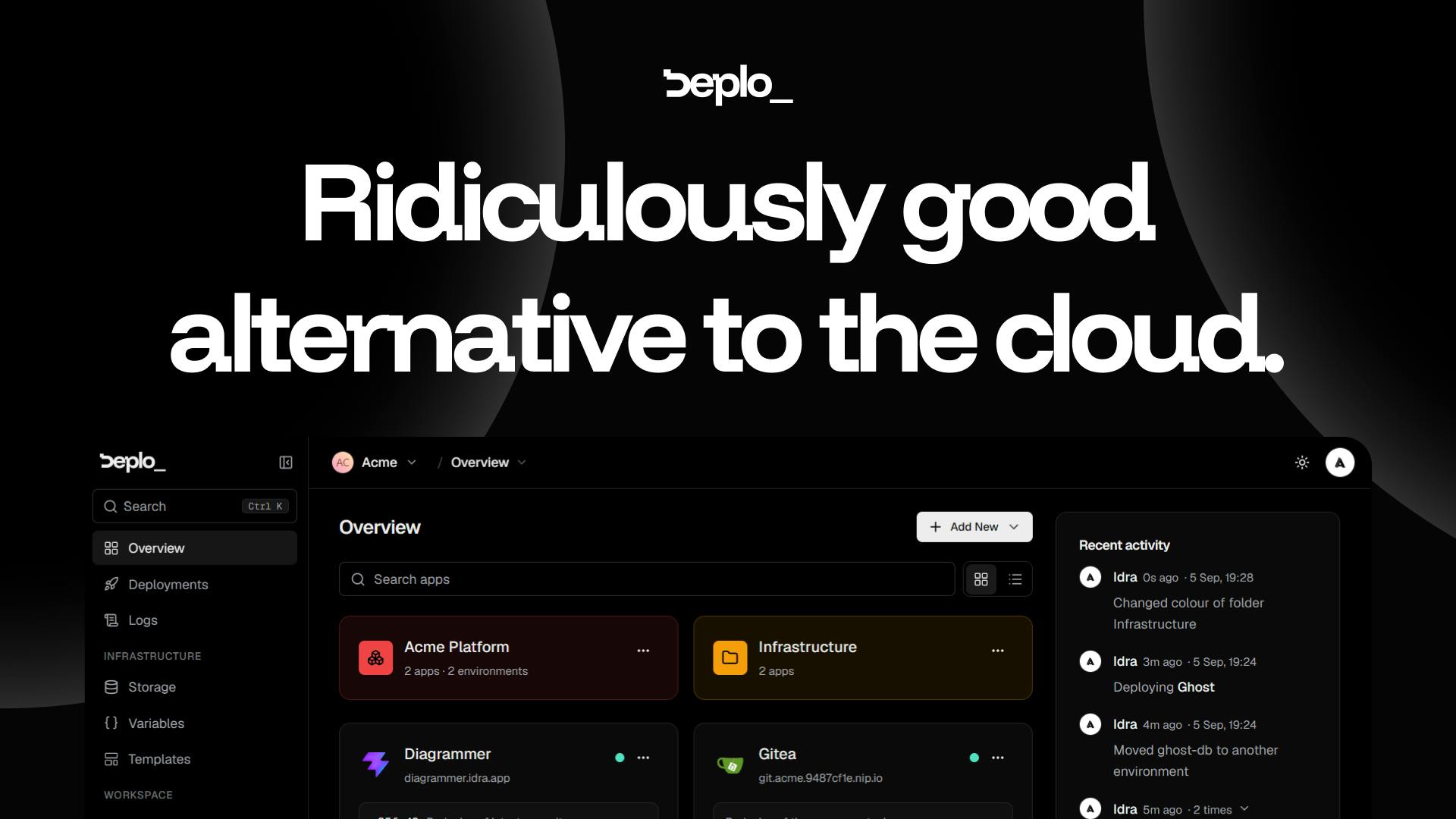
Deplo brings push-to-deploy to your own server with no Docker, no SSH, and no extra cloud bills.
Deplo is a deployment tool that recently launched on Product Hunt, aiming to bring the familiar push-to-deploy experience to developers' own VPS or self-hosted servers — eliminating Docker configuration, SSH operations, and extra cloud billing. It positions itself between managed platforms like Vercel and Railway (smooth but costly at scale) and fully self-hosted solutions (controllable but complex). Deplo earned 81 upvotes and ranked 13th on launch day, showing real market interest, though technical details around framework support and security mechanisms are still pending.
In a developer's daily workflow, "deployment" is often one of the most frustrating steps. Configuring servers, writing Dockerfiles, debugging SSH connections, dealing with increasingly complex cloud billing — these tedious tasks eat up time that could be spent writing actual code. Deplo, which recently launched on Product Hunt, aims squarely at this pain point, advocating for a deployment experience that's done "the way you already know."
What Problem Does Deplo Solve
Deplo's core philosophy can be summed up in its tagline: "Same push-to-deploy you already know, running on a machine you already pay for."
Behind that tagline are three clear rejections: No Docker, No SSH, No invoice. In other words, it doesn't require developers to write and maintain container configurations, doesn't require manually logging into a server via SSH to fiddle with the environment, and won't generate an additional cloud service bill. For developers who already own a VPS or self-hosted server but don't want to be locked into the complexity and costs of mainstream cloud platforms, this positioning is quite compelling.
It preserves the push-to-deploy experience everyone knows best — you push code to a Git repository, and deployment happens automatically. This is the core experience that made Heroku and Vercel so addictive, and Deplo tries to bring that same experience to machines under the user's own control.
Push-to-deploy was popularized by Heroku around 2009: developers simply run
git push heroku main, and the platform automatically handles the build, dependency installation, and service restart — no need to log into a server or write deployment scripts. This experience fundamentally changed developer expectations around "going live," and platforms like Vercel, Netlify, and Railway have since adopted it as a core selling point. However, this experience has long been tightly coupled with "managed platforms" — the platform manages the underlying infrastructure for you, at the cost of per-request, bandwidth, or compute-time billing that can climb quickly as a project scales. Deplo aims to decouple this interaction pattern from managed platforms and transplant it onto VPS or bare-metal servers that developers already own.
How It Differs from Mainstream Cloud Deployment
Current mainstream deployment solutions fall into roughly two categories: managed platforms like Vercel, Netlify, and Railway, which offer an excellent experience but charge based on usage (with costs adding up at scale); and self-hosted solutions, which use Docker for packaging and deploy to a private server via SSH or CI/CD pipelines — more controllable, but tedious to configure.
Deplo tries to take the best of both worlds: it preserves the smooth push-to-deploy experience of managed platforms while keeping the application running on the user's own machine, avoiding the cost uncertainty of usage-based billing.
For indie developers, small teams, and side projects, this model of "using a machine you're already paying for with a familiar deployment workflow" theoretically strikes a good balance between cost and experience. It lowers the technical barrier to self-hosting while retaining the cost and data-control advantages that self-hosting offers.
VPS (Virtual Private Server) is the most common self-hosting infrastructure choice for indie developers and small teams. Unlike the usage-based billing of managed platforms, VPS typically charges a fixed monthly or annual fee (commonly $5–$20/month), meaning the bill stays the same regardless of traffic volume. Because of this, "already paying for a VPS but also spending extra on Vercel/Railway" is a real dilemma for many developers. Traditionally, enabling automated deployment on a VPS requires configuring a Git bare repository on the server, writing post-receive hook scripts, or setting up a self-hosted CI/CD system like Drone or Woodpecker — each step carrying a significant operational overhead. Deplo targets exactly this configuration gap between "buying a VPS" and "achieving automated deployment."
Market Reception and Positioning
On Product Hunt, Deplo received 81 upvotes and 5 comments, ranking 13th for the day. These numbers suggest the product addresses a genuine need among a segment of developers — while it hasn't broken into the top tier, it has earned initial recognition as a tool focused on simplifying deployment.
It's categorized under Productivity, User Experience, SaaS, and GitHub — tags that reflect its product focus: developer-facing, emphasizing ease of use, and deeply integrated with GitHub workflows.
Who Should Try Deplo
Based on its positioning, the following types of users may benefit most:
- Indie developers with their own servers or VPS: Want a Heroku-style deployment experience without paying for a managed platform.
- Small teams and early-stage startups: Limited budget, looking to make the most of servers they've already purchased.
- Developers unfamiliar with Docker and server ops: Want to skip the learning curve of containerization and SSH operations, and focus on writing business logic.
A word of caution: since publicly available information is primarily from Deplo's Product Hunt listing, details around supported language frameworks, deployment speed, stability, and security mechanisms have yet to be fully disclosed by the team. For business-critical production environments, it's advisable to validate on non-core projects first before broader adoption.
Worth noting: the "No Docker" promise brings convenience but also comes with trade-offs. While Docker containerization can be tedious to configure, it provides important guarantees like environment isolation (preventing dependency conflicts between projects), reproducible builds (consistent behavior across machines), and finer-grained resource limits. Giving up Docker means applications run directly in the host environment — when multiple projects share the same server, there's a risk of dependency version conflicts or environment contamination. Before using Deplo on a multi-project server, it's worth confirming with the team how isolation is implemented (for example, whether it uses nix, buildpacks, or another sandboxing approach).
Summary
Deplo represents a pragmatic approach to deployment: rather than chasing a sprawling cloud platform ecosystem, it aims to bring the "push-to-deploy" experience developers love to their own machines with minimal mental overhead. The three selling points — No Docker, No SSH, No invoice — precisely target the core friction points in self-hosted deployment scenarios. For developers tired of cloud bills and operational configuration, it's worth keeping an eye on.
Related articles

Losing Memory After Claude Code Context Compaction? Practical Solutions Explained
Claude Code losing debugging context after compaction? Learn how CLAUDE.md persistent memory, manual /compact control, session splitting, and external records solve the problem.

Great at the Work, Bad at the Hustle: A Realistic Look at Monthly Income for Independent Professionals
Can a 12-year professional who hates self-promotion earn well independently? Explore real Reddit insights on income expectations and non-sales client acquisition paths.

COGEXT: A Verification Layer That Gives AI Agents a "Lie Detector"
COGEXT is a verification layer for AI Agents like LangChain that extracts commitments and cross-checks them against Gmail, GitHub, and other external systems to catch agents lying about task completion.