Designing Enterprise-Grade Agent Memory Systems: The Essential Difference Between Context and Long-Term Memory

How to design layered memory systems for enterprise AI Agents to overcome context limitations.
This article explores why large language models lack persistent memory and explains the fundamental difference between context (what the model sees now) and memory (what the system stores long-term). It presents a layered memory architecture—short-term and long-term memory—inspired by cognitive science, and covers key implementation techniques including hybrid retrieval, compression/summarization, and intelligent memory injection timing for enterprise-grade AI Agents.
Why Large Language Models Have No Built-In Memory
Many developers encounter a core puzzle when building AI Agents: why can't the agent remember user information? Fundamentally, this is because large language models themselves don't possess true persistent memory capabilities.
To understand this, you first need to grasp how LLMs work under the hood. Today's mainstream large models (such as the GPT series, Claude series, etc.) are all based on the Transformer architecture, and their inference process is essentially a stateless function call: text goes in (prompt), text comes out (completion). Model weights are fixed once training is complete — each inference call doesn't modify the weights, nor does it retain any state on the server side for a particular user. This stands in stark contrast to the Session mechanism in traditional web applications — a web server can maintain user state via a Session ID, whereas LLM APIs are fundamentally stateless RESTful services. Every call is independent and unrelated to any other.
Here's a simple example: if you call a large model and tell it "I'm Lao Xiao" the first time, then make a second call without passing that information again, the model has absolutely no idea who you are. The only way to make the model "remember" you is to pass "I'm Lao Xiao" with every single call.
This mechanism seems simple, but it leads to a critical problem: if you pass all historical information every time, the context window will quickly explode. The Context Window is one of the core constraints of the Transformer architecture — it refers to the maximum number of tokens the model can process in a single inference call. Currently, GPT-4 Turbo supports approximately 128K tokens, and Claude 3.5 supports around 200K tokens, but even so, this is far from sufficient for long-running Agents. More critically, the computational cost of the context window grows quadratically with input length (due to the O(n²) complexity of the self-attention mechanism), meaning that even if the window is theoretically large enough, stuffing it full of historical information will significantly increase inference latency and API call costs. This is the core challenge that enterprise-grade Agent memory systems must solve — injecting the right memory into the limited context at the right time.
Context Is Not Memory: The Essential Difference Between Two Core Concepts
Many developers confuse Context and Memory, but they are fundamentally different system components.
Context refers to all the information passed to the model during the current call — like the documents currently spread across a conference table, valid only for this particular call. It answers the question: "What can the model see right now?" Specifically, context typically includes the system prompt, the current user input, and any supplementary information the developer actively injects. Together, these form the model's "working memory."
Memory, on the other hand, is information that the system persists long-term and can retrieve again in the future — including knowledge bases, user preferences, historical chat records, and more. Memory is far broader in scope than context; it represents persistent data assets. Memory can reside in databases, vector stores, file systems, and other persistent media, with a lifecycle that far exceeds a single API call — potentially spanning days or months.

In modern agent architectures, context and memory must work in concert: relevant information is retrieved from memory and dynamically assembled into the context for the current call. This process is like a dynamic window whose contents change based on the needs of each call. Here's an analogy: memory is the entire library's collection; context is the few books currently open on your desk. One of an agent's core capabilities is learning to "pick the right books from the library and put them on the desk."
Why You Can't Rely Solely on Chat History
A common misconception is treating the complete chat log as the entirety of the memory system, injecting the full conversation history into the context with every call. This approach leads to three serious problems:
Context Explosion
As conversation turns accumulate, the history will quickly exceed the model's context window limit, causing the system to malfunction. Take an enterprise customer service Agent as an example: a single user might generate dozens of conversation turns in a single day. If session history spanning multiple days is fully preserved, the token count can easily surpass hundreds of thousands — far exceeding most models' capacity. Even when using models that support ultra-long contexts, the cost of each call grows linearly with the number of input tokens, which is unacceptable in high-concurrency enterprise scenarios.
Attention Dilution
Even without exceeding the window limit, a large volume of irrelevant historical information will dilute the model's attention, reducing its ability to identify key information. The technical root cause lies in the Transformer's self-attention mechanism: when the input sequence contains a massive amount of information, each token's attention weight must be distributed across all other tokens. Academic research has confirmed that large models exhibit a significant "Lost in the Middle" phenomenon — the model pays more attention to information at the beginning and end of the input sequence while tending to overlook information in the middle. This means that even if all historical information fits within the context window, critical information buried in the middle of long stretches of irrelevant conversation may simply be ignored by the model.
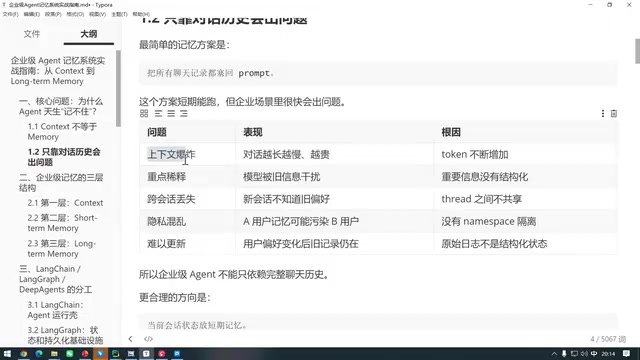
Memory Gaps
Raw conversation history alone cannot provide structured user profiles and preference information. For example, a user's long-term preferences can only be extracted by summarizing and distilling historical records. If only raw chat logs are passed, the model will lack critical context when performing intent recognition. A typical scenario: a user mentioned "I'm lactose intolerant" in a conversation three months ago. If this information only exists in the raw chat log and hasn't been extracted as a structured user attribute, then when the user next asks "recommend a breakfast for me," the system will likely fail to recall this critical piece of information, resulting in a recommendation that includes dairy products.
Design Principles for Enterprise-Grade Memory Systems
A more rational architectural approach is to build a layered memory system — a design philosophy that actually draws from the hierarchical memory model in cognitive science:
Short-term Memory: Stores the current session state and the most recent conversation turns, focusing on immediate contextual coherence. Short-term memory is typically kept in high-speed caches like in-memory storage or Redis, with a lifecycle bound to the session. It ensures that coreference resolution (e.g., what "it" refers to) and topic continuity work properly in multi-turn conversations. In practice, short-term memory usually retains the raw content of the last 5–10 conversation turns and triggers compression/summarization when a threshold is exceeded.
Long-term Memory: Preserves cross-session user preferences, factual knowledge, historical summaries, and other structured information. Long-term memory is typically stored in databases and vector stores, and its design must balance write efficiency with retrieval precision. Long-term memory can be further subdivided into: semantic memory (factual user information such as names, preferences, purchase history, etc.), episodic memory (summaries of specific historical events), and procedural memory (the user's commonly used operational patterns and habits).
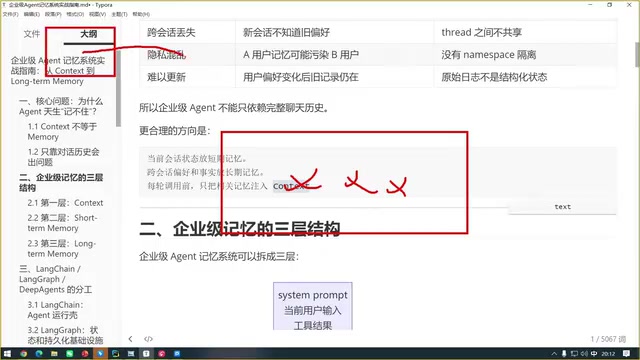
With each call, the system needs to intelligently retrieve relevant content from both short-term and long-term memory and dynamically assemble the context. This process follows the "Less is More" principle — context should remain concise, containing only the information truly needed for the current call. In practice, a well-designed memory system typically injects information occupying only 30%–50% of the total context window capacity, leaving the remaining space for the system prompt, current user input, and model reasoning output.
Key Technical Considerations in Practice
In real-world projects, implementing a memory system requires the following technical elements:
Retrieval Strategy: How to efficiently retrieve the most relevant information from massive historical memory for the current query — this typically requires combining vector search with keyword matching. Vector search is based on the RAG (Retrieval-Augmented Generation) architecture, whose core principle is converting text into high-dimensional vectors via embedding models (such as OpenAI's text-embedding-3-large or open-source BGE series models), and storing them in dedicated vector databases (such as Pinecone, Milvus, Weaviate, Qdrant, etc.). At query time, the user input is likewise converted to a vector, and the semantically closest historical memory fragments are found using metrics like cosine similarity or inner product. Keyword matching employs classic information retrieval algorithms like BM25, which excel at handling exact entity names and domain-specific terms. Practice has shown that Hybrid Search — using both vector search and keyword matching with fused ranking — typically delivers significantly better recall than any single method alone.
Compression and Summarization: Periodically summarize historical conversations, extract key facts and user preferences, and prevent raw data from accumulating indefinitely. Common compression strategies include: sliding window summarization (calling an LLM to generate a summary every N conversation turns), progressive summarization (merging existing old summaries with newly generated conversation content to produce an even more refined summary), and entity extraction (automatically extracting key entities and attributes related to the user from conversations to form a structured user profile). The Memory feature built into OpenAI's ChatGPT product uses a similar entity extraction mechanism — it can automatically identify preference information like "the user prefers concise code style" or "the user is a Python developer" from conversations, persist it in a structured format, and automatically inject it into context in subsequent conversations.
Injection Timing: Dynamically deciding which memories need to be injected into the current context based on user intent and task type — this requires carefully crafted strategies. For example, when a user initiates a new topic, the system should retrieve long-term memories related to the new topic; when the user is continuing the previous conversation turn, short-term memory should carry more weight. In more advanced implementations, a dedicated "routing model" or rules engine can be used to analyze user intent and determine which memory modules to activate and what types of information to retrieve for the current call. This "memory routing" mechanism is a key differentiating capability for building high-quality Agent experiences.
Through thoughtful design of the coordination between context and memory, enterprise-grade Agents can deliver a coherent and personalized user experience while maintaining response efficiency. A memory system is not simple data storage — it is a system engineering effort that requires careful design, involving the coordinated interplay of multiple subsystems: storage architecture, retrieval algorithms, compression strategies, and injection decisions. It's fair to say that the quality of memory system design largely determines whether an AI Agent makes the leap from "functional" to "excellent."
Key Takeaways
Related articles

Qwen3.8 Flash Deep Dive: How Hybrid Architecture Is Reshaping LLM Efficiency
Qwen releases Qwen3.8 Flash Next with hybrid architecture: 125B params, only 6B activated per token, at 1/9 training cost. Deep dive into Gated DeltaNet, million-token context, and agent workflows.

GPT-6 Astra: AI Competition Shifts from Best Answers to Workflow Ownership
AI competition is shifting from single-answer quality to workflow ownership. Explore how GPT-6 Astra signals AI's evolution from passive responder to autonomous workflow agent.
GPT-6 Astra Launch Goes Wrong: Paying Users Locked Out, Altman Issues Emergency Apology
OpenAI's GPT-6 Astra launch backfired as paying subscribers were locked out of the flagship model. CEO Sam Altman apologized within hours, calling it a messy rollout. A deep dive into what went wrong.