DeTech Agent Hands-On: AI Auto-Generates TIA Portal PLC Programs and V90 Servo Control

Hands-on look at DTAC, an AI Agent that auto-generates TIA Portal PLC programs and controls V90 servos.
The DeTech Engineering Agent (DTAC) uses conversational AI to auto-generate Siemens TIA Portal PLC programs. This article explains its workflow, a hands-on V90 servo control case on an S7-1214C, and objectively assesses the technical value and safety limits of AI-driven industrial programming.
A New Paradigm for Industrial Automation Development
In traditional industrial automation projects, engineers often spend a great deal of time on hardware configuration and PLC programming. Take Siemens TIA Portal as an example: from project creation and hardware configuration to writing ladder logic or SCL code, and then to debugging and deployment, the entire process is lengthy and heavily dependent on an engineer's accumulated experience.
About the Siemens TIA Portal platform: TIA Portal (Totally Integrated Automation Portal) is a fully integrated automation engineering software platform launched by Siemens in 2010. It consolidates engineering tasks such as PLC programming, HMI configuration, drive commissioning, and network configuration into a unified environment. It supports multiple PLC series including the S7-300, S7-400, S7-1200, and S7-1500, with programming languages spanning ladder logic (LAD), function block diagram (FBD), structured control language (SCL), statement list (STL), and sequential function chart (SFC) as defined by the IEC 61131-3 standard. TIA Portal's version lineage has evolved continuously from V13 to V19, with differences across versions in project file formats, instruction libraries, and the automation interface (TIA Openness API)—which is precisely why version compatibility becomes a critical engineering constraint.
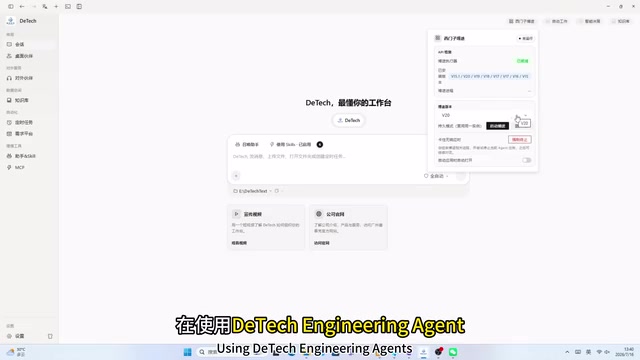
The DeTech Engineering Agent (abbreviated as DTAC) aims to change this situation. According to a related demo video on Bilibili, this tool highlights three core capabilities: AI auto-generation of configurations, intelligent code writing, and one-click deployment and execution. Its core goal is to lower the barrier to automation development and free engineers from tedious, repetitive programming work.
For engineers who have long worked on the front lines of manufacturing doing PLC programming, this paradigm of "describing requirements in natural language and having AI generate the program" represents a trend of industrial software development evolving toward a higher level of abstraction.
A Detailed Walkthrough of the DTAC Workflow
Step 1: Configuring the TIA Portal Environment
Before using DTAC for TIA Portal programming, some critical pre-configuration must be completed. According to the demo instructions, the user needs to select the TIA Portal version under the "Siemens TIA Portal" option in the upper-right corner of the homepage—it must match the version installed on the local machine—and then click to launch TIA Portal.
This step seems simple but is actually crucial. Different versions of TIA Portal software have differences in project formats and APIs, and a version mismatch will directly cause subsequent automation operations to fail. Placing version binding at the very front of the workflow reflects the tool's emphasis on compatibility with real-world engineering environments. DTAC's automation operations rely on the TIA Openness API exposed by TIA Portal. As this interface evolves with each version, method signatures and object models change, so locking the version is the foundation for stable API calls.
Step 2: Conversational PLC Programming
After completing the configuration, the user creates a new conversation and sends the programming requirements to the AI in natural language. The AI then automatically generates the required program based on the prompt.

This interaction style is consistent with the philosophy of popular AI coding assistants today (such as GitHub Copilot and Cursor), but DTAC focuses its scenario on the vertical domain of industrial control. Compared with general-purpose code generation, industrial PLC programming has higher requirements for logical rigor, safety, and timing precision.
The special nature of PLC programming: Programmable logic controller programs run atop strict scan cycles (typically 1–100ms). Each scan cycle sequentially performs input sampling, program execution, and output refresh, making timing control critical. Industrial control logic must also handle mechanisms such as hardware interrupts, diagnostic buffers, and fail-safe operation. Compared with the general-purpose software scenarios GitHub Copilot faces, AI generating PLC code must additionally understand the execution timing semantics of instructions (such as the rising-edge trigger instruction P_TRIG), the state machine models of technology objects, and Siemens' unique organization block (OB) call structure—knowledge that cannot be naturally acquired from general-purpose code corpora and requires dedicated industrial-domain training data and knowledge bases to support.
Hands-On Case: The Full V90 Servo Control Workflow
The demo video presents a complete practical case: V90 servo control, using the Siemens S7-1200 series 1214C PLC. As a detail, the video emphasizes that the entire programming process was "completed independently by the DTAC Engineering Agent, with no human intervention required," and that after the program was generated, it was directly downloaded to a physical PLC for operation.
About the V90 servo and the S7-1200 motion control system: The Siemens V90 is a servo drive in the SINAMICS series aimed at the low-to-mid-range market. It connects to the S7-1200 PLC via PROFINET or a pulse interface, and is abstractly encapsulated in TIA Portal through "Technology Objects" (TOs). Technology objects encapsulate complex servo parameters (speed loop, position loop gains, acceleration/deceleration curves, etc.) into standardized motion control function blocks that comply with the PLCopen motion control specification. The S7-1214C is a mid-range CPU in the S7-1200 series, supporting up to 4 axes of high-speed pulse output, and is a common choice for teaching demonstrations and small-to-medium motion control scenarios.

Verifying Motion Control Functions
The AI-generated program covered the core function points of servo motion control:
- Axis enable: Activating the servo axis enable (corresponding to the PLCopen standard function block MC_Power)
- Jog control: Verifying forward jog and reverse jog respectively (MC_Jog)
- Relative positioning: Triggering a relative-position move command (MC_MoveRelative)
- Homing: Returning the axis to the reference home point (MC_Home)
- Absolute positioning: Setting the target position to -20 for an absolute positioning test (MC_MoveAbsolute)
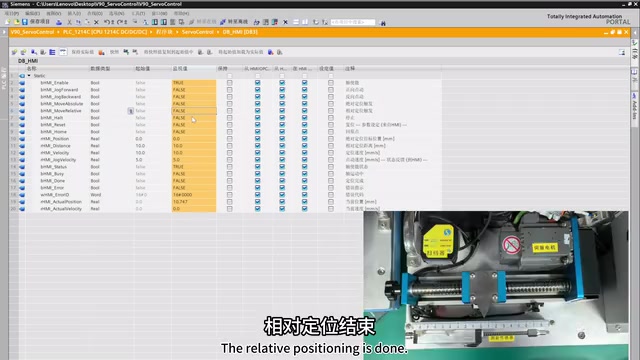
This verification workflow covers the main Technology Object operations in Siemens motion control. The ability to automatically generate a program containing complete logic such as axis enable, jog, relative/absolute positioning, and homing shows that the Agent has a considerable degree of understanding and calling capability regarding the Siemens Motion Control library. In particular, correctly handling the PLCopen function block state machine (Idle → Busy → Done/Error) is key to generating an effective program.
Technical Value and a Rational Assessment
Significantly Lowering the PLC Programming Barrier
DTAC's most direct value lies in lowering the technical barrier to automation programming. Motion control programming involves a great deal of parameter configuration and instruction calling, presenting a steep learning curve for novice engineers. If AI can automatically generate a runnable program framework based on requirements, it will significantly shorten development cycles—especially suitable for highly standardized application scenarios.
Boundaries That Require Careful Evaluation in Industrial Scenarios
Industrial control systems have requirements for reliability and safety that far exceed those of general software applications. AI-generated TIA Portal PLC programs still require engineers to focus their verification on the following aspects:
- Reliability of complex logic: The demo case is a relatively standard servo control scenario. How the AI performs when facing multi-axis coordination and complex process flows remains to be further observed.
- Code maintainability: Whether the automatically generated program conforms to engineering standards and whether it is easy to modify and maintain manually afterward.
- Safety interlock handling: Whether the AI can comprehensively cover safety logic such as emergency stops, limits, and fault handling—this point is especially critical. Safety standards such as IEC 62061 and ISO 13849 have clear specification requirements for implementing safety functions. Whether AI-generated code meets the functional safety level (SIL/PL) requirements must be specially verified by a qualified engineer.
The Industry Trend of AI Penetrating Industrial Software
Setting aside the specific product, DTAC reflects a broad trend of AI technology deeply penetrating traditional industrial software. At the 2023 Hannover Messe, Siemens released the Industrial Copilot, integrating generative AI into TIA Portal and supporting the generation of ladder logic and SCL code through natural language. Rockwell Automation and Schneider Electric have also successively launched similar features.
The technical architecture of industrial AI Agents: Such tools typically use RAG (Retrieval-Augmented Generation) to treat vendor technical documentation and instruction manuals as a knowledge base, combined with a Function Calling mechanism to drive the TIA Openness API to perform actual operations, rather than relying purely on the LLM's parametric memory. This "LLM + domain knowledge base + tool calling" Agent architecture is becoming the mainstream technical approach for industrial vertical AI. Its core challenge lies in ensuring the engineering compliance and safety conformity of the generated code, rather than merely achieving functionality. In the short term, such tools are more likely to serve as an intelligent auxiliary assistant for engineers, handling preliminary code generation and repetitive work, rather than fully replacing human judgment.
Conclusion
The DeTech Engineering Agent demonstrates the application potential of AI in the field of industrial automation programming—bringing a new working paradigm to TIA Portal PLC development through conversational interaction and automated deployment. Its performance in the V90 servo control case is noteworthy, but for critical industrial applications, manual review and verification remain indispensable. For automation engineers looking to improve development efficiency, such AI programming tools may become a powerful complement to their daily work.
Key Takeaways
Related articles

Poison-Resistant Concept Anchoring: A New Approach to Defending Against AI Data Poisoning
Deep dive into Poison-Resistant Concept Anchoring, defending against data poisoning via signed anchors and bounded updates. Experiments show 62% poison isolation with 0% false rejection rate.

Hungarian Algorithm Explained: Principles, Complexity, and Engineering Implementation Guide
In-depth explanation of the Hungarian Algorithm: core principles, O(N³) time complexity advantages, and engineering implementation. Covers assignment problem definition, step-by-step algorithm walkthrough, Python/C++ libraries, and applications in multi-object tracking and resource scheduling.
OpenAI's First Enterprise AI Report: H…
OpenAI's First Enterprise AI Report: How ChatGPT Is Changing the Way Organizations Work
OpenAI's first enterprise AI report reveals three key traits of ChatGPT Enterprise adoption: the shift from novelty to necessity, writing and coding as top use cases, and data governance as a core prerequisite.