Developer Fine-Tunes AI Model to Remove Video Subtitles and Watermarks

Developer fine-tunes open-source model to auto-remove video subtitles and watermarks, deployed free on Hugging Face.
After finding existing tools largely ineffective, a developer fine-tuned an open-source model specifically for removing subtitle and watermark overlays from video. Built on general-purpose image inpainting, it handles both video and static images. The main limitation is speed — processing 10 seconds of video takes half a minute to several minutes due to the lack of GPU acceleration or quantization. The project is live on Hugging Face Spaces for free public use, though the watermark-removal functionality raises notable copyright and ethical concerns.
Why Video Watermark Removal Is Still a Hard Problem
Removing watermarks from static images has long been a solved problem, but video is a different story. Video consists of continuous frames, and subtitles or watermarks are typically overlaid as fixed elements on top of the footage. Removing them requires not just restoring individual frames, but also maintaining consistency across frames — otherwise the repaired footage will suffer from flickering, blurring, or visible artifacts.
After testing several websites that offered similar functionality, one developer found that removing watermarks and subtitles from video remains a genuinely difficult task, with most off-the-shelf solutions producing unsatisfactory results. So he decided to take matters into his own hands, fine-tuning an open-source model to tackle the problem and deploying the result on Hugging Face Spaces for public use.
How the Model Works and What It Can Do
According to the developer, the model is based on an existing open-source model that was further fine-tuned. Compared to training from scratch, fine-tuning is more cost-effective and allows for faster results on specific tasks — in this case, detecting and removing overlaid elements from video frames, including subtitle text and various types of watermarks.
One notable aspect is that the model works not only on video but also on static images. This suggests the model has learned general-purpose image inpainting capabilities at its core, with video processing essentially being that capability applied frame by frame in a coordinated fashion.
The demo is publicly available at Hugging Face Space, where anyone can upload media and try it directly.
Image inpainting is a classic computer vision task: the goal is to "fill in" occluded or damaged regions of an image with visually plausible content. Early approaches relied on texture diffusion from surrounding pixels, while modern deep learning methods use convolutional neural networks or diffusion models trained on large image datasets to learn semantic distributions, enabling more natural and context-aware fills. In video contexts, running inpainting frame by frame causes slight variations between frames, leading to noticeable flickering. Video inpainting therefore requires temporal consistency constraints — using optical flow estimation or temporal attention mechanisms to ensure that color, texture, and motion trajectories remain coherent across adjacent frames in the repaired regions. This project's fine-tuning focuses specifically on detecting and eliminating overlay elements, effectively adding a two-stage "locate first, then repair" pipeline on top of general inpainting capability.
Processing Speed and Current Limitations
The developer is candid about performance. Processing a 10-second video takes anywhere from half a minute to several minutes, depending on how many overlay elements appear in the footage. The more overlays, the longer it takes.
The main reason for the slower speed is that the model has not yet been optimized for inference. In other words, the current version is more of a functional proof-of-concept prototype, with significant room to improve throughput. With GPU acceleration, model quantization, or inference framework optimization introduced down the line, processing times could be substantially reduced.
Model quantization is a common technique for accelerating neural network inference. The core idea is to compress model weights from 32-bit floating point (FP32) to 16-bit (FP16) or 8-bit integer (INT8), dramatically reducing memory usage and computation with minimal accuracy loss. Complementary inference framework optimizations — such as NVIDIA TensorRT or ONNX Runtime — further improve GPU utilization through operator fusion and memory reuse. For video processing tasks, batched parallel inference across multiple frames is also an effective strategy for reducing overall processing time. The current project is still at the prototype validation stage with none of these optimizations in place, which explains why a 10-second video takes several minutes to process — typically 5 to 10 times slower than an optimized production-grade solution.
The Value and Controversy Around This Type of Tool
From a technical standpoint, this project demonstrates the viability of fine-tuning open-source models to solve specific, real-world problems. Legitimate use cases — such as video restoration, archival film repair, or removing accidental obstructions from footage — can all benefit from this approach, and general-purpose inpainting for images and video has broad practical value.
However, the ability to remove watermarks and subtitles inherently carries copyright and ethical concerns. Watermarks are often how content creators identify ownership and attribution, and subtitles may represent the original creator's own labor. The tool itself is neutral — how it's used is up to the user. Applying it to your own material is entirely reasonable, but using it to strip someone else's copyright identifiers before redistributing their content could cross legal and ethical lines.
Summary
This is a practical project driven by an individual developer, built on top of a fine-tuned open-source model. It demonstrates that in the still-immature field of video overlay removal, targeted fine-tuning can produce usable results. The main weakness right now is inference speed — the unoptimized prototype limits real-world productivity — but the technical path is clear and the potential for improvement is real. For users who want to try it out, the online demo on Hugging Face offers a zero-barrier entry point.
Related articles
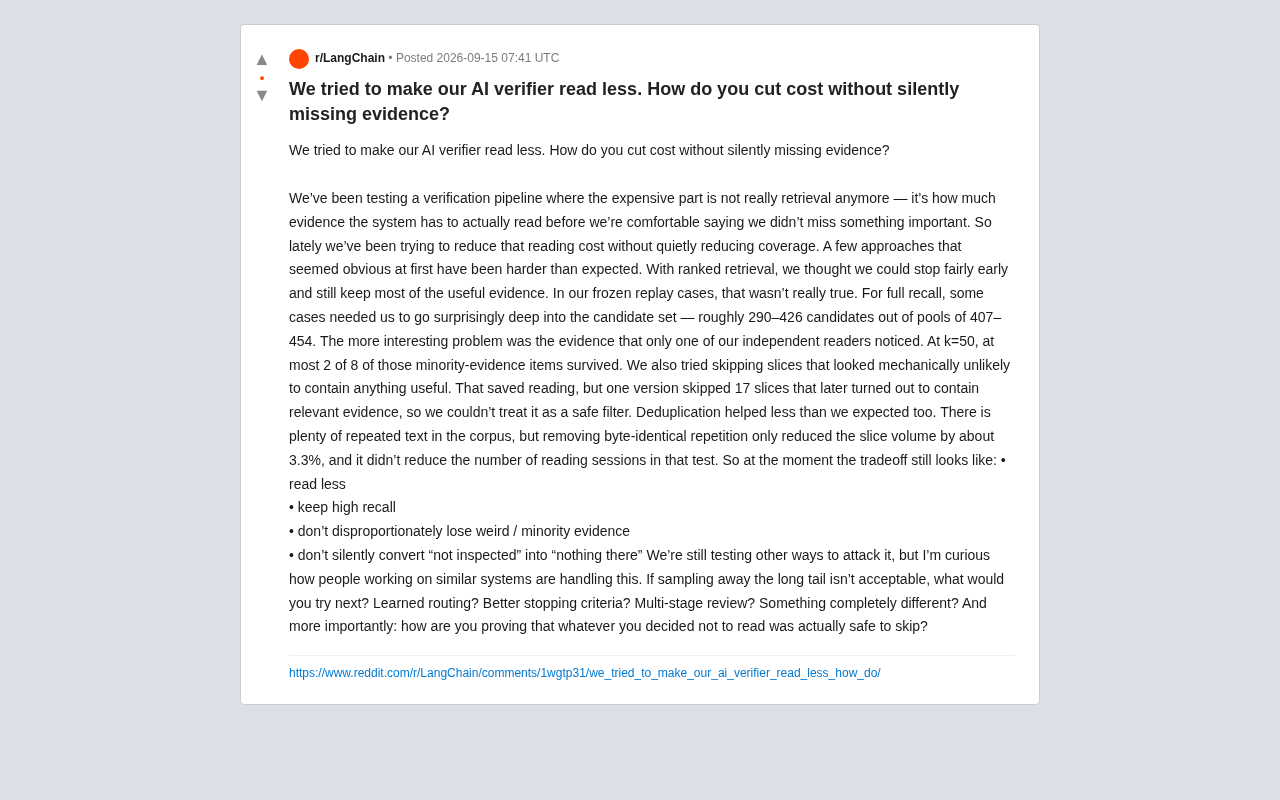
The Cost Reduction Dilemma in AI Verification Systems: How to Read Less Evidence Without Missing What Matters
The real cost in AI verification pipelines isn't retrieval — it's how much evidence must be read. This post examines why early stopping, slice skipping, and deduplication fall short, and the core challenge of preserving minority evidence.

Salesforce and Nvidia Launch Koa: How Open-Weight Models Are Disrupting Enterprise AI
Salesforce and Nvidia's Koa reasoning model targets sales, marketing, and customer support using Nvidia's open-weight Nemotron. Here's why this vertical AI strategy should worry general-purpose AI labs.

H3 Acceleration Arena Adds Three New Models: Community Crowdsourced AI Performance Testing
H3 Acceleration Arena adds VDN-H3, TaoMate H3, and LightX2V 1.2. Community votes compare new vs. old models on acceleration performance. Here's what to know.