Developer Identity Crisis in the AI Era: "I Made This" or "Claude Made This"?
In the age of AI-generated code, developers saying 'I made this' sparks deep discussion about ownership and identity.
A Hacker News discussion about why people say 'I made this' instead of 'Claude made this' touches the core tension of developer identity in the AI era. When LLMs can generate substantial code, the traditional bond between developer and creation is redefined. The article explores creative contribution, the need for new contribution description systems, and the realistic tension between client expectations and developer ownership needs.
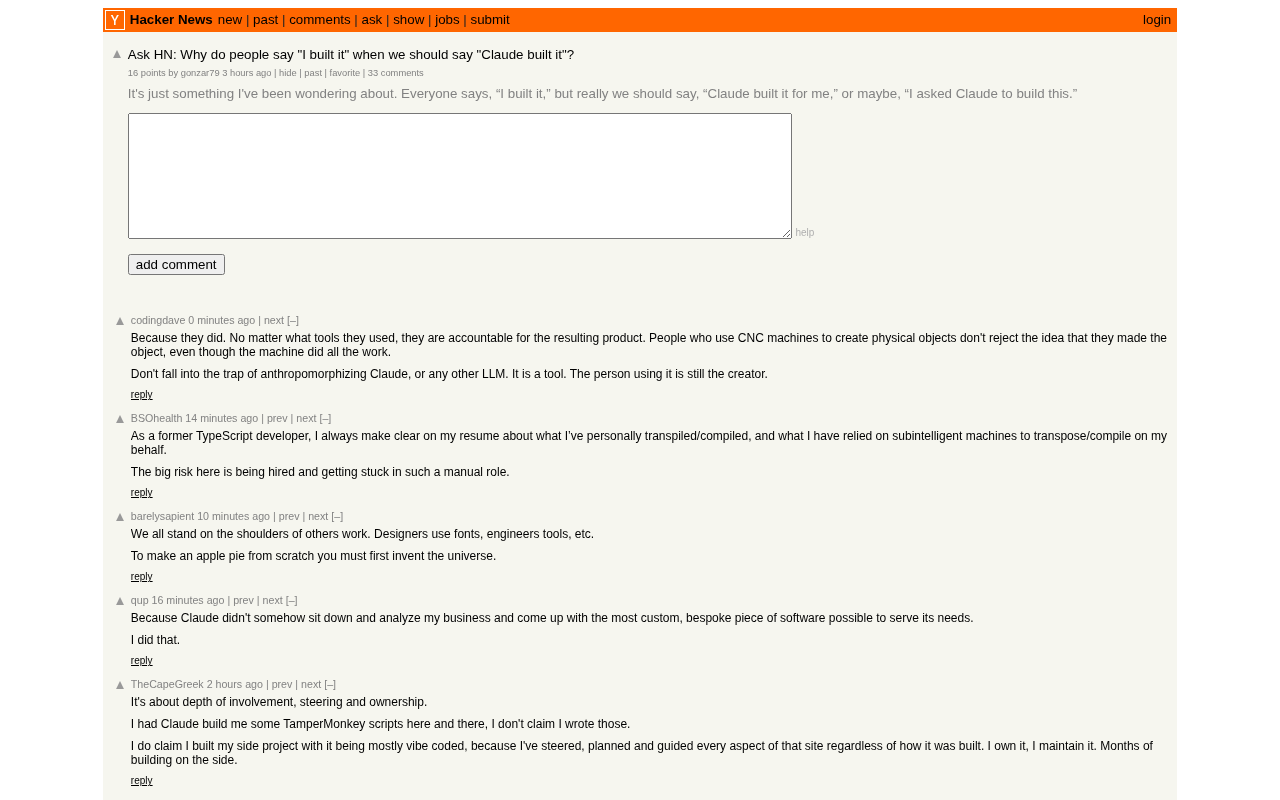
In a Hacker News discussion thread, a user posed a seemingly simple yet profoundly pointed question: Why do people always say "I made this" instead of "Claude made this"? The post received 14 upvotes and 31 comments. While the numbers aren't staggering, the depth of the discussion touches the core tension of developer identity in the AI era.
The Essence of the Question: The Shaking of Creative Ownership
When large language models like Claude and GPT can generate substantial amounts of code, the traditional bond between developer and creation is being redefined. In the past, "I made this" meant a complete process from conception to implementation—the developer personally wrote every line of code, debugged every bug, and this labor investment naturally conferred a sense of ownership.
But now, when AI can generate complete functional modules from natural language descriptions, the meaning of "I made this" becomes ambiguous. Does conceiving the requirement count as "making" it? Does reviewing and modifying AI-generated code count as "making" it? Or does only line-by-line manual coding count as "making" it?
The HN comment section reveals this anxiety: It's not a debate about technical capability, but a confusion about identity. The developer community has long regarded "creation" as a core value. When this value is partially replaced by AI, using "I made this" to assert ownership becomes a psychological defense mechanism.
Tools and Creators: AI's Positioning Dilemma
In the comments, a recurring analogy emerged: If I use a calculator to get a result, and I say "I calculated it," is that reasonable? Most people think it is. So why would using AI to write code be unreasonable?
This analogy has its limitations. A calculator merely executes mathematical operations, while AI participates in the decision-making process from requirement understanding to code structure. But the analogy also has its insights: The use of a tool itself contains creativity. A photographer wouldn't say "the camera took it," an architect wouldn't say "CAD drew it," but they all acknowledge the role of tools in creation.
The key lies in defining "creative contribution." If you provided Claude with detailed requirements, architectural constraints, and business logic, then reviewed and corrected its output, you did indeed do creative work. If you simply said "write me a login page" and copy-pasted the result, then the creativity indeed came more from the AI.
Defining creative contribution has deeper discussions in cognitive science and intellectual property. Philosophers typically divide creativity into several levels: conceptual creativity (proposing new ideas or problems), structural creativity (designing implementation paths or architecture), and executional creativity (specific implementation details). In traditional software development, these three are often completed by the same person, so ownership is clear. But AI's intervention breaks this unity—AI can independently complete executional creativity, and even participate in structural creativity when given sufficient context. This requires "I made this" to be re-anchored to which level. Legally, the U.S. Copyright Office has explicitly stated that purely AI-generated works are not protected by copyright, but humans can claim copyright after making "meaningful modifications or arrangements" to AI output. This provides a legal dimension for "how much did I do to make it mine," and also explains why developers need to actively participate in review and modification rather than passively accepting AI output.
Transparency and Honesty: The Industry Needs New Expression Norms
Another thread in the discussion: Should AI's contribution be more honestly disclosed? Some pointed out that in academic writing, using AI assistance requires declaration; in open-source communities, clearly labeling AI-generated code is also becoming the norm.
But this brings practical dilemmas. If 90% of a project's code is AI-generated and the developer only made 10% adjustments, can they say "I made this"? If they don't say "I made this," how should they express it? This is not just a semantic issue—it involves professional reputation, intellectual property, and commercial value.
Some argue that rather than debating "who made it," it's better to establish a more detailed contribution description system. Just as films have directors, screenwriters, and cinematographers, software development can distinguish roles like "requirement definer," "code reviewer," and "AI operator."
Contribution description systems have precedents in academia. The "Author Contribution Statement" (CRediT) in academic papers divides research contributions into 14 role categories, including conceptualization, methodology, software, validation, formal analysis, etc., with each author required to clearly indicate their specific contributions. This system works because it doesn't argue about "who is most important," but acknowledges the necessity of different roles. Software development can learn from this model and establish a similar contribution taxonomy. For example, labeling "AI-generated, human-reviewed" or "human-AI collaborative prototype" in code repository commit messages, and documenting the scope and extent of AI involvement in project documentation. This not only solves the attribution expression problem but also provides traceable audit trails, offering practical value for maintaining code quality and legal compliance. GitHub has already begun supporting Co-authored-by tags in commit messages, providing technical infrastructure for labeling AI contributions.
Pragmatic Perspective: What Do Clients and Employers Care About?
From a market perspective, what clients and employers really care about is the quality of results and reliability of delivery. They most likely don't care whether code is hand-written or AI-generated, as long as it meets requirements and poses no legal risk.
But this doesn't mean the attribution issue is unimportant. For individual developers, sense of ownership directly affects career satisfaction and learning motivation. If all code is completed by AI, how do developers' skills grow? Where does the sense of accomplishment come from?
Perhaps the answer lies in redefining the act of "development" itself. Future developers may be more like a hybrid of product manager and code reviewer, with core competencies shifting from writing syntax to defining problems, designing constraints, and validating results.
Professional reputation building mechanisms are undergoing subtle changes in the AI era. Traditionally, developers accumulate reputation through open-source contributions, technical blogs, and conference talks—activities that all assume code is direct proof of individual capability. But when AI can rapidly generate high-quality code, the signal value of reputation is diluted. This leads to two consequences: first, employers begin to value problem definition and system design capabilities more, as these are harder for AI to replace; second, developers need to find new signaling mechanisms, such as demonstrating how to elegantly constrain AI, how to verify the correctness of AI output, and how to design human-AI collaboration workflows. Some companies have already added "AI collaboration capability" assessment to interviews, requiring candidates to explain how they break down problems, design prompts, and review AI code. This shift means the basis of professional reputation is moving from "what I can write" to "what I can make AI write, and how I can ensure it's correct."
Cultural Adaptation Period: We're Experiencing Linguistic Lag
Perhaps the most valuable insight from this HN post is: Language lags behind technological practice. We're still using industrial-age vocabulary ("I made this") to describe information-age collaboration (humans and AI co-generating).
This lag will naturally ease over time. When AI-assisted development becomes the norm, new expressions will emerge. Just as no one now says "I made it with an IDE"—the IDE has been internalized as part of the development environment. AI will eventually be the same.
But during the transition period, this identity anxiety is real. It reminds us: Technological change is not just a change in tools, but a reconstruction of meaning systems. How we describe our work ultimately depends on how we understand our position in the creative process.
For developers, perhaps the more pragmatic question is: Rather than agonizing over how to claim ownership, think about how to maintain irreplaceable value in collaboration with AI—problem definition ability, system design judgment, sensitivity to business boundaries. These are things that Claudes cannot accomplish alone, and they are the reasons why "I made this" can ultimately stand with confidence.
Linguistic lag is a classic phenomenon in the sociology of technology. Linguists have found that when new technologies emerge, people tend to use old vocabulary to describe new practices, until new vocabulary naturally emerges. For example, "horseless carriage" was eventually replaced by "automobile," and "wireless telegraph" by "radio." This lag is not simply a vocabulary problem, but reflects the inertia of cognitive frameworks—we understand new things through old concepts until new concepts become consensus. In the field of AI-assisted development, the "I made this" we use now is like "horseless carriage"—describing something essentially different through negation or ambiguity. More precise terminology may emerge in the future, such as "AI-assisted development," "human-AI co-construction," or "prompt engineering output," which will more accurately reflect the hybrid nature of the creative process. Transition-period anxiety is normal, but history shows that language eventually catches up with practice.
One-line Summary
In the era of AI-generated code, developers saying "I made this" sparks deep discussion about ownership and identity.
Paragraph Summary
A Hacker News discussion about "why people always say 'I made this' instead of 'Claude made this'" touches the core tension of developer identity in the AI era. When large language models can generate substantial amounts of code, the traditional bond between developer and creation is redefined. Starting from the analogy between tools and creators, the article points out that defining creative contribution is key: deep participation in requirement definition, architecture design, and code review constitutes genuine creative work. The discussion also covers the industry's need for a more detailed contribution description system, and the realistic tension between clients caring about result quality and developers needing a sense of ownership. Ultimately, the article argues that language lags behind technological practice, and transition-period identity anxiety is real, but developers should focus on irreplaceable capabilities like problem definition and system design, giving "I made this" a more solid foundation.
Related articles

A Single Prompt Triggers a Global PHP Security Storm: Is AI a Savior or a Hidden Risk?
A single AI prompt triggered a global PHP security crisis affecting Wikipedia and the Internet Archive. This article reviews the incident, analyzes the OpenAI-Amazon controversy, and explores the security paradox of lowered vulnerability discovery barriers in the AI era and developer response strategies.

When AI Is Taken Away: How Reliance on Shortcuts Undermines Your Problem-Solving Resilience
A study of 1,222 people found that after using AI to answer questions, once AI was removed, people gave up on more problems than a control group that never used AI. The article analyzes the impact of AI reliance on learning resilience and metacognition, and explores design implications for AI learning tools.

Carta and NewView Partner to Let Startup Employees Cash Out Equity Early
Carta and NewView Capital partner to simplify startup tender offers, helping employees sell equity early. Analysis of the mechanism, liquidity pain points, and impact.