DG Matrix 800VDC Upgrade: AI Power Procurement Requires Control Evidence

DG Matrix launches native 800 VDC Interport power solution; procurement evaluation must expand from steady-state parameters to state transitions and software control behavior.
DG Matrix launched the Interport SST Cell and Interport OS, providing modular power conversion and software control for the Interport 360 Flex system targeting NVIDIA MGX, directly outputting native 800 VDC. The article argues that the core variable is how software coordinates power routing, storage, ride-through, and protection logic, so procurement checklists should expand from electrical output parameters to decisions made during state transitions. Buyers should require power path descriptions per operating state, trigger sequences and approval conditions for transitions, distinguish protection from optimization functions, and document behavior under communication or sensor failures. Downstream installation needs full-system review, and handover must preserve verified configuration and test records with clear change approval and retest paths.
DG Matrix 800VDC Upgrade: AI Power Procurement Requires Control Evidence
DG Matrix recently launched the Interport SST Cell and Interport OS, providing a modular power conversion and software control layer for its Interport 360 Flex system targeting the NVIDIA MGX architecture. The solution accepts AC input and directly outputs native 800 VDC, aimed squarely at the high-density power demands of AI factories.
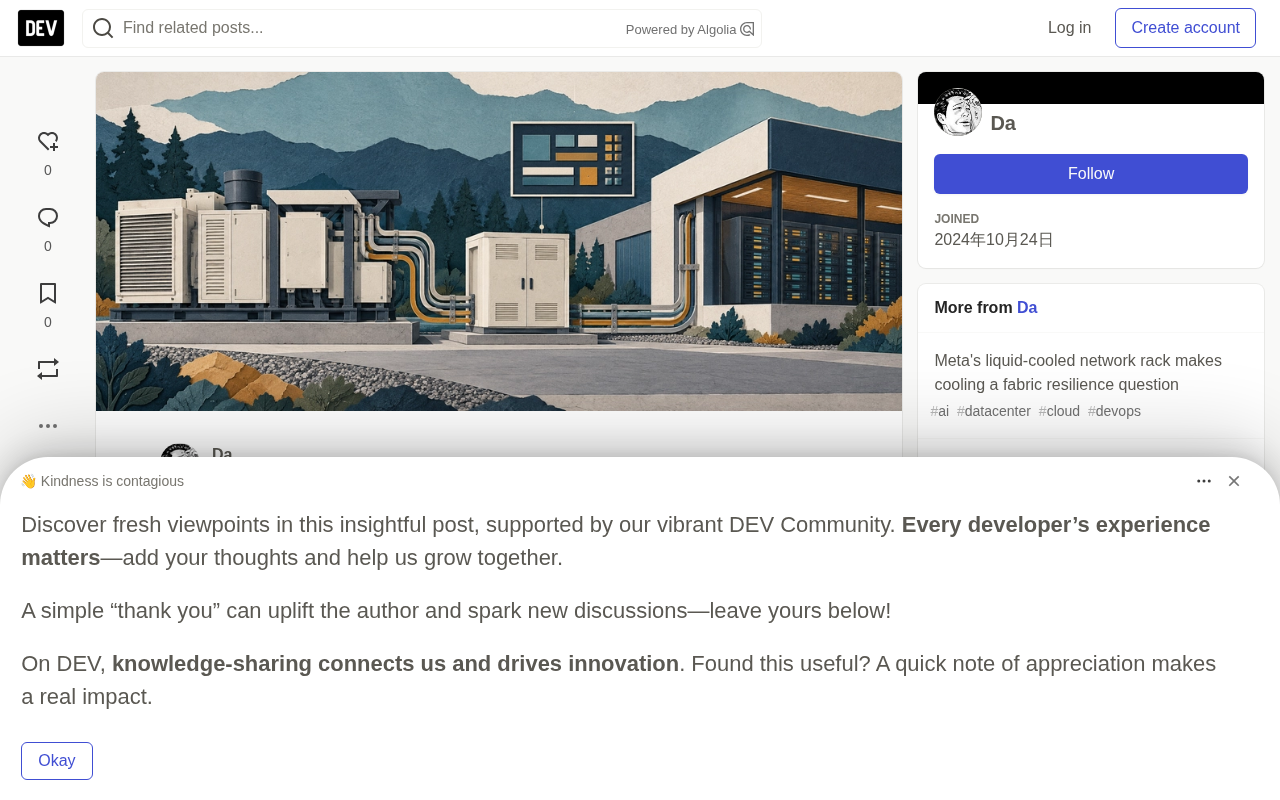
Unlike simply stacking power devices, the core variable in this system lies in how software coordinates power routing, energy storage, ride-through, and protection logic. For infrastructure procurement teams, this means the evaluation checklist needs to expand from "electrical output parameters" to "the decisions the system makes during state transitions."
The Control Model Should Be Treated as Part of the Deliverable
DG Matrix's announcement describes a skid-mounted integration approach and emphasizes that the software layer can coordinate multiple functions across systems. However, this announcement is a vendor capability description and does not provide sufficient testing details to independently verify efficiency, recovery behavior, or deployment speed at specific sites.
A pragmatic starting point for evaluation is to require the vendor to provide clear specifications of operational states. This includes conditions such as normal operation, power interruption, energy storage unavailability, maintenance isolation, and power restoration. For each condition, procurement teams should clarify the expected power path and the service outcomes committed to the customer.
More critically, the transitions between states matter. A design may list multiple supported modes without explaining how to safely switch from one mode to another. Procurement teams need to request trigger sequences, switching conditions, and which situations require operator approval.
All evidence should be tied to the actual delivered configuration. Energy storage layout, connected power sources, and downstream loads should all be documented. Demonstrations conducted with different configurations can serve engineering discussions, but their limitations should remain visible in the acceptance plan.
SST (Solid-State Transformer) is key background for understanding the positioning of the Interport SST Cell. Traditional line-frequency transformers rely on iron cores and copper windings and can only passively step voltage up or down at a fixed ratio—bulky and incapable of active regulation. Solid-state transformers instead use power semiconductors (such as SiC and GaN devices) to perform power conversion at high frequency, rectifying AC to DC and then inverting to the required AC or DC form, giving them the characteristics of small size, active controllability, and multi-port output. For AI factories, the value of SST lies in its ability to produce the 800 VDC bus that servers require directly from utility AC, eliminating the losses and footprint of multi-stage AC-DC-AC-DC conversion in traditional architectures. But the cost is significantly increased control complexity: semiconductor switches, topology, and software together determine output quality, and any flaw in control logic will directly reflect on power supply reliability. Therefore, when evaluating SST solutions, procurement teams cannot look only at rated power and efficiency curves—they must also examine whether the control firmware and state management are auditable and verifiable.
NVIDIA MGX is a modular server architecture specification introduced by NVIDIA, designed to make GPU servers from different vendors follow unified standards for chassis, power, liquid cooling, and motherboard layout, thereby accelerating AI server design and deployment. Understanding MGX helps grasp the "AI factory" power requirements discussed in this article: MGX racks typically integrate multiple high-power GPUs, with single-rack power reaching tens or even hundreds of kilowatts, far exceeding the density of traditional data center racks. This density makes 48 VDC or traditional AC distribution increasingly strained in terms of copper losses, cable volume, and conversion efficiency. The industry is therefore trending toward higher-voltage DC buses (such as 800 VDC) to reduce current, cut losses, and simplify distribution layers. DG Matrix's emphasis that its solution targets the MGX architecture and outputs native 800 VDC is precisely a response to this trend, and it also explains why its software control layer becomes a focal point in procurement evaluation.
Protection Functions and Optimization Functions Must Be Distinguished
Power optimization and protection serve different purposes. Procurement teams should require vendors to clearly identify which decisions are made to improve efficiency or smooth loads, and which are operating limits enforced to support operations.
Behaviors that need to be documented include: how the system responds when optimization services stop, when communication is interrupted, and when sensor readings are invalid. Determine which functions continue to operate locally and which require a broader control path. Also establish mechanisms that allow operators to recognize when the system has entered a restricted operating mode.
These are procurement due diligence questions, not conclusions about DG Matrix's products. Their value lies in making assumptions explicit before procurement teams rely on a single integrated platform to deliver multiple functions. According to industry analysis, similar architectures are gaining more attention in data center power distribution, but independently verified cases remain limited.
Protection coordination is an established concept in electrical engineering, referring to the setting of operating currents and times for circuit breakers, fuses, or electronic protection at each level to ensure that when a fault occurs, only the protection device closest to the fault point operates, avoiding cascading trips that cause widespread outages. In traditional AC distribution, this logic is mainly achieved through hardware selection and settings. In programmable power systems like SST, however, protection logic is partly implemented in software, and the system may switch between AC, DC, and energy storage modes, changing the fault current path and significantly increasing the difficulty of protection coordination. Therefore, when procurement teams ask vendors to provide a protection coordination plan, the essence is to confirm: regardless of which operating mode the system is in, faults can be correctly isolated, and mode switching will not create protection blind spots or false trips. This requirement echoes the article's call to "distinguish protection functions from optimization functions."
Downstream Installation Must Be Reviewed as a Complete System
Converting existing AC power to a different distribution architecture still leaves site-specific integration tasks. Project teams need to reach agreed boundary definitions for conversion systems, distribution equipment, connected racks, and maintenance arrangements.
Procurement teams should request design documents and protection coordination plans applicable to the actual installation. Clarify isolation procedures, responsible parties, and the qualifications required for service work. A factory-integrated skid should come with the information site teams need to integrate it into their own operational processes.
This review requires joint participation from facilities, electrical, and IT teams. They need to reach consensus on how workloads change when the power system switches modes, including any conditions that require reducing load or shutting down equipment.
The Handover Process Must Preserve Verified Behavior
Programmable power systems require a configuration record that persists after commissioning. Procurement teams should capture approved hardware, software, settings, and test conditions, along with corresponding results.
The approval method for future changes should also be agreed upon in advance. Software updates, module replacements, or energy storage configuration adjustments should all have a clear review path and a method for determining which acceptance checks must be repeated. Document who has authority to approve changes and who is responsible for confirming that the installation remains within supported conditions.
For technical B2B vendors, this creates concrete work: translating the capabilities of an integrated product into an auditable operating plan and maintaining that plan throughout the installation lifecycle. DG Matrix's update makes the software layer of AI power infrastructure more visible. Procurement teams can use this disclosure to demand stronger handovers: documented power paths, verified state transitions, and clear accountability for keeping the verified configuration intact.
One-line Summary
DG Matrix launches a native 800 VDC Interport power solution; procurement evaluation must expand from steady-state parameters to state transitions and software control behavior.
Paragraph Summary
DG Matrix launched the Interport SST Cell and Interport OS, providing modular power conversion and software control for the Interport 360 Flex system targeting the NVIDIA MGX architecture, directly outputting native 800 VDC. The article notes that the core variable in such solutions lies in how software coordinates power routing, energy storage, ride-through, and protection logic, so the procurement evaluation checklist should expand from electrical output parameters to the decisions the system makes during state transitions. Procurement teams should require vendors to provide power path descriptions for each operating state, trigger sequences and operator approval conditions for transitions between states, and clearly distinguish protection functions from optimization functions, documenting behavior under anomalies such as communication interruptions and sensor failures. Downstream installation must be reviewed as a complete system, covering design documents, protection coordination, and cross-team consensus; after handover, configuration and test records must be preserved, and change approval and retest paths established.
Related articles

Amphibious Transforming Drone: Beyond 100x Power Savings, What Are the Real Needs?
Is the amphibious transforming drone just a gimmick? Starting from the 100x power difference of the M4 Morphobot, explore real application scenarios and thesis topic ideas, analyzing boundary conditions where pure drones and pure ground robots both fail.

Warhound Raises $200 Million: Genetically Engineered "War Dogs" Paired with Anduril Gear
Warhound raises $200M, backed by Ben Lamm and Palmer Luckey, to genetically engineer dogs for military and law enforcement use and equip them with Anduril gear. This article analyzes its technology direction, funding logic, and ethical controversy.

Claude API Comes to Google Cloud: IAM Integration and SDK Access Guide
Anthropic hosts the full Claude API on Google Cloud with IAM-controlled permissions and unified billing. This guide covers the Vertex AI and Anthropic-hosted entry points, IAM role configuration, and SDK access.