Dia Open-Source Project Hits 5,000 Stars in One Day: Two Undergrads Replicate NotebookLM's Podcast Feature in 3 Months
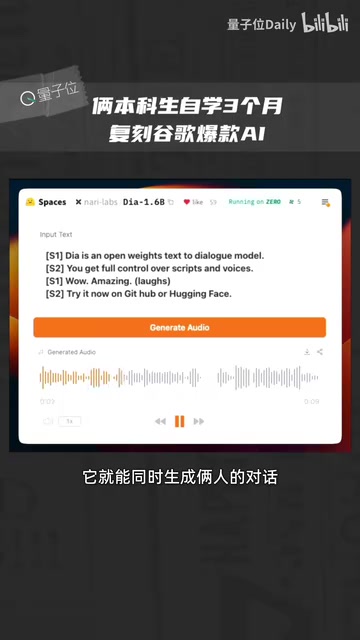
Two undergrads self-taught for 3 months to build Dia, an open-source AI dialogue voice generator rivaling Google NotebookLM.
Dia, an open-source project by the two-person Nari AI team of undergraduate students, was completed in just three months. With a lightweight 1.6B parameters, it achieves near real-time two-person dialogue audio generation capable of simulating non-verbal details like laughter and coughs, earning industry praise as the strongest AI dialogue generation to date. The team completed training by self-studying TPU technology and applying for Google's free computing resources. It surpassed 5,000 GitHub stars within a day of launch, though Chinese language support is not yet available.
A Phenomenal Open-Source Project Emerges
Recently, an AI voice generation project called Dia exploded in popularity across the open-source community — surpassing 5,000 GitHub stars in less than a day. The project directly targets the podcast conversation feature of Google's phenomenal product NotebookLM, and what makes it even more remarkable is that the team behind it consists of just two undergraduate students who self-taught for three months to complete the development.
Dia was built by the Nari AI team, with the core capability of automatically generating two-person dialogue audio from input text. Unlike conventional TTS (Text-to-Speech), Dia generates emotionally rich conversations — not only with natural, fluid intonation but also simulating non-verbal details like coughs and laughter, delivering an extremely realistic feel.
Technical Background: The Generational Gap Between TTS and Dialogue Generation Traditional TTS (Text-to-Speech) technology has existed for decades, evolving from early concatenative synthesis and parametric synthesis to recent deep learning-based end-to-end models (such as Tacotron and VITS), with naturalness continuously improving. But the fundamental limitation of traditional TTS is that it handles "reading aloud" rather than "conversation" — lacking emotional dynamics, turn-taking, paralinguistic signals (laughter, pauses, sighs), and other elements of real dialogue. The new generation of dialogue generation models that Dia represents essentially layers conversational dynamic modeling on top of speech synthesis, requiring simultaneous understanding of semantic emotion, speaker roles, and scene context. The technical complexity far exceeds traditional TTS, which is the fundamental reason why its demo results have stunned industry professionals.
The most widely circulated demo clip online features two people discovering a fire and frantically shouting as they escape — industry professionals who listened exclaimed it's "the strongest AI dialogue generation performance to date."
Technical Highlights: 1.6B Parameters Achieving Near Real-Time Voice Generation
Dia's model has only 1.6B (1.6 billion) parameters — in an era where large models routinely reach tens or even hundreds of billions of parameters, this is remarkably lightweight. Yet this "small model" achieves near real-time audio generation speed, striking an excellent balance between quality and efficiency.
Deep Dive: The Significance of 1.6B Parameters Being Lightweight Parameter count is the core metric for measuring neural network scale, representing the number of trainable weights in a model. Current mainstream large language models like GPT-4 are estimated to exceed 1 trillion parameters, and the LLaMA 3 series has 70B-level versions. 1.6B falls into the "small model" category by today's standards, with advantages including fast inference speed, low VRAM usage, and minimal deployment costs. Dia's success validates the value of "task specialization": when a model is carefully designed and focused on a single vertical scenario, parameter efficiency can be dramatically improved. This aligns closely with the rising trend of "small and specialized" models (such as Microsoft's Phi series and Apple's OpenELM) — in specific scenarios, a carefully trained small model can absolutely compete in quality with general-purpose models dozens of times larger, offering significant reference value for compute-constrained developers and enterprises.
In practical use, Dia is already available for online experimentation on Hugging Face. Hugging Face is currently the world's most important open-source AI model hosting platform, often called "the GitHub of AI," offering one-stop services including model repositories, dataset hosting, and online inference — users can call models directly through their browser without local deployment. Users simply input text content, click the generate button, and the model randomly assigns voice timbres while automatically adjusting tone and emotional expression based on the text content. Whether for podcast voiceovers, audiobooks, or dialogue content creation, everything can be done effortlessly in minutes.
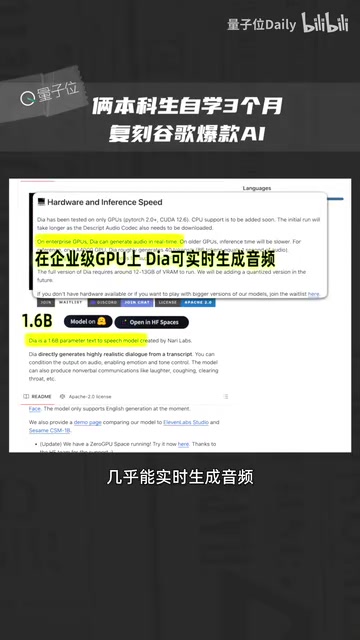
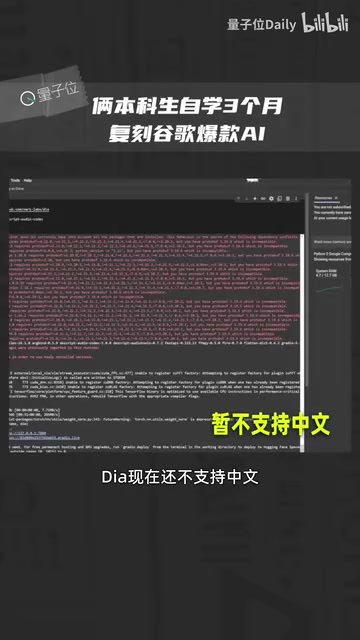
However, Dia currently has one notable limitation — it doesn't support Chinese yet. For Chinese-speaking users, this means they cannot directly use it to generate Chinese podcast dialogues in the short term. But given that the project is already open-source, community contributions for Chinese support are only a matter of time.
The Underdog Story: From Zero to 5,000 GitHub Stars
The story behind Dia is equally noteworthy. The entire team consists of just two people — one full-time and one part-time — and neither are professional AI researchers; both are undergraduate students.
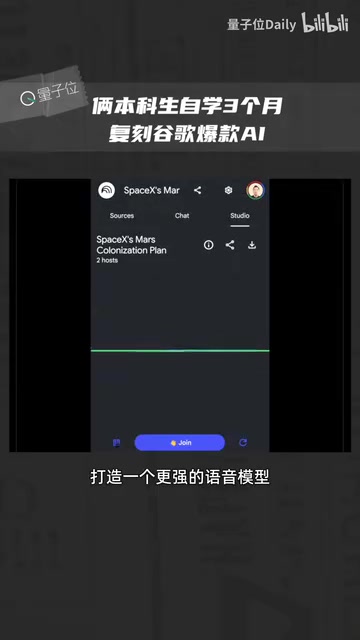
Last year, Google NotebookLM's podcast generation feature went viral, deeply inspiring the two to pursue the idea of building an even stronger voice model. Google NotebookLM's "Audio Overview" feature allows users to upload documents and automatically generates podcast audio featuring two AI hosts engaging in in-depth discussion. The two virtual hosts interrupt each other, express surprise, and ask follow-up questions, completely shattering people's preconceptions about AI voice being "robotic." The viral success of this feature not only validated the enormous market demand for "AI-generated podcasts" as an application scenario but also inspired numerous developers to attempt replicating or even surpassing its results — Dia was born as a direct product of this context.
However, as non-specialist students, their first challenge was insufficient technical preparation.
Their solution was straightforward — self-study. The two began systematically learning TPU (Tensor Processing Unit) tutorials, mastering the core technology of large-scale model training from scratch.
What Are TPUs and Google's TRC Program? TPU (Tensor Processing Unit) is a custom chip designed by Google specifically for machine learning workloads. Compared to general-purpose GPUs, it offers significant speed and energy efficiency advantages in matrix operations, serving as core computing infrastructure for training large-scale deep learning models. Google's TRC (TPU Research Cloud) program is a free TPU computing application project offered by Google to academic researchers and open-source developers, aimed at lowering the computing barrier to AI research. Applicants submit a research plan, and after approval, receive free TPU access for a limited time. This program has incubated multiple important open-source projects and is a key initiative in Google's efforts to build the AI ecosystem.
Funding was equally tight. With no investors and no corporate backing, they applied for Google's research program (Google TRC Program) to obtain free TPU computing resources for model training — this channel helped them bypass what would have otherwise been tens of thousands of dollars in cloud computing costs. Just like that, leveraging open-source community resources and their own execution capability, they built Dia in just three months.
Future Plans and Industry Implications
According to the team, Dia is currently still at the model and demo stage. In the future, they plan to develop it into a complete application product supporting richer dialogue content and mixing effects.
From an industry perspective, Dia's emergence brings insights on at least three levels:
First, AI voice generation is entering the era of "democratization."
Related articles
 Tech Frontiers
A Rare Quiet Day in AI: Recursive Self-Improvement Stirs Beneath the Surface
A rare quiet day in AI sees multiple sources go silent simultaneously. Behind the calm, Recursive Self-Improvement (RSI) research continues. What this means for the industry.
 Tech Frontiers
Reve 2 vs. Ideogram 4: A Deep Dive into Layout Control in AI Image Generation
A deep comparison of Reve 2 and Ideogram 4's layout control capabilities, covering technical approaches, real-world use cases, and industry trends for designers and creators.
 Tech Frontiers
In the Weights: Check Your Influence Score in the AI World
In the Weights is an AI influence search engine that quantifies your presence in the AI world with a score. Explore how it evaluates practitioners and what it means for digital identity.