Diablo II: A Classic Retrospective That Changed Gaming History

Diablo II's random loot farming and numerical systems remain the ARPG design paradigm, sparking ongoing tech community discussion.
The article centers on the discussion Diablo II sparked on Hacker News, noting that the work has transcended gaming itself to become an important reference for understanding modern ARPG design logic. Its core designs—the random map and drop-driven loot loop, and the deep numerical system of skill trees and attribute points—established the paradigm for many later works. The tech community focuses on how procedural generation controls resource usage, multiplayer state synchronization trade-offs, and atmosphere with limited art resources. The article concludes that the value for today's developers lies not in replication but in understanding the principles behind its design trade-offs: randomness must be constrained, progression feedback must be immediate, and content depth should match repetition costs.
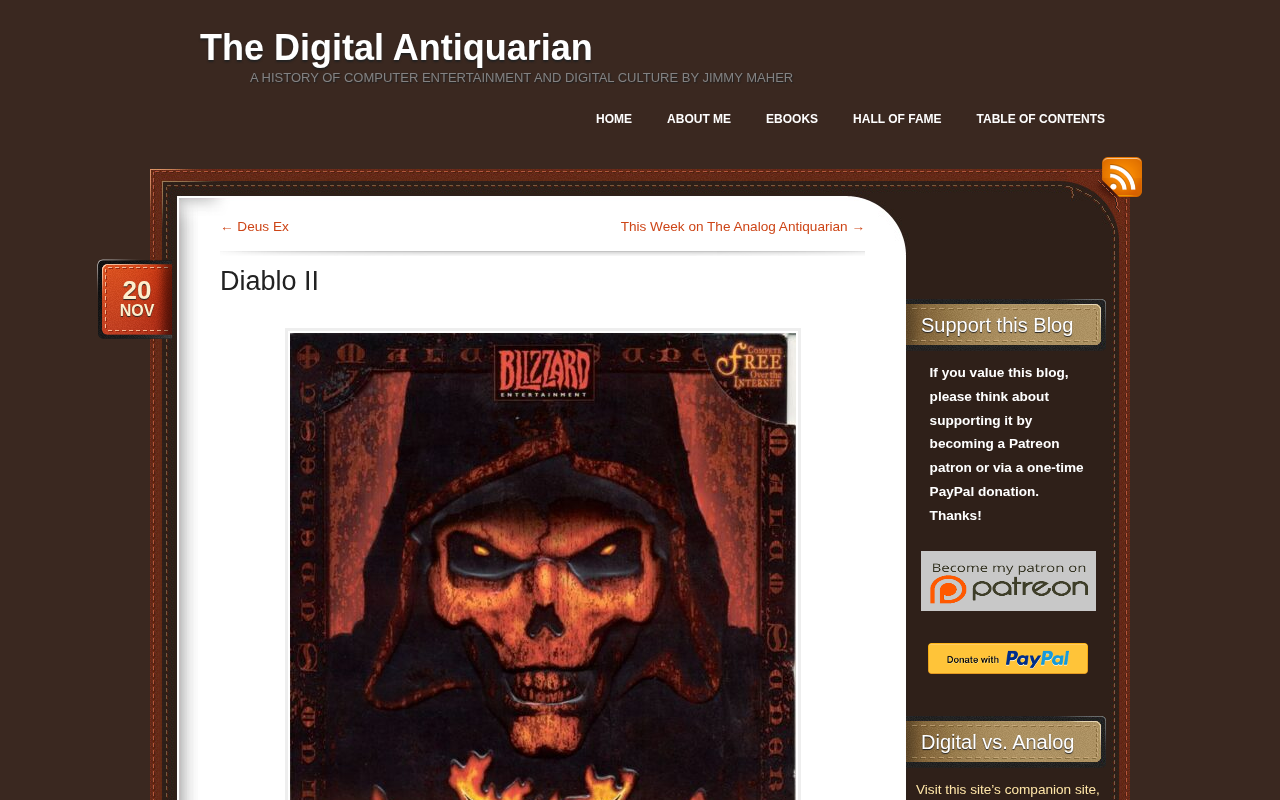
Diablo II long ago transcended being just a game—it has become a collective memory for a generation of players and an unavoidable reference point for understanding the design logic of modern action role-playing games (ARPGs). A recent long-form retrospective about it sparked over two hundred points of discussion and more than eighty comments on Hacker News, demonstrating that this work still maintains lasting topical heat in both tech and gaming circles.
A Game History Written and Rewritten
The article that sparked discussion comes from the game history writing site filfre.net, a site long known for rigorous historical research and in-depth narrative. Its articles typically cover everything from development background and team composition to technical constraints, all the way through to the work's impact on the industry. The fact that discussion around Diablo II could garner over two hundred points of recognition on a news aggregation community reflects two things: first, the work's historical status is solid enough, and second, there remains room for its narrative to be re-examined.
Why It's Still Discussed After Twenty-Plus Years
Judging from the heat of discussion, what players and developers care about isn't just nostalgia—it's the game's forward-thinking system design.
The Delicate Balance of Randomness and Repetition
Diablo II's core loop is built on random maps, random drops, and character progression. This design ensures that the process of repeatedly farming gear always carries uncertainty, both extending the game's lifespan and giving players something new to anticipate each run. The many ARPGs that followed—including various "loot-driven" games—have almost all adopted this structure, demonstrating the far-reaching influence of its design paradigm.
Procedural Generation in this title isn't simply "random maps" but a constrained set of generation rules: room layouts, monster distribution, and chest positions are combined by algorithms on preset templates, ensuring each run feels different while avoiding complete chaos. The engineering value of this approach lies in allowing developers to support extremely long playtime with limited level assets while controlling memory and art resource usage. For players, the uncertainty brought by randomness is the core driver of repeated farming, but if the random range is too large, it weakens the sense of purpose. Therefore, excellent random systems typically need to set boundaries between "predictable" and "pleasant surprise"—a problem that many later loot games have repeatedly weighed when designing drop tables and map affixes.
The Long-Term Vitality of Numerical Systems
Skill trees, attribute points, equipment affixes, and resistance mechanics together form a numerical system that is both deep enough and intuitive enough. Players can repeatedly refine characters around a particular build, while balance adjustments between versions continually spawn new construction ideas. This layered sense of "easy to learn, hard to master" is something many similar works struggle to replicate.
ARPG (Action Role-Playing Game) as a genre label deserves some explanation. It typically refers to games centered on real-time combat while retaining the level, skill, and equipment progression systems of role-playing games. Unlike turn-based or strategy RPGs, ARPGs emphasize operational feedback and combat rhythm—players complete attacks, dodges, and skill releases in short time windows, while long-term growth relies on numerical accumulation and equipment iteration. The Diablo series is widely regarded as one of the founders of the modern ARPG, and its design language—including random dungeons, loot-driven loops, and skill trees—has been borrowed by a large number of works and extended to console and mobile platforms. Understanding this genre positioning helps clarify the intrinsic connections between concepts like "loot farming," "builds," and "seasons" that repeatedly appear in discussions of Diablo II.
Why the Tech Community Also Pays Attention
Discussing an old game in a tech community like Hacker News usually means the topic touches on more universal engineering or design propositions. Points often mentioned about Diablo II include: how to control resource usage through procedural generation under the hardware conditions of the time, how to handle state synchronization in multiplayer, and how to create a sufficiently strong atmosphere with limited art resources. These trade-offs still have reference value for today's indie developers.
According to cross-referenced information from the article and community comments, discussions about game pacing, drop feedback, and character progression curves often ultimately return to the proposition of "how systems serve players' long-term motivation." This also explains why a retrospective of an old work can generate so much technical discussion.
Multiplayer state synchronization is another engineering challenge often discussed by the tech community. Under early network conditions, games needed to let multiple players see relatively consistent monster positions, drop ownership, and skill effects in the same dungeon while tolerating some network latency. Common approaches include authoritative determination of key events by servers or hosts, prediction and interpolation for non-critical states, and zone partitioning to reduce synchronization pressure. These ideas are consistent with today's multiplayer game concepts of "authoritative servers" and "client prediction." Reviewing Diablo II's implementation trade-offs can help developers understand: when bandwidth and computing power are limited, which states must be strictly synchronized and which can be approximately handled by clients, thereby achieving a balance between experience and cost.
Implications for Today's Developers
For readers interested in game system design or indie development, the value of Diablo II lies not in replication but in understanding the logic behind its design trade-offs: randomness needs to be constrained within a perceivable range, progression feedback needs to be immediate enough, and content depth must match repetition costs. These principles still hold in today's product design context.
If you want to learn more about this history, you can continue reading along the original article and community discussions. A work that can be continuously discussed often indicates that the problems it touches have not yet been truly solved.
"Easy to learn, hard to master" is a commonly used framework for evaluating system depth, with its core being layered exposure of complexity: beginners only encounter a small number of core rules, and as play deepens, hidden numerical interactions and build space gradually emerge. Diablo II's skill tree and equipment affix systems are typical examples of this layered design—on the surface it's just point allocation and equipment swapping, but in reality it involves multiple layers of variables including damage types, resistance penetration, and attack speed breakpoints. For indie developers, this means you don't need to show players all systems from the start, but should guide players to discover depth themselves through feedback rhythm. At the same time, layered design also requires underlying numbers to be stable enough, otherwise complexity exposed later can easily become frustration rather than exploratory fun.
One-line Summary
Diablo II's random loot farming and numerical systems remain the ARPG design paradigm, sparking ongoing discussion in the tech community.
Paragraph Summary
The article revolves around the discussion Diablo II sparked on Hacker News, pointing out that this work has long transcended the game itself to become an important reference point for understanding modern ARPG design logic. Its core designs—the random map and drop-driven loot farming loop, and the deep numerical system formed by skill trees and attribute points—established the basic paradigm for many similar works that followed. The tech community's focus includes how procedural generation controls resource usage, the engineering trade-offs of multiplayer state synchronization, and atmosphere creation with limited art resources. The article concludes by emphasizing that the value of this work for today's developers lies not in replication but in understanding the principles behind its design trade-offs: randomness must be constrained, progression feedback must be immediate, and content depth should match repetition costs.
Related articles

Nightmare Mode: Engineering Practices for Simulating Disk Failures
Starting from the Hacker News Nightmare mode discussion, this article analyzes typical forms of simulated disk failures, fault injection implementation approaches, and how to integrate fault drills into the development process to improve distributed system fault tolerance.

Datasette-charts-pie Plugin Released: New Options for Pie and Sunburst Charts
Datasette-charts-pie 0.1a0 is released, adding pie, donut, sunburst, and rose charts to Datasette. The author dislikes pie charts but built the plugin to test the plugin architecture.

The Underrated Gemini Neon: The Most Cost-Effective Everyday AI Model
Google's Gemini Neon beats Claude Opus and GPT Sol 6.2 on most benchmarks at a lower price. Someone built a game in 15 minutes for $1.50, with coding on par with Opus 5.5.