Did Claude Help Prove the Riemann Hypothesis? The Boundary Between AI and Formal Verification

Claude-assisted formal proof of the Riemann Hypothesis earns Lean community endorsement, but the Clay prize process and mathematical acceptance are two independent timelines.
The article examines Claude assisting mathematician Levent Alpoji with a Riemann Hypothesis-related proof. It explains the zeta function, analytic continuation, nontrivial zeros on the critical line, and how zeros control prime count error. Computers cannot exhaustively prove infinite cases, but formal proofs cover arbitrary inputs. Claude contributed mathematical construction ideas, not just proofreading; Lean and Mathlib communities confirmed the proof matches Mathlib's Riemann statement with no extra assumptions. Verification is limited to Dirichlet L-functions, distinct from the broader Generalized Riemann Hypothesis. Clay still labels it unsolved because its prize process requires publication, a two-year wait, and general acceptance—an independent timeline from formal verification.
The role of AI in mathematical discovery is once again sparking debate. News that Claude assisted mathematician Levent Alpoji in completing a proof related to the Riemann Hypothesis has received endorsements from the Lean and MathLib communities, yet it stands in subtle contrast with the Clay Mathematics Institute's continued labeling of the problem as "unsolved." This is not a contradiction but rather two different kinds of recognition. This article breaks down the true value of this discussion across three layers: the mathematical core, the formal verification process, and the boundaries of AI's contribution.
What Is the Riemann Hypothesis Actually Saying?
The gaps between primes 2, 3, 5, 7, 11 are irregular. Rather than predicting the next prime, it's more useful to ask: how many primes are there not exceeding x? This count rises in a staircase pattern, and mathematicians compare it to a smooth estimate—the logarithmic integral. The Riemann Hypothesis controls precisely how far this staircase can deviate from the smooth curve.
The central entry point to the story is the zeta function. Within its original domain of convergence, it is written as 1 + 1/2^s + 1/3^s + …, which appears to be a sum over all integers. But Euler proved it can also be written as a product with one factor per prime, because every integer greater than 1 has a unique prime factorization. Primes are thus embedded into the structure of the zeta function.
A key detail: that infinite series does not converge everywhere. Mathematicians extend the function through analytic continuation. What appears in the conjecture is the continued function, not some arbitrary summation of a divergent series.
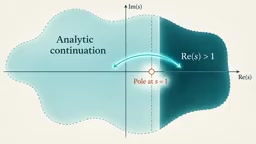
On the complex plane, the zeros of the zeta function fall into two categories: the trivial zeros at negative even integers, and the nontrivial zeros lying in the vertical strip with real part between 0 and 1. The Riemann Hypothesis asserts that every nontrivial zero lies exactly on the critical line with real part 1/2—not most of them, but all of them.
Why should this geometric property control the primes? Because there exists a formula connecting the prime count to the zeta zeros. The zeros provide correction terms that manifest as overlapping oscillations: the imaginary part of a zero controls the oscillation frequency, and the real part controls the envelope size. A real part of 1/2 corresponds to square-root growth; a real part of 3/4 would allow a much larger contribution. The Riemann Hypothesis sets an upper bound on the error in the prime count, growing on the order of sqrt(x) times the natural logarithm of x (up to a constant factor for sufficiently large x). This does not say the error always equals that value—it places a ceiling on it.
Analytic continuation is the key technique for understanding the Riemann Hypothesis. The original series 1 + 1/2^s + 1/3^s + … converges only when the real part of s is greater than 1, but mathematicians want to study a broader range of s. Analytic continuation tells us: if two functions agree completely on some open region, and one of them is analytic on a larger region, then the other function is uniquely "extended" there as well. For the zeta function, the Euler product and the functional equation (relating ζ(s) and ζ(1−s)) provide the bridge for continuation, making ζ(s) a meromorphic function on the complex plane except for a simple pole at s=1. It is precisely for this continued function that the nontrivial zeros lie in the critical strip with real part between 0 and 1, and only then can the Riemann Hypothesis be stated. "Casually summing" a divergent series is mathematically illegitimate; analytic continuation is the rigorous and unique way to extend.
Why Computers Cannot "Exhaustively" Prove It
A natural question: can computers check enough zeros? The answer is that they can check an enormous finite range, providing strong evidence. But a counterexample could lie beyond the checked height. A trillion successful cases still leave infinitely many unchecked points. A proof must rule out every possible counterexample, not merely make counterexamples increasingly hard to imagine.
A finite proof can cover infinitely many cases because it reasons about arbitrary inputs. For example, to prove that the square of every even number is even, you need only write the number as 2 times some integer—no endless testing required. A proof about arbitrary zeta zeros is far harder, but it pursues the same kind of universal coverage.

What Did Claude Contribute?
Alpoji's own account describes a collaboration, not an unattended chatbot solving the problem from a single prompt. He mentions gathering ideas from simpler settings, guiding the work toward the relevant case, and then seeing Claude propose mathematical moves near the finish that exceeded his own speed.
One example involves linking mathematical constructs called theta lifts. According to Alpoji, Claude suggested letting the chain length scale with the square root of the length of a sum related to primes. By his account, Claude contributed the mathematics itself, not just proofreading.
But his announcement is not a complete derivation for beginners. He released a formal proof in Lean—a language and proof assistant designed to make mathematical reasoning machine-checkable. The community reported 17 million lines of code. That number indicates the artifact is enormous, but it does not indicate how many fundamentally new ideas it contains.
Claude and Lean play different roles. Claude can propose mathematical routes and help construct arguments; Lean checks whether a precisely stated conclusion follows from precisely specified premises under logical rules. It does not judge whether prose sounds clever. A persuasive explanation and a valid proof are two different things.
Lean is an interactive theorem prover based on dependent type theory, whose core is a small kernel that accepts only proof terms constructed according to strict logical rules. Mathlib is a community mathematics library built on Lean, containing a large number of formalized theorems from basic algebra to analysis and number theory. The difference between a formal proof and an ordinary paper is that every step of reasoning must be made explicit—any skipped step or "obviously" fails to pass the kernel check. The scale of 17 million lines reflects the enormous volume produced by breaking high-level mathematical arguments into machine-checkable low-level steps, not the complexity of the mathematical ideas. This also explains why formal verification can close the loophole of "equivocation"—definitions, assumptions, and inference rules are all fixed, and the compiler does not accept vague statements.
How Formal Verification Closes the "Equivocation" Loophole
Mathlib provides a shared library of formalized mathematics, including the established statement of the Riemann Hypothesis. This is crucial, because a computer could perfectly check a proof of a false proposition—by changing definitions, sneaking in extra assumptions, or proving a simpler theorem under a familiar name.
Imagine you announce you have proved that "every locked door can be opened," while quietly defining "locked door" as "a door for which you already have the key." Your reasoning may be flawless, but your theorem is not what your audience thinks it is. Formal verification requires both the correct statement and a valid proof.
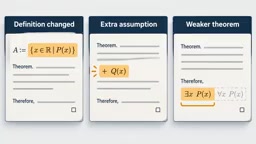
The Lean and Mathlib communities addressed this explicitly. They isolated the Riemann statement in a separate file importing only Mathlib, then compared it with the theorem in Alpoji's library using tools such as Comparator and ConLetch. The community reported that the two match exactly.
There is another possible shortcut: proof systems allow you to declare assumptions, and you could simply assume the result you are supposed to prove. So reviewers also checked the proof's axiom dependencies. Andrew Sutherland's verification report at MIT noted that the core theorem uses only Lean's three standard axioms, with no extra assumptions sneaking in the Riemann conclusion.
Finally, the proof itself must pass checking. In a proof assistant, the kernel accepts or rejects proofs. The community also checked the exported, lazy proof representation with multiple checkers. These checkers are not asked "does the result look plausible"—they are checking a logical certificate. Using exported proof data also separates verification from any malicious behavior that might exist in the original source code. Sutherland's report documents successful checking with independently written systems (including NanoDA and ConLece), as well as replaying every compiled module through the Lean kernel.
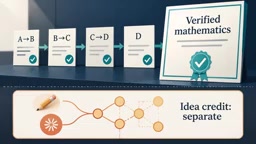
This does not mean computers are magically infallible; it means reduced reliance on undiscovered flaws in a single implementation. The evidence is a reproducible chain of deduction, checked against an independently reviewed statement. What these checks certify is the mathematics, not how much credit each collaborator deserves.
Axiom dependency checking is an easily overlooked but crucial part of formal verification. In Lean, any theorem ultimately depends on a set of axioms (typically including the axiom of choice, propositional extensionality, etc.). A prover can declare additional axioms or assumptions in the code, and if reviewers only look at the theorem statement without checking dependencies, they could be misled—for example, by directly assuming the Riemann Hypothesis and then "proving" it. Tools export the complete list of axiom dependencies for a theorem, and reviewers use this to confirm that the core theorem uses only standard axioms and has not secretly introduced extra premises. Sutherland's report did exactly this: checking the axiom set of the core theorem and confirming that the conclusion itself was not inserted as an assumption. This is as important as checking the proof steps, and together they form a complete chain of trustworthy verification.
Where Is the Boundary: Dirichlet L-functions and the Generalized Riemann Hypothesis
Sutherland's verification covers Dirichlet L-functions. These are relatives of the zeta function, used to study primes in arithmetic progressions—for example, primes congruent to 1 mod 4 versus primes congruent to 3 mod 4. But they are not the only relatives mathematicians study. Sutherland explicitly states that broader families are outside the scope of his checking. So the phrase "Generalized Riemann Hypothesis" here needs a qualifier: the verified extension concerns Dirichlet L-functions.
This differs from some results released by OpenAI in October. The relevant manuscript describes a zero-free region with real part greater than 7/8. Excluding zeros from that region and forcing every nontrivial zero onto 1/2 are different mathematical goals—not competing descriptions of the same theorem.
Dirichlet L-functions are generalizations of the zeta function to arithmetic progressions, defined as L(s, χ) = Σ χ(n)/n^s, where χ is a Dirichlet character. For characters modulo q, L-functions likewise have Euler products and analytic continuation, and their nontrivial zeros also lie in the critical strip. The Generalized Riemann Hypothesis asserts that for all Dirichlet L-functions, the nontrivial zeros lie on the line with real part 1/2. What Alpoji's work formally verifies covers this family, not broader automorphic L-functions or elliptic curve L-functions. Mathematically, Dirichlet L-functions already suffice to control prime distribution in arithmetic progressions (such as the error term in the prime number theorem for arithmetic progressions), but there is still a significant distance to covering all L-functions. Therefore, the claim "the Generalized Riemann Hypothesis has been proved" must be qualified as "formal verification for the family of Dirichlet L-functions," otherwise it exaggerates the actual scope of coverage.
Why Does Clay Still Label It "Unsolved"?
As of November 21, 2026, the Clay Mathematics Institute's Riemann Hypothesis page still carries the "unsolved" label after the Lean and MathLib communities endorsed the proof. Clay's prize process is separate from software verification announcements. Its rules require publication in a qualifying venue, at least two years after publication, and the proposed solution must achieve general acceptance in the global mathematical community before Clay will consider it.
This waiting period is not a mathematical objection to the proof, and a successful kernel check does not automatically award a prize. A proof can be formally valid before its ideas are widely understood. Broad acceptance and prize decisions can follow different timelines. Alpoji himself emphasizes that understanding and explaining the argument still requires substantial work, and he expects simplifications.
This is a striking distinction: a massive proof can be checked before mathematicians have distilled its core ideas into explanations that can be taught, adapted, and built upon. The mathematical gain is turning a conditional guarantee about the error in the prime count into a proved guarantee. It does not make the primes uniformly distributed, and the proof of that statement is not itself a fast way to factor large integers.
The more instructive AI lesson concerns trust. Discovery can involve a system whose suggestions you would not accept on authority. Verification still demands precise definitions and independently checked deduction. Claude can help find the root, but it is not the final judge of whether that root reaches its destination.
One-line Summary
Claude-assisted formal proof of the Riemann Hypothesis earns Lean community endorsement, but the Clay prize process and mathematical acceptance are two independent timelines.
Paragraph Summary
The article examines the discussion around Claude assisting mathematician Levent Alpoji in completing a proof related to the Riemann Hypothesis. It first explains the hypothesis itself: analytic continuation of the zeta function, nontrivial zeros on the critical line, and how the zeros control the error in the prime count. It then explains that computers cannot exhaustively prove infinite cases, but formal proofs can cover arbitrary inputs. Claude's contribution lies in proposing mathematical construction ideas (such as scaling the chain length of theta lifts), not merely proofreading; the Lean and Mathlib communities confirmed through isolating the statement, checking axiom dependencies, and cross-checking with multiple checkers that the proof matches the Riemann statement in Mathlib with no extra assumptions. The verification scope is limited to Dirichlet L-functions, distinct from the broader Generalized Riemann Hypothesis. Clay still labels it "unsolved" because its prize process requires publication, a two-year wait, and general acceptance by the global mathematical community—an independent timeline from formal verification endorsement.
Related articles

Jensen Huang Returns to Nvidia: The Power Game Behind an "Aggro Reset"
Nvidia's board reappointed Jensen Huang as CEO less than two weeks after his scandal-driven resignation. This analysis explores the board's decision-making, Trump's political intervention, media power failure, and market reaction behind the dramatic return.

Why Voice AI Can't Understand Kenyans' Everyday Conversations
Swahili speech recognition hits 3.24% error on read text, but everyday Kenyan speech mixes English, Sheng slang, and accents—leaving mainstream voice AI struggling.

Data Centers Build Their Own Natural Gas Plants: AI Compute's Breakout Around a Decade-Long Grid Wait
Grid interconnection approvals can take a decade, so xAI and others are building off-grid natural gas plants to power AI clusters. This article analyzes the drivers, costs, and impact of behind-the-meter generation on AI infrastructure.