Dify Comprehensive Guide: The Open-Source Platform for Building AI Apps Without Code

Dify is an open-source platform for building production-grade AI apps visually without code.
Dify is an open-source LLM application development platform by LangGenius that enables users to build AI applications through visual drag-and-drop workflows. It supports hundreds of models, offers production-grade features including RAG pipelines, Agent capabilities, and LLM observability, and deploys easily via Docker. Licensed under Apache 2.0, it balances accessibility for non-programmers with enterprise-grade power.
Introduction: Enabling Non-Programmers to Build AI Applications
Want to build a ChatGPT-like LLM application but can't write code? Or maybe you're an enterprise architect looking to set up an internal AI assistant platform for your team? Dify, a hugely popular project on GitHub, is the open-source LLM application development platform built for both of these audiences — enabling you to build AI workflows through visual drag-and-drop, taking you from prototype to production in one seamless experience.
Today, we'll do a deep dive into Dify, this open-source AI development tool, and explore what makes it stand out in the global open-source community.
Dify's Team Background and Open-Source Ecosystem
Dify's development team is called LangGenius, a team based in China that has been building this project since 2023. The project uses the Apache 2.0 open-source license, meaning it's completely free for commercial use — extremely friendly for both enterprises and individual developers. Apache 2.0 is one of the most permissive open-source licenses available, maintained by the Apache Software Foundation. Unlike the GPL license, which requires derivative works to also be open-sourced, Apache 2.0 allows users to freely use, modify, and distribute code, and even integrate it into closed-source commercial products. The only requirement is to retain the original copyright notice and license text. This means enterprises can adopt Dify without legal concerns, performing secondary development and customized deployments based on its source code without needing to disclose their own business code.
The project operates on a parallel open-source version + Cloud service (Cloud) model, a classic healthy "open-source + SaaS" business model. The GitHub Readme has been translated into 17 languages, covering Chinese, English, Japanese, Korean, German, French, Arabic, and more — a level of internationalization that surpasses many Silicon Valley projects. Linux Foundation Insights is also continuously tracking this project, with positive feedback from the international community, representing a new paradigm of "Chinese team + global perspective."
Core Selling Point: Dify's Visual Workflow Engine
When you open Dify, you'll see a canvas. On the left are various node "building blocks":
- LLM Node: Connect to various large language models
- Knowledge Base Retrieval Node: Implement RAG-enhanced retrieval
- Python Code Node: Insert custom logic
- HTTP Request Node: Interface with external APIs
- Conditional Branch Node: Build complex flows
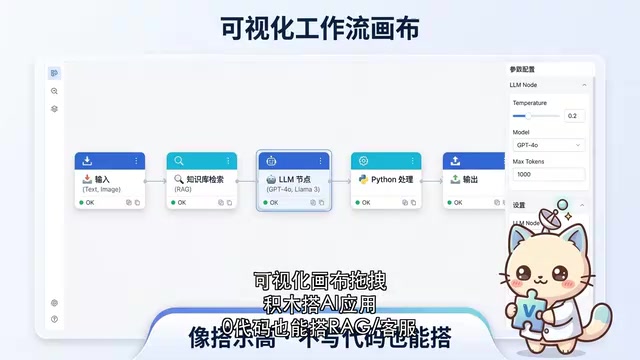
You connect these nodes together like building with LEGO, creating a complete AI application. Each node's parameters are configured in the right-side panel, and the canvas supports real-time test runs. Even without writing a single line of code, you can build impressive RAG Q&A systems, intelligent customer service bots, data analysis assistants, and more.
This visual workflow design philosophy shares the same lineage as traditional low-code/no-code platforms, but Dify has deeply optimized it specifically for LLM application scenarios. Each node isn't just a simple functional module — it also incorporates LLM domain best practices. For example, the knowledge base retrieval node automatically handles complex details like document chunking strategies, embedding model selection, and similarity threshold settings, enabling non-technical users to achieve professional-grade RAG results.
This low-barrier visual approach dramatically lowers the entry threshold for AI application development, allowing product managers, operations staff, and even business departments to independently build AI applications.
Model Compatibility: Dify Supports Hundreds of LLMs with Full Coverage
Dify achieves top-tier compatibility in model integration, supporting hundreds of large language models:
- International Commercial Models: GPT series, Claude, Gemini, Mistral
- Open-Source Models: Full LLaMA 3 series
- Chinese Models: Tongyi Qianwen, Zhipu GLM, ERNIE Bot, Kimi, DeepSeek
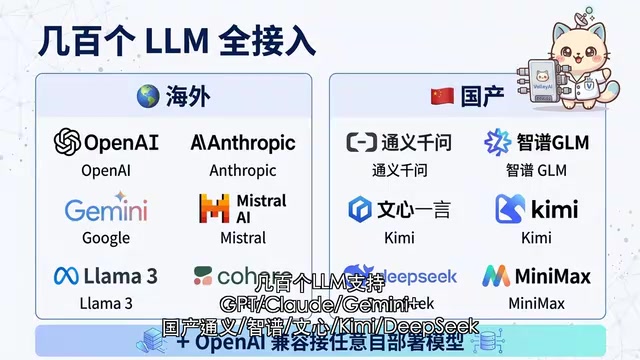
More critically, Dify also supports connecting to any self-deployed model using the OpenAI-compatible protocol. The OpenAI-compatible API has become the de facto standard interface specification in the LLM field, defining a unified HTTP API format including endpoints like /chat/completions and /embeddings, along with standardized request and response JSON structures. Currently, the vast majority of open-source model inference frameworks — such as vLLM, Ollama, LM Studio, LocalAI, and others — implement this protocol. This means as long as your model service exposes an OpenAI-compatible API endpoint, Dify can connect directly without writing any adapter code. Your project can simultaneously run Chinese and international models with zero compatibility barriers, which is especially friendly for developers in China.
In today's landscape where AI models are flourishing, this design philosophy of "not being locked into any single model" gives users maximum flexibility and freedom of choice.
Dify's Production-Grade Features: From Prototype to Enterprise Deployment
Dify isn't just a prototyping tool — it comes with complete production-grade features:
RAG Pipeline (Knowledge Base Q&A)
Supports document upload, automatic chunking, vectorization, and retrieval augmentation. Out-of-the-box RAG capabilities make knowledge base Q&A effortless. RAG (Retrieval-Augmented Generation) is the mainstream technical approach for addressing LLM "hallucination" issues and knowledge timeliness problems. Its core idea is: before the LLM generates an answer, first retrieve the most relevant document fragments from an external knowledge base, then feed these fragments as context into the model, allowing it to generate answers based on real data. The entire pipeline includes document chunking, vector embedding, vector database storage and retrieval, and final context assembly and generation. RAG's advantage is that it enables LLMs to "understand" enterprise private data without model fine-tuning, and answers are traceable and verifiable. Dify encapsulates this entire complex pipeline into an out-of-the-box functional module — users only need to upload documents to complete knowledge base construction.
Agent Capabilities
Supports tool calling and multi-step reasoning, enabling you to build AI Agents with complex decision-making abilities. AI Agents represent the cutting edge of current large model applications. The core concept is enabling LLMs to not just passively answer questions, but to actively plan tasks, call external tools, and perform multi-step reasoning and decision-making based on intermediate results. A typical Agent architecture includes: a perception layer (receiving user input), a planning layer (decomposing complex tasks into sub-steps), an execution layer (calling search engines, database queries, code execution, and other external tools), and a reflection layer (evaluating execution results and deciding next actions). OpenAI's Function Calling and Anthropic's Tool Use are both underlying technologies supporting Agent capabilities. Dify's built-in Agent capabilities allow users to build intelligent agent applications with tool calling and multi-step reasoning through visual configuration, without implementing this complex architecture from scratch.
Model Management Dashboard
Configure different API Keys and quotas for different team members, meeting enterprise multi-user collaboration management needs.
Observability
This is one of Dify's killer features. It has built-in integration with LangFuse, Arize Phoenix, and other mainstream LLM Observability platforms — what Prompts were run, how many Tokens were consumed, where the bottlenecks are — everything is fully traceable.
LLM Observability is an emerging field extending from traditional software engineering's APM (Application Performance Monitoring) concept. Because LLM application outputs are non-deterministic, traditional unit tests and integration tests cannot cover all scenarios, necessitating a specialized monitoring system to track the complete chain of each inference call. LangFuse is currently the most popular open-source LLM observability platform, capable of recording the complete Prompt, model response, Token consumption, latency, and other metrics for each API call, with support for analysis by session, user, model version, and other dimensions. Arize Phoenix focuses more on model evaluation and Trace visualization. These tools help teams discover Prompt design flaws, identify cost anomalies, and locate performance bottlenecks — they are the critical infrastructure for taking LLM applications from "it works" to "it works well." This is exactly the key capability needed to cross from prototype projects to production environments.
Dify Deployment: One-Click Launch with Docker
Dify has an extremely low deployment barrier:
- Minimum Requirements: 2 CPU cores, 4GB RAM — a basic server will do
- One-Click Launch:
docker compose up -dstarts the entire service stack - Immediate Use: Visit
localhost:80to enter the dashboard and start building applications

Docker Compose is Docker's official multi-container orchestration tool that lets you define and manage multiple interdependent service containers through a single YAML configuration file. As a complete application platform, Dify's backend involves multiple components — including the API service, web frontend, Worker async task processing, PostgreSQL database, Redis cache, vector database (such as Weaviate or Qdrant), and more. Manually installing and configuring each of these components individually would be tedious and error-prone. Docker Compose packages all these dependencies into a single command, greatly simplifying the deployment process. For production environments, users can further use Kubernetes for container orchestration, achieving auto-scaling and high-availability deployment.
If you don't want to self-deploy, you can also register an account at cloud.dify.ai and use it directly, paying by tier. Both deployment modes share the same source code — migrating from local to cloud after successful local testing costs nothing. This is the true value of the open-source + SaaS dual-track model.
Competitor Comparison: Dify vs LangChain vs Coze vs FastGPT
These LLM application platforms are frequently compared, each with its own positioning:
| Platform | Positioning | Strengths | Limitations |
|---|---|---|---|
| LangChain | Developer SDK | Extremely flexible | High barrier, requires programming skills |
| Coze (ByteDance) | ByteDance ecosystem | Easy integration with Douyin, Feishu | Platform lock-in |
| FastGPT | Open-source platform | Simple and easy to use | Relatively limited features |
| Dify | Middle ground | Visual + open-source + self-deployable | Moderate learning curve |
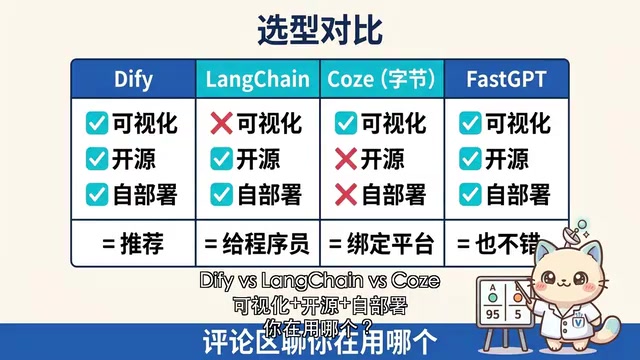
Core assessment: LangChain is an SDK for programmers, providing both Python and JavaScript development frameworks that orchestrate LLM call chains through code. It offers extreme flexibility but requires developers to have solid programming foundations and deep understanding of the LLM tech stack. Coze leverages the ByteDance ecosystem, with natural advantages in integration with ByteDance products like Douyin and Feishu, but application runtime and data depend on ByteDance's cloud platform, creating vendor lock-in risk. FastGPT is also a Chinese open-source project centered on knowledge base Q&A scenarios. It's easy to get started with but relatively lacks Dify's workflow orchestration and Agent capabilities. Dify takes the middle road — visual interfaces lower the barrier while remaining fully open-source and not locked to any platform, with self-deployment support. If your application prioritizes portability and autonomous control, Dify is the safest choice.
Conclusion: Who Is Dify For?
What Dify shows us is the speed at which Chinese open-source AI tools are going global. A Readme in 17 languages, tracking by Linux Foundation, positive reputation in international communities — all of this proves that Chinese teams are fully capable of building infrastructure-level products recognized by developers worldwide.
For individual developers, Dify is a powerful tool for rapidly validating AI ideas without code; for enterprise teams, it's a controllable, observable, and scalable AI application development platform. Regardless of what stage you're at in AI application development, Dify is worth exploring in depth.
Key Takeaways
Related articles
Complete Guide to Deploying LLMs Locally on Mac: Ollama Integration with AI Coding Tools
Complete guide to deploying LLMs locally on Mac: hardware assessment, model selection, Ollama setup, and AI coding tool integration with Qwen 35B benchmarks and memory optimization tips.
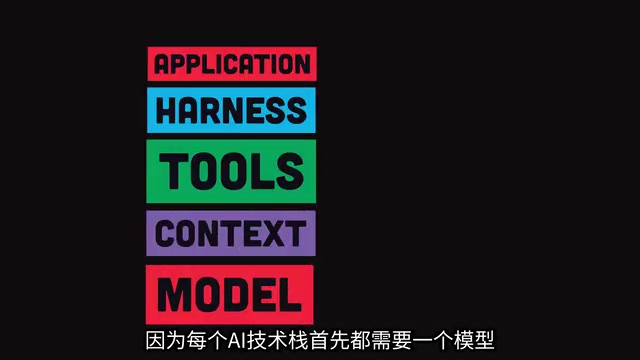
5 Open-Source Tools to Replace $320/Month in AI Subscriptions
Spending $320+/month on AI subscriptions? Use 5 open-source tools — Ollama, 9Router, Headroom, Dify, OpenHands — to build a self-hosted AI stack and drastically cut costs.
DeepMind Alumni Found Fusionality: How AI Is Accelerating the Commercialization of Nuclear Fusion
Former DeepMind employees founded Fusionality, applying reinforcement learning and AI control to nuclear fusion, accelerating clean energy commercialization with digital twins and smart control systems.