Dify for Beginners: A Complete Visual Guide to Building RAG Knowledge Bases

Build RAG knowledge bases and AI agents visually with Dify — no coding required.
Dify is a low-code AI development platform that lets beginners build agents and RAG knowledge bases through a visual drag-and-drop interface. This guide covers Dify's core features, explains the RAG retrieval-generation workflow, and compares Dify to Coze — highlighting why private deployment makes Dify the stronger choice for enterprise use cases involving sensitive data.
For many professionals without a programming background, AI application development can feel like an insurmountable barrier. Low-code AI development platforms like Dify are dramatically lowering that barrier. This article draws from a beginner-friendly Dify tutorial to walk through how to understand intelligent agents and RAG knowledge bases visually — and build your own AI application without writing a single line of code.
Why Beginners Should Start with Dify Instead of Code
For newcomers, the biggest obstacle to learning AI application development is rarely the concepts themselves — it's getting bogged down in code. As the tutorial points out, if you jump straight into building RAG (Retrieval-Augmented Generation) with a framework like LangChain, beginners often get "lost in the code" — obsessing over syntax details or comparing it to languages like Java, while missing the actual business logic entirely.
LangChain is one of the most popular frameworks for building LLM-powered applications, released by Harrison Chase in October 2022. It provides a standardized set of interfaces that help developers connect and orchestrate large language models with external tools, databases, and APIs. However, LangChain has a steep learning curve — developers need to understand abstract concepts like Chains, Agents, and Memory, and must be comfortable with Python before they can get started. For non-technical professionals, this often means weeks or even months of investment. Low-code platforms like Dify essentially wrap the underlying capabilities of frameworks like LangChain into visual components, allowing users to build equivalent functionality without needing to understand what's happening under the hood.
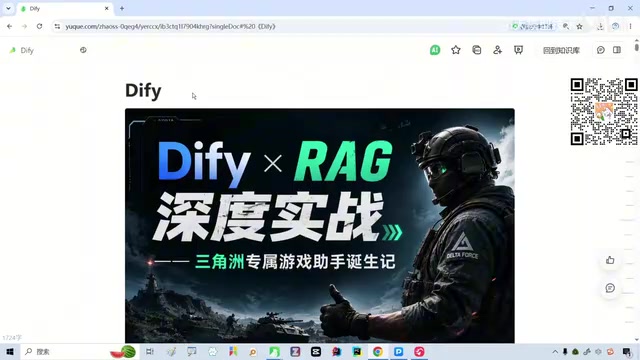
This is exactly where Dify's value lies. As a visual AI application development platform, Dify lets users build applications through a drag-and-drop interface — no code required. For beginners, it's a much smoother learning path to first build an intuitive understanding of "what is an agent" and "what is RAG" using accessible tools, and then circle back to understand how the underlying code works.
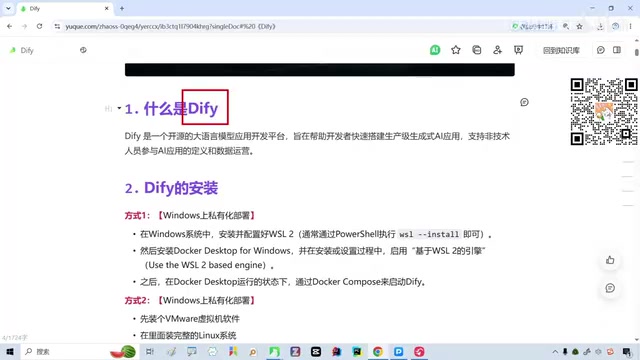
One candid note from the tutorial author: if you're already a seasoned LLM application developer, this content may feel too basic. It's explicitly designed for people who have never touched Dify and have no prior knowledge of agents or RAG.
Dify's Core Features: From Chat Assistants to Automated Workflows
Dify's core capabilities cover the most common AI application scenarios today. According to the tutorial, it supports creating multiple types of applications:
- Chat Assistants: Build conversational AI interfaces
- Agents: Intelligent agents capable of tool-calling and task execution
- Text Generation Apps: Generative applications for content creation
- Workflows: Orchestrate multiple steps into automated pipelines
What these capabilities share is that they're all built without code. Through the visual interface, users can combine functional modules like building blocks. Dify also supports connecting knowledge bases, enabling AI assistants to answer questions based on internal company documents — significantly boosting workplace productivity.
It's worth clarifying what an Agent actually means in the context of large language models. An agent is an AI system that can autonomously plan steps, call external tools, and iterate in a loop until a goal is accomplished. Unlike the simple back-and-forth of a standard chat model, agents follow the ReAct (Reasoning + Acting) paradigm: the model reasons (Thought), decides on a next action (Action), observes the result (Observation), then reasons again — repeating this cycle until the task is complete. Tools an agent can call include web search, code executors, database queries, API endpoints, and more. In Dify's visual interface, this complex orchestration logic is abstracted into draggable nodes and connections, dramatically reducing the barrier to entry. Understanding that an agent is fundamentally an "autonomous decision-making system that uses tools" — not just a chatbot — helps practitioners design AI applications with real business value.
The Tutorial's Focus: What Is a RAG Knowledge Base and Why Does It Matter
The heart of this tutorial is RAG (Retrieval-Augmented Generation) — what's commonly referred to as a "knowledge base." RAG was first introduced by the Meta AI Research team in 2020 in the paper Retrieval-Augmented Generation for Knowledge-Intensive NLP Tasks. Its core workflow involves three stages: first, the indexing stage, where documents are split into chunks, converted into vectors via an embedding model, and stored in a vector database (such as Faiss, Pinecone, or Weaviate); next, the retrieval stage, where a user's query is also converted into a vector and the most relevant text chunks are retrieved from the vector store using cosine similarity or approximate nearest neighbor (ANN) algorithms; finally, the generation stage, where the retrieved context and the user's question are fed together into the large language model to produce a factually grounded response.
This mechanism directly addresses a core weakness of large language models: they don't know your company's proprietary information, and they tend to confidently fabricate answers — a phenomenon technically called hallucination, where the model invents information that doesn't exist. In knowledge-intensive enterprise scenarios, this is particularly harmful.
The tutorial uses a case-driven teaching approach: it starts with real-world examples to spark interest and help learners understand why a knowledge base is needed before gradually going deeper. This application-first, principle-second method is far more accessible for beginners than leading with theory.
Dify vs. Coze: Private Deployment Is the Key Differentiator
Any discussion of Dify inevitably leads to a comparison with Coze (扣子), another commonly used tool. The tutorial author makes clear that they personally prefer Dify — and the reason is worth paying attention to for any enterprise user.
Coze is primarily cloud-hosted, meaning your data has to be processed by the platform provider. For individual users this might not matter, but for enterprises, entrusting core data entirely to a third-party cloud platform is often a non-starter.
Dify supports both cloud and private deployment. On-premise deployment means running the software on servers owned or leased by your organization, rather than relying on third-party cloud infrastructure. Dify is an open-source project (with over 80,000 stars on GitHub), with fully public code, allowing enterprises to run it independently on their own servers or in a private cloud environment. This is highly significant from a compliance standpoint: regulations such as China's Data Security Law and Personal Information Protection Law hold enterprises directly responsible for how sensitive data is handled. Financial sector standards like Classified Protection 2.0 (等保2.0), and healthcare standards like HIPAA compliance, all impose explicit requirements that data must not leave certain boundaries or be stored in third-party systems. Private deployment ensures that data never leaves the corporate network, eliminating compliance risk at the architectural level — rather than relying on contractual terms or vendor promises.
This difference also reflects the fundamental positioning of each tool: Coze is better suited for individual developers and lightweight use cases that need to get up and running fast; Dify, with its open-source foundation and private deployment option, is better suited for enterprise-grade deployments where data sovereignty is a requirement.
A Recommended Learning Path for Beginners
Drawing from this tutorial's approach, here's a three-step recommendation for zero-experience learners:
- Build intuition through tools first: Use Dify's visual interface to quickly build a working AI application and get a hands-on feel for what agents and RAG knowledge bases actually do.
- Understand principles through examples: Don't start with theory. Work through a concrete knowledge base example to understand the RAG retrieval-and-generation flow, and build a complete mental model.
- Then revisit the code: Once the overall workflow makes sense, explore how to implement the same thing with LangChain or similar frameworks. The learning will be far more efficient at that point.
For teams looking to deploy AI applications in real business contexts — especially in industries handling sensitive data — evaluating Dify's private deployment option early is the safer path forward.
Summary
Dify lowers the barrier to AI application development, enabling professionals without coding backgrounds to build agents and RAG knowledge bases. Its value goes beyond "zero-code" ease of use — private deployment provides genuine data security guarantees, which represents a fundamental architectural commitment to data sovereignty, not just a feature comparison. For readers looking to get started with AI application development, or hoping to bring AI capabilities into their organization, building your first knowledge base with Dify is a learning path that's both engaging and practically valuable.
Related articles

WebMCP in Practice: How MakeMyTrip Is Reshaping the Travel Booking Experience
India's largest OTA platform MakeMyTrip uses WebMCP to standardize AI Agent interactions with web apps, replacing fragile DOM scraping with natural language-driven test automation and simplified complex booking scenarios.

Deep Dive into the EYG Programming Language: A New Portable Programming Paradigm Designed for Humans
Deep analysis of the EYG programming language's core design, including algebraic effects, program state persistence, and cross-platform portability, exploring how it addresses modern software fragmentation.

WebMCP in Practice: How MakeMyTrip Is Reshaping the Travel Booking Experience
India's largest OTA platform MakeMyTrip uses WebMCP to standardize AI Agent interaction with web apps, solving DOM scraping fragility, enabling natural language test automation, and simplifying complex international flight bookings.