DiSARM: Using LLMs to Mine "Surprising and Diverse" Association Rules

DiSARM uses LLMs to judge the subjective interestingness of association rules and combines this with statistical reliability and diversity.
The article introduces the hybrid framework DiSARM, which addresses the problem in association rule mining that "there are many rules but few useful ones." Traditional ARM relies on objective metrics that ensure statistical reliability but cannot determine whether a rule is counterintuitive; existing subjective interestingness measures depend on manual annotation and are hard to scale. DiSARM uses LLM world knowledge to assess subjective surprise while retaining statistical constraints and actively promoting diversity. Experiments on three transactional datasets show it can balance reliability, surprise, and diversity, though LLM knowledge bias and call costs remain obstacles.
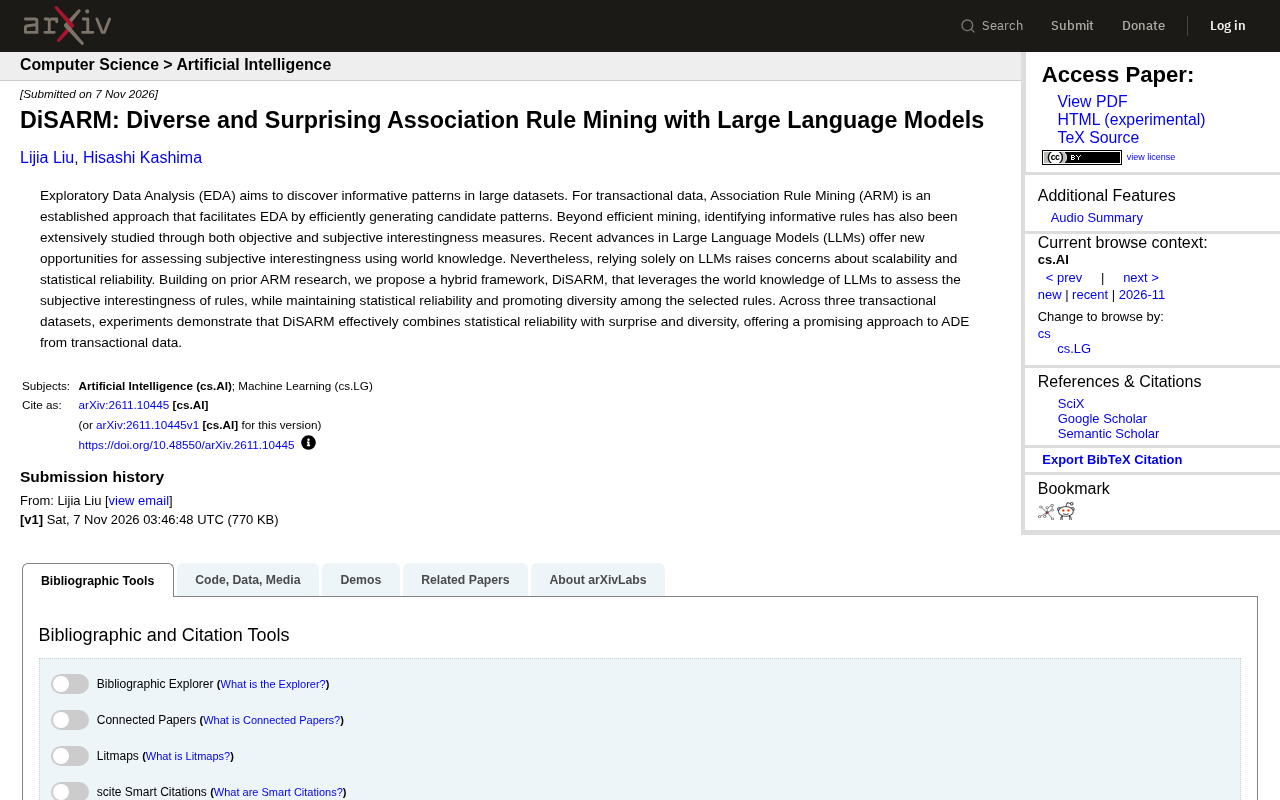
Exploratory data analysis (EDA) aims to uncover informative patterns from massive datasets. For transactional data, association rule mining (ARM) is a mature approach that can efficiently generate candidate patterns. But "mining a lot" doesn't equal "mining something useful"—how to pick out the few rules that genuinely catch the eye from tens of thousands of candidates has long been a research challenge. A recent paper proposes a hybrid framework called DiSARM, which attempts to use the world knowledge of large language models (LLMs) to judge the "subjective interestingness" of rules while also accounting for statistical reliability and result diversity.
The Old Problem of Association Rule Mining: How to Measure Interestingness
Traditional ARM relies on objective metrics such as support, confidence, and lift to filter rules. These metrics guarantee statistical reliability, but they cannot answer the question "is this rule counterintuitive?" For example, the classic case of "people who buy diapers often buy beer" became famous precisely because it was unexpected—not because its lift was particularly high.
To fill this gap, researchers have introduced subjective interestingness measures in an attempt to incorporate human background knowledge into the evaluation system. But subjective measures often depend on manual settings or domain expert annotations, making them hard to scale. The emergence of LLMs offers a new path: the models themselves carry a wealth of world knowledge and can directly judge whether a rule is "surprising." This is exactly the point the paper seizes upon, using LLMs as evaluators of subjective interestingness.
Support, confidence, and lift are the three most commonly used objective metrics in association rule mining. Support refers to the proportion of transactions in which both the antecedent and consequent of a rule appear together, measuring the rule's generality; confidence refers to the probability that the consequent also appears given that the antecedent appears, measuring the rule's reliability; and lift is the ratio of confidence to the probability of the consequent appearing on its own, where a value greater than 1 indicates that the antecedent has a positive promoting effect on the consequent. Together, these three metrics form the filtering foundation of traditional ARM, but they are all purely statistical quantities and cannot express "whether this rule matches human expectations"—a rule with high lift may simply be well-known common sense, while a rule with moderate lift may instead be highly insightful. For this reason, a gap has always existed between objective metrics and subjective interestingness, which is also the starting point for subsequently introducing LLM judgment.
DiSARM's Core Idea: Hybrid, Not Replacement
The key design of DiSARM lies in "hybridization." The paper explicitly points out that relying solely on LLMs carries risks in two respects: scalability and statistical reliability—LLM calls are costly, outputs may be unstable, and its judgments about frequent patterns are not naturally equivalent to statistical significance.
Therefore, building on existing ARM research, DiSARM lets the LLM be responsible for evaluating the subjective interestingness (surprise) of rules, while retaining statistical reliability constraints and actively promoting diversity among rules during the selection process. In other words, it does not treat the LLM as the sole judge, but embeds it within a framework that still respects statistics. This division of labor allows the system to discover counterintuitive patterns without selecting rules that are statistically untenable.
Subjective interestingness differs from objective metrics in one core respect: it depends on the evaluator's existing background knowledge. Whether a rule is "surprising" depends on whether the observer already knew that an association existed between the antecedent and the consequent. Before DiSARM, such measures were usually implemented through domain expert scoring, prior probabilities in Bayesian networks, or information-theoretic surprise formulas—but the first cannot scale, and the latter requires a pre-built knowledge base. The reason LLMs are suitable for this role is that their pretraining corpus is itself an implicit knowledge base covering a broad range of common sense, allowing them to directly judge in natural language whether "people who buy X buy Y" is counterintuitive. It should be noted, however, that an LLM's surprise judgments are probabilistic and may vary with prompts, so it is suitable as a source of subjective signal but not suitable for bearing the selection decision alone.
Performance on Three Datasets
The paper conducted experiments on three transactional datasets. The results show that DiSARM can effectively combine statistical reliability with "surprise" and diversity, offering a promising path for ADE (association discovery and exploration) from transactional data.
One detail: the experimental scale was limited to three datasets, and the paper did not disclose specific performance figures or details of comparison baselines. Judging from the abstract-level description, its contribution lies more in the framework design idea—namely, how to organize collaboration between LLMs and statistical methods—rather than in an absolute lead on any single metric.
Potential Impact on EDA Workflows
If such hybrid frameworks mature, the entire exploratory analysis pipeline will be affected. Analysts will no longer need to manually comb through lengthy rule lists; instead, the system will prioritize rules that are both statistically significant and beyond common-sense expectations. This is especially valuable for scenarios that rely on transactional data, such as retail, recommendation, and risk control.
But limitations should also be recognized: the LLM's "world knowledge" carries training data bias, and rules it considers "surprising" may not actually be novel for a specific business; moreover, the cost of LLM evaluation on large-scale rule sets remains an obstacle to deployment. DiSARM's choice of a hybrid route is itself a response to these real-world constraints.
Result diversity in rule mining means that a selected set of rules should avoid repeating each other as much as possible in terms of covered itemsets or pattern structures. If rules are simply sorted by interestingness and the top-K are taken, it is easy to obtain many highly similar rules—for example, variants all centered on the same popular product—making the list appear long while actually containing limited information. Common diversity-promoting methods include maximum marginal relevance (MMR) and imposing penalties during greedy selection on patterns already covered by selected rules. DiSARM actively introduces diversity constraints during the selection stage, essentially making "the overall information coverage of a set of rules" rather than "the score of a single rule" the optimization objective, which is consistent with EDA's goal of quickly understanding the overall picture of the data.
Conclusion
The value of DiSARM is not in claiming that LLMs can replace statistical methods, but in demonstrating a pragmatic division of labor: statistical metrics safeguard the baseline of reliability, LLMs provide subjective surprise, and diversity mechanisms prevent homogenization of results. For readers interested in the practical adoption of LLMs in data analysis, this is a direction worth following.
One-line Summary
DiSARM uses LLMs to judge the subjective interestingness of association rules and combines this with statistical reliability and diversity.
Paragraph Summary
The article introduces the hybrid framework DiSARM, which aims to solve the problem in association rule mining that "there are many rules but few useful ones." Traditional ARM relies on objective metrics such as support, confidence, and lift, which ensure statistical reliability but cannot determine whether a rule is counterintuitive; existing subjective interestingness measures depend on manual annotation and are hard to scale. DiSARM leverages LLM world knowledge to assess the subjective surprise of rules while retaining statistical constraints and actively promoting result diversity, avoiding the scalability and reliability risks of relying solely on LLMs. Experiments on three transactional datasets show that the framework can balance statistical reliability, surprise, and diversity. The article also points out its limitations: limited experimental scale, no disclosure of specific figures, and the LLM's knowledge bias and call costs remain obstacles to deployment.
Related articles

Incident Response in the Age of AI Attackers: A 6-Month Retrospective and the Four Pillars
AI attackers are making attacks on AI infrastructure more frequent. This article explains MarkTechPost's four-pillar incident response playbook based on a 6-month retrospective, with Fireworks AI and Klue case studies on implementation.

Abnormal Error Rate Spike in Claude Mythos 5.2 and Fable 5.2
Claude Mythos 5.2 and Claude Fable 5.2 show an abnormal spike in request error rates, marked as investigating on the official status page. This article covers the incident overview, practical impact on developers, and recommended responses.

ReAct Runtime Context Trimming: Why Claude Code Acts at 70%
A deep dive into ReAct runtime context trimming: why Claude Code compresses at ~70% usage, why tool calls dominate, why messages must be dropped in pairs, and why codebases don't need RAG.