Discovering an Unknown Planet with Claude Code? An Experiment in AI-Assisted Astronomy
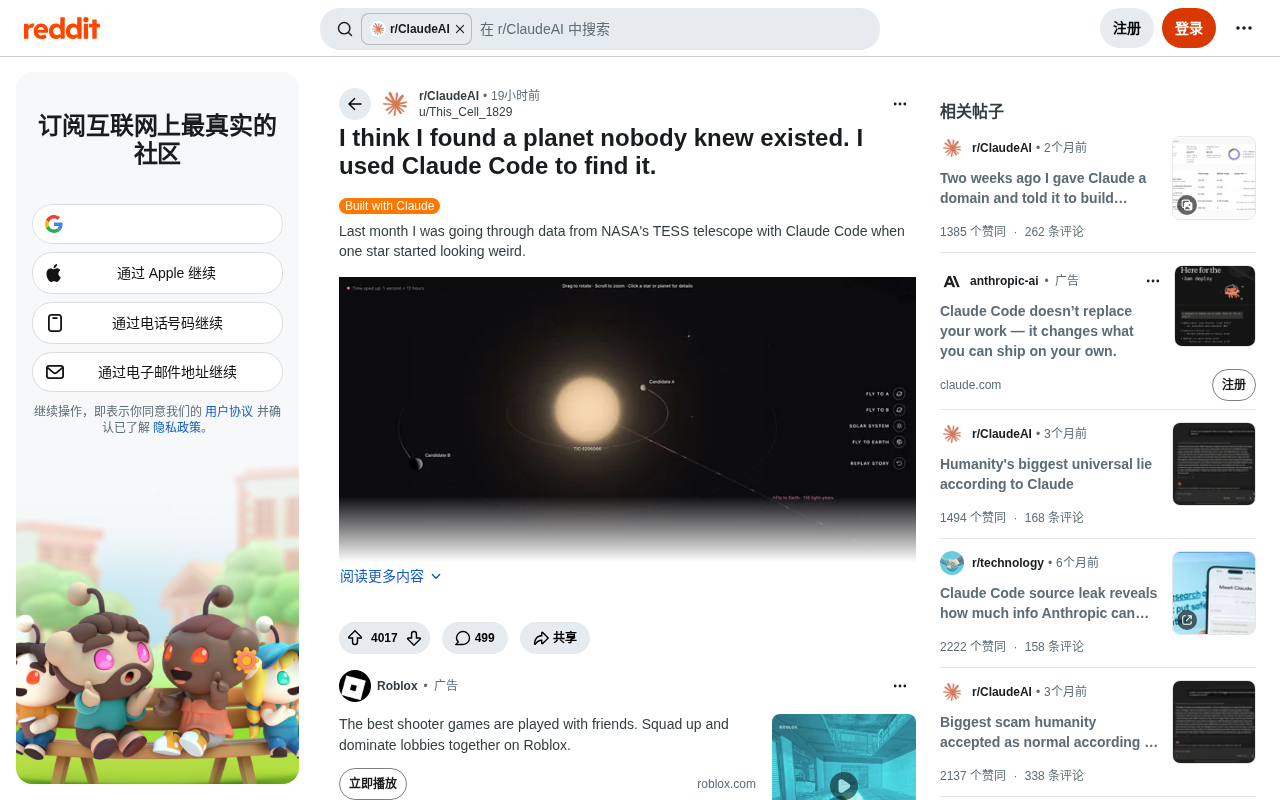
An amateur used Claude Code to analyze public astronomy data and claims to have found an unknown exoplanet candidate.
A Hacker News user claims to have used Anthropic's AI coding assistant Claude Code to process public astronomical data and identify a potentially unrecorded exoplanet candidate. While the claim awaits professional verification, it highlights a broader trend: AI coding tools are dramatically lowering the technical barrier to data-intensive research, letting domain-curious enthusiasts engage with cutting-edge analysis pipelines. Yet scientific verification standards don't bend for convenience — the path from candidate signal to confirmed planet still demands peer review, independent observation, and database cross-referencing. The case points toward a healthy future ecosystem where AI handles exploration access while professional institutions manage filtering and confirmation.
A Bold Claim
A notable post appeared on Hacker News with a refreshingly blunt title: "I think I found a planet nobody knows about, and I found it using Claude Code." The poster claimed to have used Anthropic's programming assistant Claude Code to mine publicly available astronomical data and identify a previously unrecorded candidate object.
The post received 24 upvotes and 7 comments — not exactly viral, but it touched on a rapidly heating topic: as general-purpose AI coding tools begin inserting themselves into specific stages of scientific research, is the boundary between amateur enthusiasts and professional researchers being redrawn?
A word of caution first: in astronomy, a claim like "discovering a planet" carries a strict verification threshold. There's a long road between identifying a candidate signal in data and confirming it's actually a planet — one that runs through peer review, independent replication, and cross-validation observations. The "I think" in the post title itself signals the author's own caution. This reads more like an engaging account of exploration than a settled scientific conclusion.
How AI Coding Tools Enter Astronomical Data Analysis
Modern astronomy has long been a data-intensive discipline. Space telescopes like Kepler and TESS continuously produce enormous volumes of light curve data. That data is publicly accessible, but processing it requires professional programming skills and statistical methods. Traditionally, searching for exoplanets in raw data means writing complex signal-processing scripts to detect the periodic, minuscule dips in stellar brightness caused by a planet transiting in front of its star.
This is precisely where AI coding assistants like Claude Code add value: they can help users rapidly write code for data downloading, cleaning, period analysis, and visualization — dramatically lowering the technical barrier. In theory, an enthusiast with foundational astronomy knowledge but limited coding ability could use AI to carry out an analysis pipeline that once required team collaboration.
The significance of this isn't that "AI discovered a planet for a human" — it's that AI acts as an amplifier, connecting a person's curiosity and domain intuition to engineering capabilities that previously required specialized training to wield. At its core, the poster's story is a case study in the democratization of tools.
The transit method is one of the most mature techniques for detecting exoplanets. When a planet passes in front of its host star, it causes a periodic, subtle dimming — typically between 0.01% and 1% — lasting anywhere from a few hours to several dozen hours. During its mission, the Kepler Space Telescope accumulated continuous light curve data on more than 200,000 stars; TESS continues producing new data with near all-sky coverage. Raw data from both missions is fully public and freely accessible through astronomical archives like MAST (Mikulski Archive for Space Telescopes). The standard analysis pipeline involves detrending to remove instrument drift and stellar activity, followed by searching for periodic transit signals using algorithms like BLS (Box Least Squares), and finally evaluating candidate statistical significance. This engineering workflow — spanning multiple Python libraries such as lightkurve and astropy — represents the hardest technical bottleneck for independent amateur researchers, and the point where AI coding assistants can generate the greatest leverage.
Between Enthusiasm and Caution
The Hacker News community has historically maintained a rational stance toward claims like this. Predictable criticisms in the comments tend to center on a few questions: Has the candidate signal been ruled out as instrument noise or stellar activity? Is this "discovery" simply a rediscovery of an already-catalogued object? Has any independent verification taken place?
These aren't wet-blanket objections — they're the core of scientific method. The false positive rate for exoplanets is quite high. Many seemingly perfect transit signals ultimately turn out to be binary star systems, stellar spots, or data artifacts. A genuine discovery requires submission to professional databases for cross-referencing and follow-up observational resources for confirmation.
For researchers using AI tools, there's also a new risk dimension lurking here: AI-generated analysis code may contain subtle logical flaws, or produce overly optimistic conclusions about statistical significance. When users lack sufficient domain expertise to audit AI output, the credibility of a "discovery" becomes even more dependent on external verification mechanisms.
The false positive problem for exoplanet candidates has been thoroughly studied. NASA's Exoplanet Archive strictly distinguishes between "confirmed planets" and "planet candidates" — the vetting process between the two often takes years. Common false positive sources include background eclipsing binary systems producing spurious transit-like signals, stellar surface spot activity causing brightness variations, and instrumental effects like CCD pixel contamination. Professional teams typically use radial velocity measurements to independently confirm transit signals: a real planet exerts a measurable gravitational pull on its host star, causing detectable Doppler shifts in its spectrum — something none of the common false positive sources would produce. This additional confirmation step requires professional spectroscopic instruments, placing it entirely beyond the reach of AI coding tools — and it represents the most formidable threshold between "candidate" and "confirmed discovery."
What This Story Is Really About
Setting aside whether this particular "planet" will ever be confirmed, the trend this case reflects is worth far more attention. AI coding assistants are spilling out of software development and into specialized domains, becoming general-purpose tools for cross-disciplinary exploration. A person no longer needs to be simultaneously expert in both astronomy and programming to attempt engaging with cutting-edge data.
This presents both opportunity and challenge. The opportunity: more diverse perspectives and broader participation could yield unexpected discoveries — citizen science projects have long demonstrated the value of amateur contributions. The challenge: the capacity for professional verification cannot be democratized by AI in the same way. Finding a signal is easy. Proving it holds up remains hard.
The healthy ecosystem that may emerge looks something like this: AI lowers the entry barrier for exploration, enabling more people to generate valuable candidate leads, while professional institutions and peer review systems take on the responsibility of filtering and confirmation. If the poster's story ever makes it to formal verification — whatever the outcome — it will be a fascinating footnote in the story of AI-assisted scientific research.
Citizen science in astronomy already has mature success stories that provide a useful frame for evaluating AI-assisted exploration. The Galaxy Zoo project used crowdsourcing to classify the morphology of hundreds of thousands of galaxies; Planet Hunters enlisted tens of thousands of volunteers to manually review Kepler data and has yielded multiple professionally confirmed planets. These projects demonstrate that non-specialist participants can contribute real value at the "pattern recognition" and "candidate nomination" stages — but effective operation depends on clear methodological constraints and rigorous back-end professional filtering. Where AI coding tools differ from traditional citizen science platforms is that they grant individuals much stronger autonomous analytical capability, while simultaneously removing the standardized workflows and quality control environments that project platforms provide. This raises individual exploratory flexibility, but makes the reliability of results more dependent on the explorer's own domain judgment.
Closing Thoughts
The Hacker News post itself is light on details — more of a thought-provoking proposition than a complete research report. It reminds us that the capability boundaries of AI tools are continuously expanding, but the rigorous standards of science won't soften simply because those tools have become more convenient. While celebrating the democratization of technology, maintaining appropriate caution about conclusions may be the most fitting stance toward claims like this. The real answer awaits professional astronomical observation.
Related articles

AI New Grad Resume Diagnosis: How to Stand Out for ML/CV Roles?
How can AI/ML new grads optimize their resumes to get interviews? Based on a real Reddit case, this article analyzes project selection, depth display, and structure for ML/CV roles, with actionable revision advice.

OpenAI Opens Up Decision Models as Competition with Jev Heats Up
OpenAI makes its decision model widely available, directly challenging first mover Jev. We analyze the impact on the decision model competitive landscape and key considerations for developers and enterprises.

Startup Growth Secrets: Early Sales Are Not the Key
At Disrupt, experts from Lovable, Polska, and Theory Ventures said early startup growth depends not on early sales but on a repeatable sales process, a clear ICP, team development, and data-driven iteration.