Discovery Phase AI vs ChatGPT: Which to Choose for Requirements Discovery

ChatGPT excels at local drafting during discovery, while specialized tools solve cross-phase consistency; the choice depends on time cost.
The article compares the general-purpose conversational assistant ChatGPT with Discovery Phase AI, designed specifically for requirements discovery. ChatGPT's strengths lie in quickly generating problem statements, requirement first drafts, and rewritten notes from rough input, and in thinking out loud with users and producing multiple formats. But when a discovery involves ten interconnected phases, spans several weeks, and involves multi-person collaboration, its shortcomings become apparent: structure lives in the user's head, answers don't know about each other, editing relies on copy-paste, and records lack IDs and priority fields. Specialized tools fill these gaps with ten guided phases, records with IDs and MoSCoW priorities, consistency checks, and change logs, but they don't conduct interviews or make decisions for people, and gaps still need human filling. The selection criterion is time cost: if copying, checking, and formatting take more time than thinking, a specialized tool is worth the price; most teams end up using both.
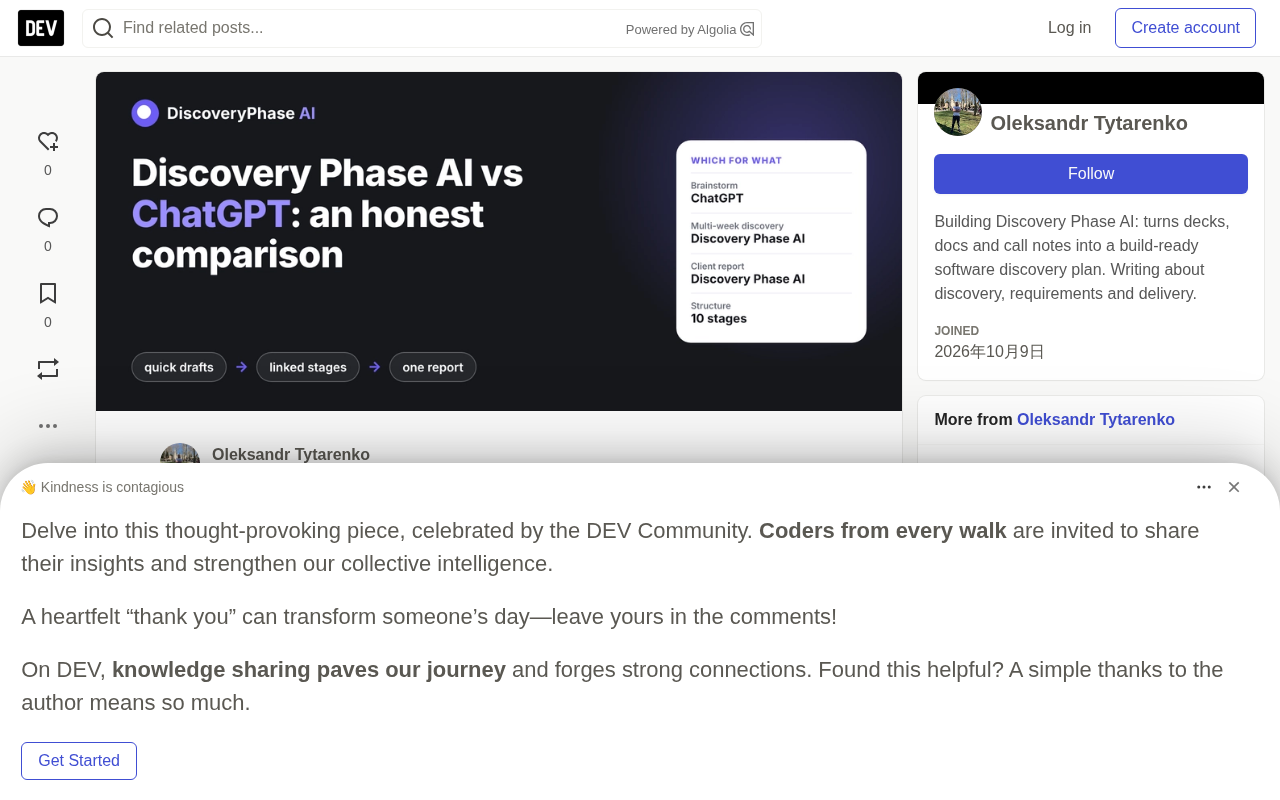
In the requirements discovery phase of software projects, ChatGPT and Discovery Phase AI are often compared. The former is a general-purpose conversational assistant, while the latter is a workflow tool designed specifically for the discovery phase. The original article for this comparison was written by the Discovery Phase AI team, and the authors state their position upfront while attempting to remain fair on the question of "when a general-purpose assistant is better."
The core conclusion can actually be stated in one sentence: ChatGPT excels at drafting local content—problem statements, preliminary requirement lists, call notes; but when a discovery involves ten interconnected phases, spans several weeks, and ultimately must deliver a complete document, it falls short. Whether it's worth switching to a specialized tool for this depends on whether "assembling and maintaining consistency" is actually consuming your time.
ChatGPT's Real Strengths in Requirements Drafting
The flexibility of a general-purpose conversational assistant is exactly what many discovery tasks need.
Generating first drafts from rough input is its strongest capability: paste in meeting notes or a project brief, ask it to output a problem statement, a list of user types, or ten candidate requirements, and within seconds you have something to react to. Rewriting is equally excellent—"make this requirement testable," "rewrite this paragraph for a non-technical sponsor" are instructions it handles well.
It can also think out loud with you. Asking "what am I missing for a booking system" often surfaces edge cases like cancellations, time zones, and refunds. Output formats are almost unlimited: tables, user stories, Mermaid diagrams, emails—depending on how you ask. Current versions can read uploaded files, and some plans allow conversations and files to be retained within projects.
If your discovery is small—one person, a few days, a short document—this may be enough. Pair it with a discovery phase template to ensure nothing is missed.
Where Conversation Threads Hit the Ceiling
The limitations emerge when discovery grows larger, spans longer periods, or involves multiple people.
Structure always lives in your head. Conversations only answer the questions asked; they don't know your discovery should include stakeholders, goals with metrics, user journeys, requirements, architecture decisions, and a roadmap—unless you tell it every time, or you maintain the template yourself.
More troublesome is that answers don't know about each other. You might finalize goals in one conversation and write requirements in another, with no mechanism to alert you when a requirement conflicts with a number in the goals, and no mechanism to detect that a journey step has no corresponding requirement behind it. The longer the thread, the more easily early material gets pushed out of view.
Editing relies on copy-paste. Copy a draft from the conversation into a document, manually edit it, paste it back for the AI to improve, then copy the result out again. There's no change log, no knowing who changed what or why.
Records aren't true records either. A requirement in a conversation is just a paragraph—no ID, no priority field, no owner, no link to the goal it serves. You can ask the AI to provide these in text form, but you have to maintain consistency yourself. Final document assembly, formatting, and syncing with the latest changes are all on you.
None of this means ChatGPT does a bad job. It's a general-purpose assistant, and maintaining consistency across a multi-phase project is a different job entirely.
Context window is the upper limit of text a large language model can "see" at once, usually measured in tokens. All messages exchanged in a conversation, uploaded files, and model replies consume this budget; anything beyond gets truncated or discarded. This is the technical root of the original article's statement that "the longer the thread, the more easily early material gets pushed out of view": when discovery accumulates weeks of meeting notes and multiple rounds of revisions, early finalized goals, constraints, and terminology slip out of the window, and the model can only answer based on residual context, leading to inconsistencies. Practical mitigations include regularly consolidating key conclusions into a "fact summary" and pinning it at the top, proactively pasting it when starting a new thread, or using paid features that support project/file memory. But these methods all rely on manual maintenance and cannot fundamentally replace a persistent structured record.
What Structured Discovery Tools Fill In
Discovery Phase AI was born for this "different job." The original article uses a comparison table to clarify the differences; here are the key points.
In terms of structure, it provides ten guided phases from stakeholders to roadmap, each prompting what content should go into it; ChatGPT requires you to bring your own structure or maintain a template. For starting points, when creating a project you can upload presentations, documents, transcripts, or images, and the AI drafts content for each phase, which you retain, edit, or uncheck item by item.
The record format is the biggest divide. In a specialized tool, a requirement is a record with an ID, type, MoSCoW priority, status, owner, associated goals, and acceptance criteria; milestones carry effort ranges and dependencies; whereas in a conversation it's just a piece of text.
Consistency checks are also worth mentioning: Check impact reads through the entire project and lists conflicts, outdated content, gaps, and broken links. During editing, the assistant proposes changes and you apply them one by one; deletions require confirmation; every change is logged, with AI and file updates marked separately, and paid plans can restore earlier phase versions. Output is a discovery report generated from completed phases, exportable as Markdown, with PDF, Word, and PowerPoint supported on paid plans.
For client projects, two details matter: uploaded source files are analyzed in memory and not stored, and each company's workspace is isolated from others.
MoSCoW priority is a widely used method for ranking requirements; the four letters stand for Must have, Should have, Could have, and Won't have. It turns "importance" from a vague adjective into four enumerated levels, with the benefit that teams can quickly judge during review which delays are acceptable and which would cause project failure. A common accompanying practice is: the total of Must items should not exceed sixty percent of deliverable capacity, leaving margin for surprises. Acceptance criteria are the specific, testable conditions for judging whether a requirement is met, usually written in Given-When-Then form, for example "When the user's balance is insufficient, submitting an order should return a clear error message." Storing requirements as records with IDs, priorities, statuses, and acceptance criteria, rather than as a paragraph in a conversation, is the essence of the original article's statement that "the record format is the biggest divide": records can be searched, linked, and audited; paragraphs cannot.
What It Doesn't Solve Still Relies on Human Judgment
Structured tools don't replace the "human" parts of discovery, and the original article is quite candid on this point.
It doesn't conduct interviews. It only processes what you upload or input. If no one has asked what goes wrong for a dispatcher on Monday morning, the tool won't know either. It doesn't make decisions—it can point out that two requirements conflict, but which one wins is negotiated with the sponsor.
An interesting design choice: file analysis is instructed not to fabricate names, numbers, or goals, so a goal without a stated metric returns without a metric. This is the right approach, but it also means gaps remain gaps until someone fills them.
Moreover, any AI output—whether from ChatGPT or a specialized tool—requires review. Scores and suggestions are signals to pay attention, not proof of quality. Effort range estimates in the roadmap in person-weeks are only as reliable as the assumptions written beneath them.
Person-week is a common unit in software estimation, representing the work of one full-time person for one week. Expressing it as a range rather than a single point (e.g., "6 to 9 person-weeks") acknowledges the uncertainty inherent in estimation; the wider the range, the less is known. The original article's emphasis that "effort range estimates in the roadmap in person-weeks are only as reliable as the assumptions written beneath them" points to the foundational assumptions problem of estimation: if the assumption is "no integration with legacy systems is needed," but integration is actually required, then the entire person-week number becomes invalid. This is also why structured tools, while capable of generating milestones with dependencies, cannot verify whether assumptions hold—assumptions come from interviews, technical research, and judgment about team capabilities, which remain human work. When reviewing AI-generated estimates, you should first look at what premises it relies on, rather than directly adopting the numbers.
Cost Comparison and Selection Advice
Both options have free tiers and paid plans; prices adjust from time to time, so check current pages before deciding. ChatGPT's personal paid plan is widely reported at around $20 per month, and business plans are priced per seat. Discovery Phase AI's Free plan requires no credit card and includes three active projects, one file upload up to 10 MB at a time, 50 AI credits per month, and Markdown export; Pro is $19 per month per person and includes unlimited active projects, up to ten files per upload, 1000 credits per month, PDF/Word/PowerPoint export, and restorable phase versions.
But the more important cost is time. The rule of thumb from the original article: if you spend more time during discovery copying, checking, and formatting than thinking, a structured tool is worth the price; if you mainly need quick drafts, it probably isn't.
A simple way to choose: pick ChatGPT for quick brainstorming or one-off rewrites; for short discoveries completed by one person in a few days, use ChatGPT with a template; for turning a pile of presentations and transcripts into first drafts for each phase, for discoveries spanning several weeks, for multi-person review and editing, and for client- or board-ready finished reports, Discovery Phase AI is better suited. And when exploring a completely unfamiliar domain where you don't yet know what to ask, either works—conversation is often faster to get started with.
Many teams ultimately use both: the conversational assistant for open-ended thinking, and the structured workspace for the record that needs to be signed off.
One-line Summary
ChatGPT excels at local drafting during discovery, while specialized tools solve cross-phase consistency; the choice depends on time cost.
Paragraph Summary
The article compares the general-purpose conversational assistant ChatGPT with Discovery Phase AI, designed specifically for requirements discovery. ChatGPT's strengths lie in quickly generating problem statements, requirement first drafts, and rewritten notes from rough input, and in thinking out loud with users and producing multiple formats. But when a discovery involves ten interconnected phases, spans several weeks, and involves multi-person collaboration, its shortcomings become apparent: structure lives in the user's head, answers don't know about each other, editing relies on copy-paste, and records lack IDs and priority fields. Specialized tools fill these gaps with ten guided phases, records with IDs and MoSCoW priorities, consistency checks, and change logs, but they don't conduct interviews or make decisions for people, and gaps still need human filling. The selection criterion is time cost: if copying, checking, and formatting take more time than thinking, a specialized tool is worth the price; most teams end up using both.
Related articles

JobRunner MCP Server: AI Agents Can Now Fix Failed Java Jobs
JobRunner launches an open-source MCP server enabling AI agents to view cluster status, diagnose failures, and recover Java jobs—incident response from any cloud coding environment or existing agent.

MLAI Digital Launches 9 Security Agents: MCP Server Safeguards the Full Lifecycle of Agentic AI
MLAI Digital launches Security MCP Server with nine built-in specialized security agents covering vulnerability discovery, attack simulation, prompt injection detection, API and infrastructure assessment, and accelerated remediation—embedding security validation across the full Agentic AI lifecycle from development to production.

Running Isaac Lab on H100 GPUs: Exploring Better Approaches
Exploring optimization methods for running Isaac Lab on NVIDIA H100 GPUs, including MIG configuration, mixed precision, TensorRT acceleration, and community experience to improve robotics simulation and reinforcement learning efficiency.