Disney's AI Star Wars Robots: Real-Time Interaction with Park Guests

Disney unveils three Amazon AI-powered animatronic prototypes that can interact with guests in real time.
Walt Disney Imagineering R&D has revealed three new Audio-Animatronic prototypes powered by Amazon AI that interact with guests in real time instead of following preset routines or behind-the-scenes control. The shift moves park experiences from scene immersion toward character immersion, with Star Wars as an ideal testing ground. The prototypes remain in R&D, and deployment timelines and child-safety questions are still unresolved.
Disney parks have long been known for their immersive attractions, but those lifelike Audio-Animatronic characters have faced a persistent awkwardness: they either repeat pre-programmed movements or rely on behind-the-scenes operators controlling them in real time. This kind of "fake interaction" is about to be rewritten by AI.
According to an RSS source, Walt Disney Imagineering R&D recently unveiled three new Audio-Animatronic prototypes. Powered by Amazon's AI technology, these robots can interact with guests in real time rather than simply playing fixed lines or movements.
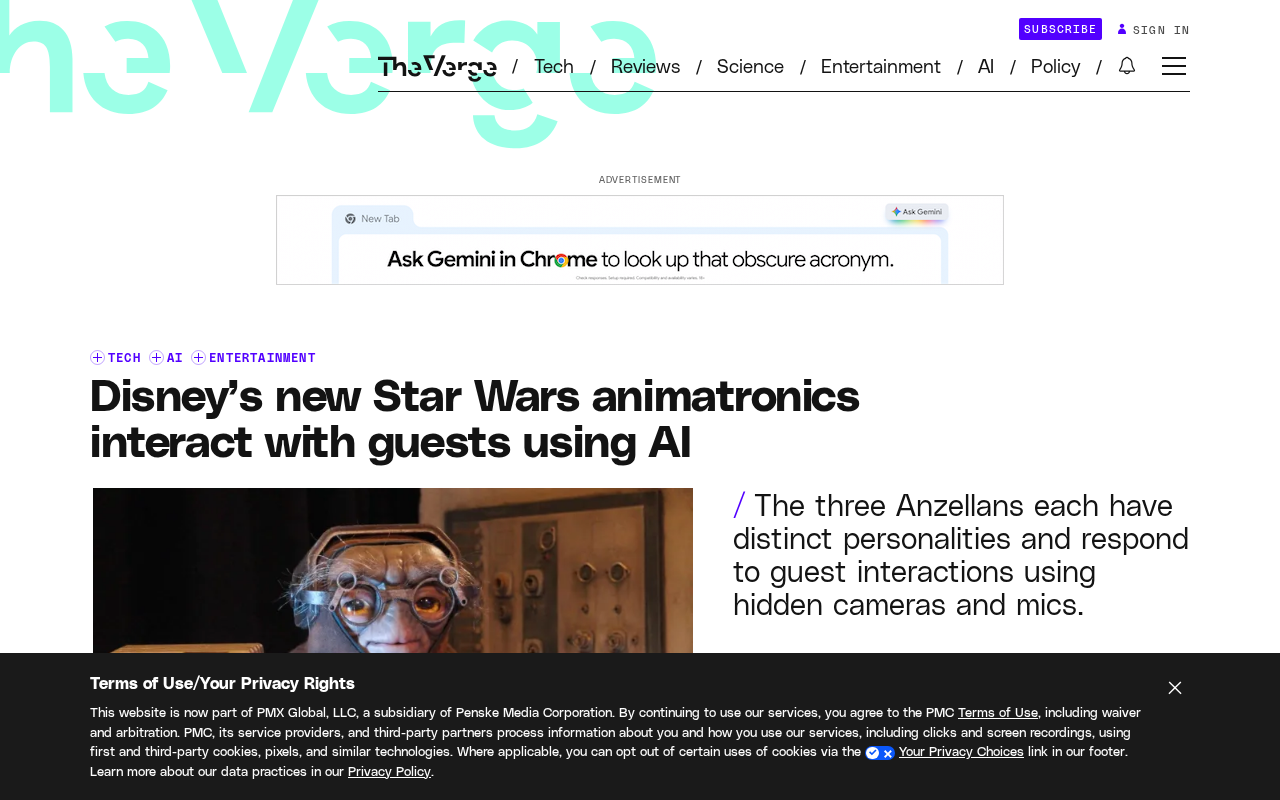
From "Marionettes" to "Autonomous Characters"
The technical approach behind traditional Disney animatronics is no mystery: high-precision mechanical structures paired with pre-programmed routines that make characters perform fixed movements at fixed times. Every blink and every head turn guests see is backed by a timeline engineers choreographed in advance. The occasional moment of "spontaneity" usually comes from an operator hidden out of sight.
The core change in the new prototypes is the introduction of AI-driven interaction capabilities. Although the original article does not disclose specific technical details, it explicitly mentions that these robots rely on Amazon's technology stack, suggesting that speech recognition, natural language understanding, and even affective computing may be integrated into the characters' behavior. Guests no longer face a mechanical body performing to a script, but a "character" capable of responding to the situation at hand.
The significance of this shift is that immersive experiences at Disney parks move from "scene immersion" toward "character immersion." When a robot's responses are no longer part of a preset loop, guest engagement rises noticeably—you ask it a question, and it actually "thinks" before answering, rather than waiting for you to press some hidden button.
Audio-Animatronics is a class of mechatronic human or animal character technology that Disney Imagineering has gradually developed since the 1960s. The name combines Audio and Animatronics, and its earliest representative was the Lincoln robot at the 1963 New York World's Fair. Its basic principle is to convert pre-recorded audio signals into multi-channel control signals that drive hydraulic or pneumatic actuators, synchronizing a character's lip movements, limbs, and head with its dialogue. After decades of iteration, its mechanical degrees of freedom and motion smoothness have become quite advanced, but the control logic is essentially open-loop—that is, playback along a timeline rather than real-time decision-making based on external input. Understanding this is essential to seeing the real breakthrough of these prototypes: moving from open-loop choreography to closed-loop interaction. The robot must perceive guests' speech, posture, and even emotions in real time, then generate movements and dialogue—which imposes entirely new requirements on mechanical response speed and control architecture.
The Star Wars IP as a Natural Testing Ground
The pairing of these prototypes with the Star Wars IP is no accident. The Star Wars universe has a vast character library and rich world-building, and guests have clear reference points for how characters should behave—making it an ideal testing ground for judging whether AI interaction "feels right."
From an operational perspective, the Star Wars-themed land (Galaxy's Edge) is itself one of Disney's heaviest investments in immersive projects, and its in-park interactive experiences have long depended on Cast Members playing characters. The introduction of AI robots could help share some of the interaction load while maintaining character consistency—a robot won't "break character" due to fatigue or mood swings.
However, the original article does not say whether these prototypes have already been tested in the parks, nor does it mention a specific deployment timeline. What is certain is that they remain in the R&D stage and are still some distance from large-scale commercial use.
Amazon's Technology Enters: A Signal Beyond the Parks
One easily overlooked detail is the choice of technology supplier. Disney did not fully develop its own AI interaction system but instead adopted Amazon's technology, reflecting two trends:
First, the AI transformation of theme parks is borrowing mature cloud services and AI infrastructure. Amazon's accumulated expertise in voice assistants and conversational AI can shorten Disney's development cycle and avoid building models from scratch.
Second, this also means that the interactive capabilities of park robots will be constrained by the supplier's technical boundaries. How Disney layers its own character personalities and narrative logic on top of Amazon's general-purpose AI capabilities is key to the experience's success—after all, a "Star Wars robot that sounds like Alexa" is clearly not what fans want.
From an industry perspective, the value of this news goes beyond Disney. It marks the beginning of themed entertainment pushing generative AI and conversational AI from back-office tools (such as customer service and ticketing) into the foreground, directly affecting the core of the guest experience. If the prototypes prove successful, other park operators will likely follow suit.
Conversational AI generally refers to systems capable of multi-turn natural language interaction, with a technology stack that typically includes automatic speech recognition (ASR), natural language understanding (NLU), dialogue management and state tracking, and text-to-speech (TTS). In open scenarios, the system must also handle interruptions, coreference, topic drift, and user emotions. Amazon's accumulated expertise in this field comes mainly from the Alexa voice assistant and the cloud services behind it, such as Alexa Skills Kit and Bedrock, which allow developers to call pre-trained models and inject custom knowledge bases and persona settings. For Disney, borrowing this infrastructure means it does not need to train speech and language models from scratch, but character persona, world-building constraints, and narrative consistency still need to be layered on top—essentially building a "character layer" over general conversational capabilities, a challenge whose difficulty is often underestimated.
Unresolved Experience and Ethical Questions
There are still some practical questions without answers when it comes to deploying AI interactive robots in parks. How does the system filter inappropriate content when child guests talk to AI characters? Faced with thousands of different guest questions, how can a robot maintain the coherence of its character setting without "breaking character"? Under long operating hours, are stability and maintenance costs actually more advantageous than traditional pre-programmed routines?
These questions are not addressed in the original article, but they will determine how quickly this technology moves from prototype to actual park operations. Disney Imagineering has always been known for a "build it first, then iterate" approach, and these prototypes feel more like a directional statement: the next step for park characters is to have "on-the-spot reactions."
For guests, the most intuitive change may be this: the next time you encounter a robot character in the Star Wars land, the way it looks at you and responds may genuinely not have been written in advance.
A common term used in industry discussions of such systems is "breaking character," which refers to a large language model deviating from its preset persona in long conversations, leaking system prompts, or giving answers that conflict with the character's world-building. Common mitigation methods include system prompt constraints, retrieval-augmented generation (RAG) to anchor responses within setting documents, output filtering and persona consistency scoring, and fixed in-character refusal scripts for high-risk topics. For child guests, content safety policies and age-appropriate dialogue strategies must also be layered on. In addition, the latency budget for real-time interaction is extremely tight—speech recognition, model inference, motion planning, and mechanical execution must all be completed within hundreds of milliseconds, or immersion will be noticeably disrupted. This is also one of the main engineering bottlenecks for such prototypes moving from the lab to the parks.
One-line Summary
Disney unveils three Amazon AI-powered animatronic prototypes that can interact with guests in real time.
Paragraph Summary
Walt Disney Imagineering R&D has unveiled three new Audio-Animatronic prototypes that use Amazon's AI technology to move animatronic characters from pre-programmed routines or behind-the-scenes control toward real-time interaction with guests. The article traces the technical context of this shift: traditional animatronics rely on timeline choreography, while the new prototypes introduce capabilities such as speech recognition and natural language understanding, enabling characters to respond to the current situation and pushing park experiences from scene immersion toward character immersion. The Star Wars IP, with its vast character library and clear guest expectations, serves as an ideal testing ground. Disney chose an external AI supplier rather than fully developing in-house, which shortens the development cycle but also raises the challenge of how to layer general capabilities with character persona. The prototypes remain in R&D, and deployment timelines and child-interaction safety issues have not yet been disclosed.
Related articles

Gemini 4 Neon Leak: A Potential Strong Contender Against Opus 5.5
A Hacker News thread suggests Gemini 4 Neon looks like an Opus 5.5 competitor. This article unpacks the product positioning behind this community signal, shifts in the top-model competitive landscape, and what it means for developers' model selection strategy.

Claude Fable 5.2's Self-Authored Short Film 'Fable' Sparks Discussion
A short film 'Fable,' credited to Claude Fable 5.2 for script, visuals, and directing, appears on Hacker News. This article analyzes the significance of full-pipeline AI creation, community reactions, and what it means for content creators.

Anthropic IPO Pricing: A Signal of AI Giants Going Public
Anthropic's IPO pricing draws attention. This article analyzes its potential impact on AI industry valuation, commercialization paths, and the competitive landscape, and highlights public-market expectations and challenges for AI companies.