DL Alchemy Course: An ML Teaching Experiment That Hands Theory-Building to Students and Claude
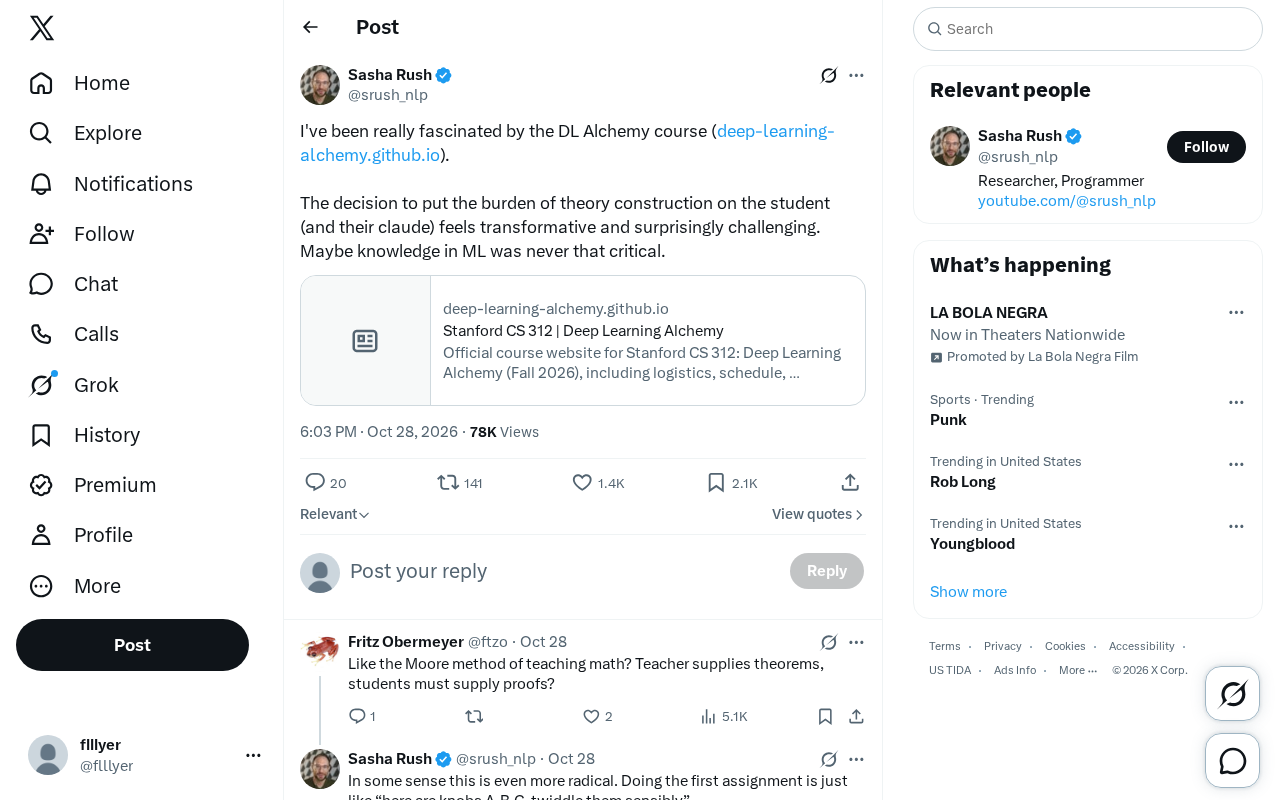
DL Alchemy hands theory-building to students collaborating with AI, redefining the focus of ML learning.
The DL Alchemy course draws attention for a counterintuitive design: it does not teach theory first, but hands theory-building to students and the Claude they use. A Twitter user described the experience as "transformative and surprisingly challenging," and further asked whether knowledge in machine learning was ever the most critical part. The article argues this does not deny the value of theory, but points out that when AI can handle much derivation and explanation, learners' core competitiveness is shifting from memorization and recitation to proposing hypotheses, designing experiments, and validating intuition. The course essentially redistributes cognitive load, demands more initiative, and more easily exposes weak points in understanding, but may better help internalize machine learning thinking. AI here acts as a collaborator rather than an answer machine.
A Course That Hands 'Wheel-Building' to Students
Recently, a user on Twitter shared observations about the DL Alchemy course, calling its design "fascinating." The most striking decision in this course is to put the burden of theory-building directly into the hands of students—and the Claude they use. Compared to the traditional machine learning course path of presenting formulas first and then providing code, this arrangement feels quite counterintuitive: students are no longer passive recipients of theory, but must "grow" their own understanding of principles through hands-on work.
The user described the experience as "transformative and surprisingly challenging." In other words, this pedagogy is not just a formal inversion—it genuinely brings a pronounced sense of challenge, and is therefore all the more potentially transformative.
Is Knowledge Still That Critical in ML?
The tweet raises a sharper question: "Maybe knowledge in ML was never that critical." This is not to say theory is useless, but to suggest that now that AI-assisted tools can already handle a great deal of derivation and explanation, the core competitiveness of machine learning learners may be shifting—from "memorizing and reciting knowledge" to "proposing hypotheses, designing experiments, and validating intuition."
DL Alchemy's approach echoes this shift precisely: when Claude can quickly provide theoretical frameworks, what students really need to practice is how to judge whether these frameworks hold up and how to translate them into runnable experiments. Knowledge is still important, but it is more like material to be invoked and tested rather than the endpoint of learning.
The discussion of "whether knowledge is critical in ML" cannot avoid the two forms of "knowledge" in machine learning. One is declarative knowledge, such as the convergence conditions of gradient descent or the mathematical form of regularization; the other is procedural knowledge, namely the ability to formalize problems, choose baselines, and design controlled experiments. Traditional courses lean heavily toward the former because it is easy to teach and assess. But when large language models can fluently recite derivations, the scarcity of declarative knowledge drops rapidly, and its acquisition cost is greatly diluted. What is truly hard to replace is procedural knowledge—it relies on repeated trial and error and real feedback, and cannot be obtained merely by reading. This also explains why DL Alchemy focuses on experiment design: it trains the judgment that models cannot do on your behalf.
What the Shift in Teaching Focus Means
Delegating the responsibility of theory-building to students is essentially redistributing the cognitive load in the course. In traditional classrooms, teachers are responsible for "chewing up" theory and feeding it to students; under the DL Alchemy model, students need to collaborate with AI and build their own paths to understanding. This model demands more initiative from learners and is also more likely to expose weak points in understanding.
Of course, the user also admitted that this experience is "surprisingly challenging," indicating that it is not an easy path. For learners accustomed to standard answers, the lack of ready-made theoretical scaffolding may bring frustration; but for those who hope to truly internalize machine learning thinking, this process of "being forced to think" may instead be more valuable.
"Cognitive load" is a core concept in educational psychology, referring to the consumption of mental resources by working memory when completing a task. Cognitive load theory distinguishes intrinsic load (the complexity of the task itself), extraneous load (additional consumption caused by poor instructional design), and germane load (effective investment used for schema construction). Traditional classrooms "chewing up" theory actually lowers intrinsic load for students, but may also compress the space for germane load. DL Alchemy returning theory-building to students is equivalent to increasing intrinsic load while directing cognitive resources toward germane load—that is, genuine understanding construction. The cost of this arrangement is a steeper learning curve, while the benefit may be more solid knowledge schemas.
Insights from Collaborative Learning with AI
The DL Alchemy case provides a sample for observing learning methods in the AI era: AI does not complete thinking for students, but pushes students into a position where they must think for themselves. Claude here plays the role of collaborator and sparring partner, not an answer machine. If this design can be validated in more courses, then the discussion of "whether knowledge is critical" may have a more concrete answer—what is critical is not knowledge itself, but the judgment and creation that unfold around knowledge.
Related articles
 Tech Frontiers
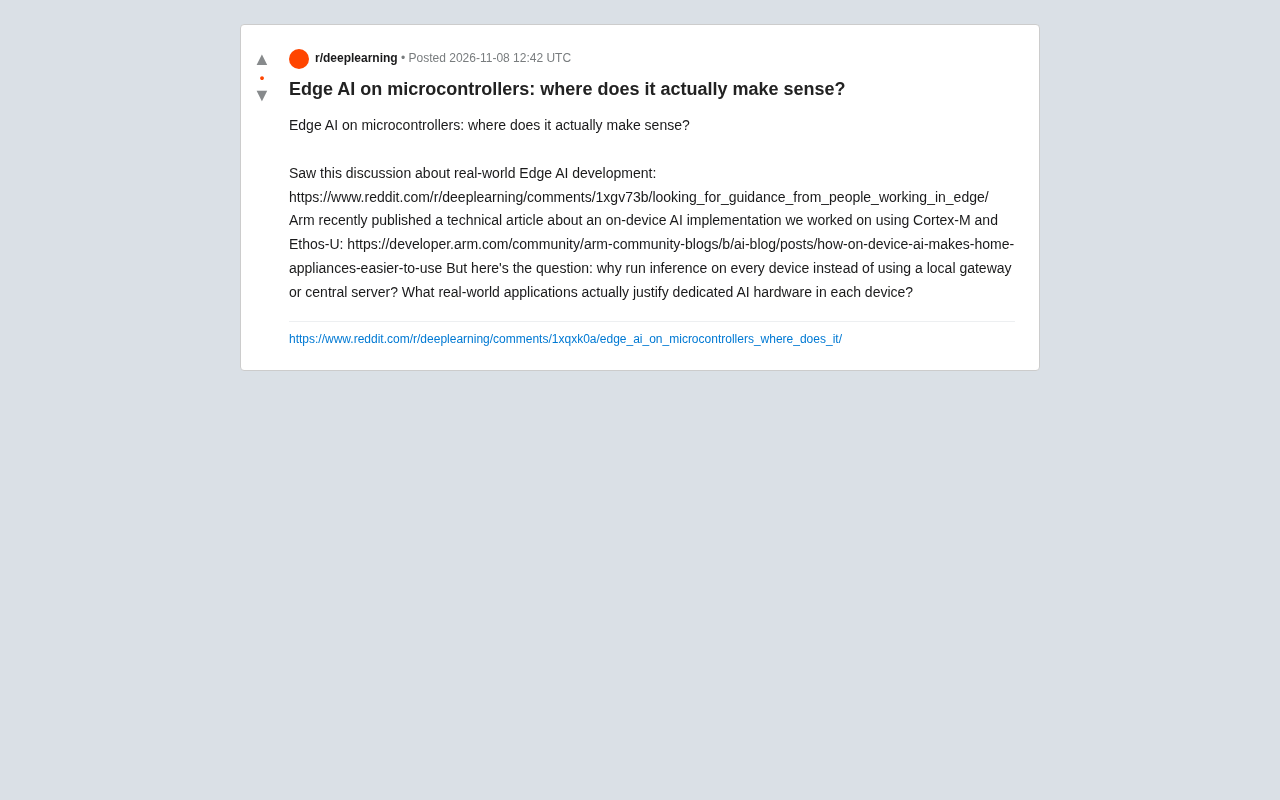
Edge AI on Microcontrollers: When Is It Actually Worth Deploying?
Drawing on Reddit discussions and Arm case studies, this article analyzes the real-world use cases for edge AI on microcontrollers: when each device needs independent inference, when a gateway or cloud is more reasonable, and the costs and boundaries of specialized hardware.
 Tech Frontiers
Pushing the Limits of Extreme Sudoku on a 16GB GPU: Insights from Depth and Flow Matching
A researcher trained a 16.54M-parameter model on a 16GB GPU to solve extreme Sudoku, finding effective depth breaks the 60% plateau and flow matching with improved sampling pushes accuracy past 99% with ~50× lower layer-evaluation budget.
 Tech Frontiers
AI Agent Approval Workflows: Why Human Confirmations Always Get Mindlessly Clicked
Why do AI agent approval workflows always get mindlessly clicked? A Reddit discussion shows that separating rules from keys, low-frequency high-risk approvals, and GitHub Environments-style gates are the keys to effective approvals.