Do LLMs Really "Understand" Language? Attention Mechanisms and the Pattern Recognition Debate

Do LLMs genuinely understand language, or are they just very sophisticated pattern matchers? The debate remains unresolved.
This article explores a fundamental question sparked by revisiting *Attention Is All You Need*: do LLMs truly "understand" when predicting the next token? It examines two opposing camps — the "stochastic parrot" view (models lack real-world grounding and merely stitch text statistically) versus the "emergent understanding" view (scale produces internal world models enabling functional understanding). The debate persists because "understanding" itself is undefined: functional and phenomenal understanding demand entirely different verification standards, and the symbol grounding problem reveals inherent limits of text-only models. The article concludes with a pragmatic reframe: instead of asking "does it understand?", ask "in which tasks and conditions does it show reliable understanding-like behavior?"
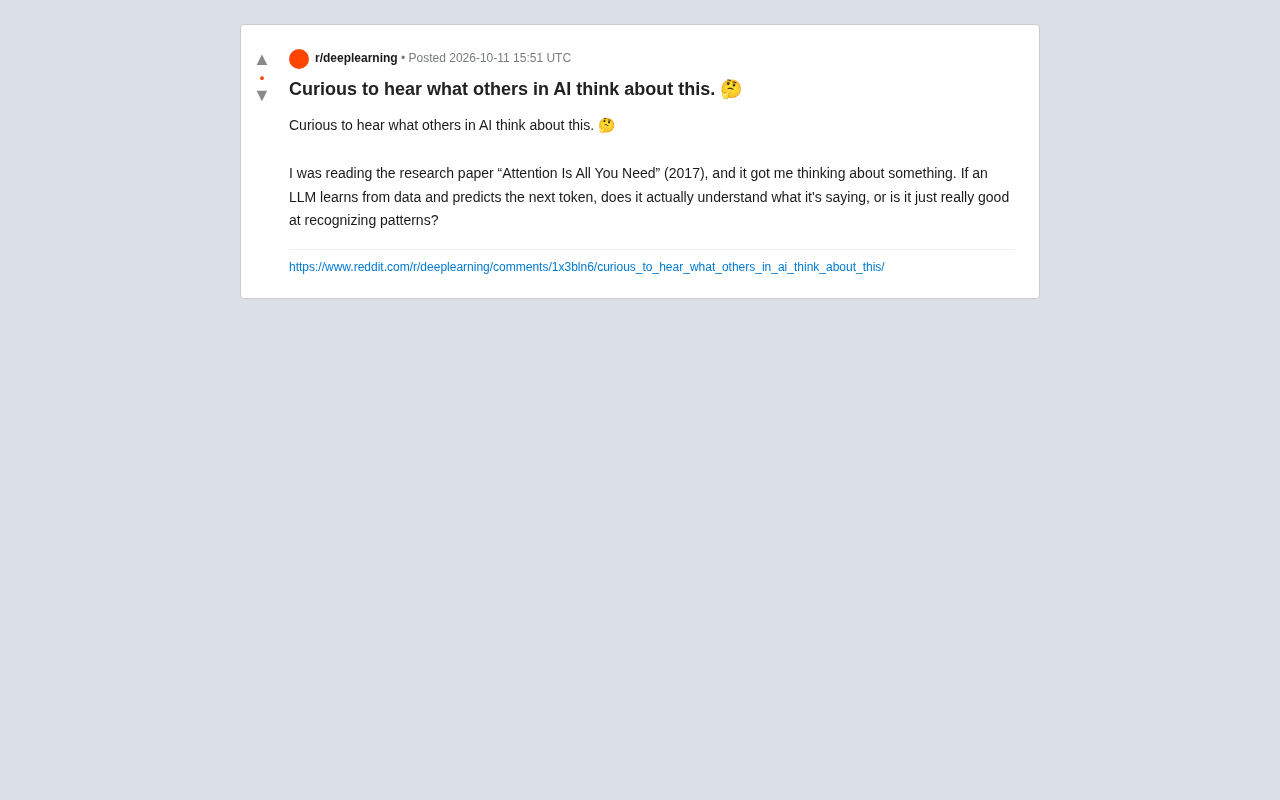
A Reddit user, after revisiting the foundational Transformer paper Attention Is All You Need, raised a question that has troubled the AI field for years: when a large language model (LLM) learns from data and predicts the next token, does it truly "understand" what it's saying — or is it performing extraordinarily sophisticated pattern recognition?
The question sounds simple, but it sits at the intersection of artificial intelligence, cognitive science, and philosophy. There's no definitive answer, yet the debate around it helps us more clearly map the capability boundaries of today's AI wave.
Where It Starts: Next-Token Prediction
The core training objective of LLMs is surprisingly modest — predict the most likely next token (word or subword) given the preceding context. The entire GPT series, Claude, Gemini, and similar models are, at their core, doing exactly this. By repeatedly optimizing this prediction objective across massive amounts of text, they gradually learn grammar, facts, chains of reasoning, and even a degree of "common sense."
The Transformer architecture introduced in Attention Is All You Need is the technical foundation for all of this. It replaces traditional recurrent networks with self-attention mechanisms, allowing the model to efficiently capture dependencies between any two positions in a sequence. This powerful contextual modeling capability is precisely what allows "predict the next token" to scale into surprisingly complex behavior.
The crux of the question is this: can a system trained purely to predict exhibit "understanding-like" behavior that counts as genuine understanding?
The "Stochastic Parrot" Camp: It's Just Imitation
One school of thought holds that LLMs are essentially "stochastic parrots." The core of this metaphor: models never encounter the real-world referents behind linguistic symbols — they merely stitch together statistically plausible text.
The arguments supporting this view are quite compelling:
- Lack of grounding: Models learn co-occurrence relationships between words, not correspondences between words and real objects. A model knows "apple" often appears alongside "red" and "sweet," but has never seen or tasted one.
- Systematic failures: LLMs confidently fabricate nonexistent facts (hallucinations) and stumble on simple multi-step arithmetic or logic problems — exposing the fact that they aren't operating from genuine conceptual understanding.
- The limits of the objective function: "Understanding" is simply not part of the training objective. What gets optimized is prediction accuracy, nothing more.
Under this view, any apparent "understanding" is a projection by the observer — a reflection of humans' tendency to equate fluent language with the presence of a mind behind it.
The term "stochastic parrot" was formally introduced by Emily Bender, Timnit Gebru, and colleagues in their 2021 paper On the Dangers of Stochastic Parrots: Can Language Models Be Too Big? The paper argues that large language models do nothing more than probabilistically stitch together text fragments, superficially reproducing statistical patterns from training data without any genuine language understanding or intent. The paper sparked widespread controversy — Gebru's conflict with Google over it ultimately led to her departure — elevating the discussion beyond academia into a landmark event in AI ethics. Notably, the "stochastic parrot" critique targets not only understanding, but also social biases baked into large-scale training data and the environmental costs of ever-expanding model size. These dimensions are often overlooked when the debate narrows to "understanding or not."
The "Emergent Understanding" Camp: Scale Produces Qualitative Change
The opposing camp argues that reducing LLMs to pattern matching underestimates the qualitative shifts that large-scale training produces. When model parameters and data volume reach a sufficient scale, capabilities that were never explicitly taught can "emerge" — such as few-shot learning, chain-of-thought reasoning, and cross-lingual transfer.
The central argument here is: to predict the next token well enough, a model is often forced to construct some internal representation of the world. For example, to accurately continue a description of a physical process, the model may need to form implicit models of causality, space, and quantity. Traces of "world models" detected inside these models by researchers provide partial evidence for this view.
If "understanding" is defined as "the ability to construct and use structured internal representations of inputs, and to respond consistently and generalizably based on them," then large models do exhibit understanding in a functional sense.
In the context of large models, "emergence" refers specifically to the phenomenon where certain capabilities leap from near-zero to usable levels as parameter count or training data scales up — not a gradual, linear progression. Google Research's 2022 paper Emergent Abilities of Large Language Models systematically documented this phenomenon, cataloging capabilities like arithmetic, multi-step reasoning, and language translation that appeared suddenly beyond certain scale thresholds. However, the concept of emergence is itself contested: some researchers (such as Schaeffer et al. at Stanford) have argued that apparent emergence may be an artifact of metric selection — switch to smoother evaluation measures, and those "sudden jumps" often revert to smooth, incremental capability curves. This means that using emergence as evidence of scale-driven qualitative change requires careful scrutiny of the measurement methods themselves.
The Root of the Disagreement: We Haven't Defined "Understanding"
A major reason this debate resists resolution is that "understanding" itself lacks a universally accepted definition. It can be approached from at least several angles:
Functional Understanding vs. Phenomenal Understanding
Functional understanding asks: "Can it be used?" — does the system correctly answer questions, complete tasks, and generalize to new situations? By this standard, top LLMs already demonstrate strong understanding across many tasks.
Phenomenal understanding asks: "Is there subjective experience?" — does the system actually know what it's talking about internally? This touches on the hard problem of consciousness, which no current technical method can verify — and which is difficult to confirm even between humans.
The Symbol Grounding Problem
This is a classic challenge in cognitive science: how do abstract symbols acquire meaning? Models trained purely on text inherently lack direct connections between sensory input and the real world. But as multimodal models (combining images, audio, and video) develop, this gap is being partially bridged, and the boundaries of "grounding" are shifting.
The symbol grounding problem was formally articulated by cognitive scientist Stevan Harnad in 1990. His core argument: a closed system that defines symbols purely in terms of other symbols (like a dictionary defining words with more words) can never give those symbols genuine meaning — meaning must ultimately be anchored in perception and action, not in another set of symbols. This resonates with philosopher John Searle's "Chinese Room" thought experiment: a person manipulating Chinese characters according to rules, even while producing perfectly fluent Chinese dialogue, has no internal understanding of Chinese whatsoever. For LLMs, this means that even if a model correctly uses the word "hot" across countless contexts, it has never felt heat — its "understanding" remains at the level of symbolic association. Multimodal models attempt to address this by introducing perceptual signals like images and audio, but critics argue that aligning one type of symbol (pixels) with text symbols doesn't truly solve the grounding problem — it merely extends the boundary of the symbolic system.
What This Means for Practitioners
Setting aside philosophical speculation, this question has real practical value for those actually building and using AI.
Acknowledging that models "don't truly understand" means we should approach their outputs with caution: don't blindly trust factual claims, maintain human review in high-stakes scenarios, and design systems with the assumption that edge cases will produce failures.
Acknowledging that models "possess some form of functional understanding" means we can confidently deploy them on increasingly complex reasoning and collaborative tasks, rather than treating them as pure lookup tools.
The pragmatic stance may be this: stop asking "does it understand?" in binary terms, and start asking "in which tasks and under which conditions does it exhibit reliable understanding-like behavior?" That's a measurable, engineerable question — far more productive than abstract debate.
Conclusion
The reason this Reddit user's question resonated so widely is that it strikes at an uncertainty the entire industry tacitly shares. From Attention Is All You Need to today's massive models, the technology has come a long way — but the philosophical question of whether machines understand has not been resolved along the way. If anything, the rapid escalation of model capabilities has made it sharper.
For the foreseeable future, we may all need to learn to live with this ambiguity: neither deifying LLMs as intelligences that truly understand the world, nor dismissing the remarkable capabilities they exhibit as pattern-recognition systems.
Related articles

Huberman's Rational Supplement Guide: A Five-Layer Health Framework and Scientific Decision-Making
Stanford neurobiology professor Huberman proposes a rational supplement framework: behavior and nutrition are the foundation, basic combination supplements serve as insurance, and sleep/hormonal/cognitive directions should stick to single-ingredient experiments. Omega-3 is the top single-ingredient choice, and melatonin is not recommended.

The Unsung Painter Behind Gilded Age Manhattan Interior Design
HN discussion highlights the painter behind Gilded Age Manhattan interiors: he created murals and decorative paintings but was long overlooked as his work was seen as architectural appendage.

Can AI Agents Be Socially Engineered? Understanding Prompt Injection and Tool Permission Risks
Through Invariant Lab's GitHub Issue injection and Brave's AI browser attack, this article analyzes how Prompt Injection induces AI Agents to perform unauthorized actions, and offers protection advice across three layers: least privilege, tool validation, and operation auditing.